
Risk Indicators
- FATF/EU Blacklist/Greylist (Lower Concern)
- Terrorism Financing (Medium Concern)
- US Dept of State INCSR
- Proliferation Financing
- Corruption
- Criminality
- Resilience & Governance
- Financial Transparency
- Offshore Finance Centres
- Sanctions
Background
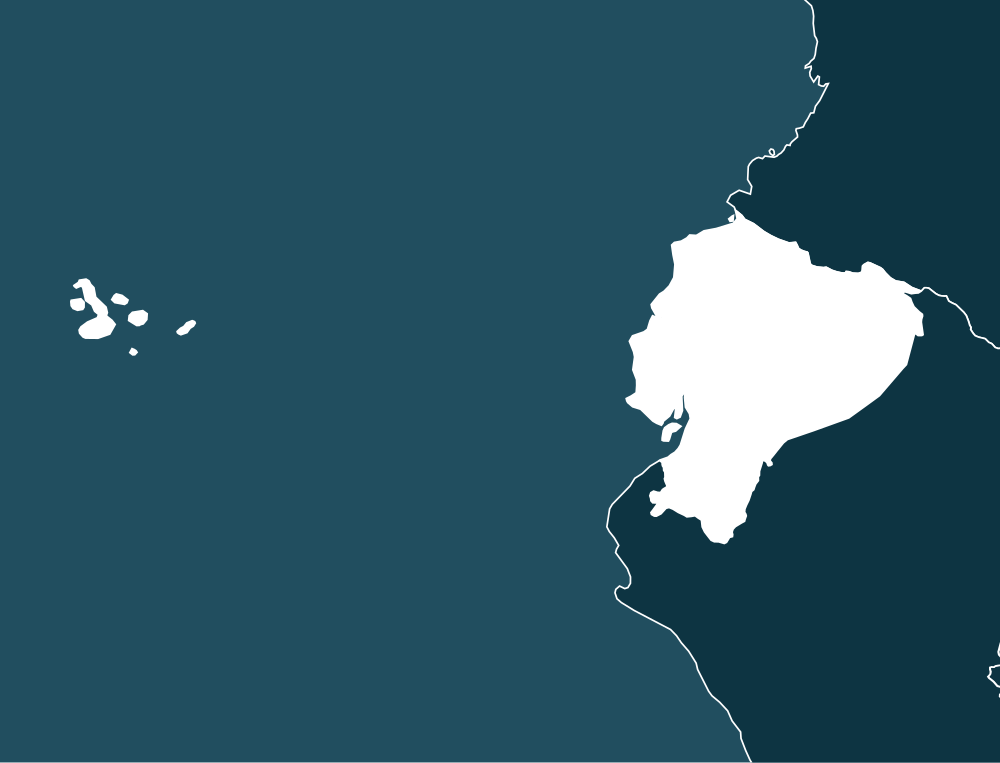
Ecuador’s modern identity emerged from Quito’s role in the northern Inca Empire, Spanish colonial administration, and the eventual dissolution of Gran Colombia in 1830. Territorial losses in conflicts with neighboring states, including a border dispute with Peru resolved in 1999, form part of a longer history marked by political instability despite extended civilian rule. The country’s strategic position between Colombia and Peru continues to shape its security and economic environment.
Today, Ecuador is confronting an internal armed conflict involving powerful criminal organizations, including groups such as Los Choneros, amid exceptionally high homicide levels and cross-border criminal connections. Its role as a transit and logistics hub for cocaine from Colombia and Peru is compounded by violence linked to dissident FARC factions, the ELN, the Red Command, and other transnational networks. Porous Amazonian borders, illicit mining, smuggling, money laundering, and sanctions affecting regional actors add further complexity to Ecuador’s evolving security landscape.
AML & Terrorist Financing
Ecuador is no longer subject to FATF monitoring and has strengthened its AML/CFT framework, although the 2022 mutual evaluation still identified uneven compliance and only limited effectiveness across key outcomes. Its medium-high money-laundering risk reflects drug trafficking, corruption, smuggling, tax evasion, and a largely cash-based economy, while UAFE produces well-regarded intelligence but faces constraints in coverage, resources, and the conversion of financial intelligence into investigations and convictions. Terrorist-financing and proliferation-financing controls show coordination through UAFE, CIES, SISLAFT, and other authorities, yet judicial understanding, DNFBP supervision, beneficial-ownership consistency, and the ability to impose freezes within 24 hours remain areas of concern.
Sanctions
Ecuador implements United Nations Security Council sanctions measures, including those administered through sanctions committees and reflected on the Consolidated List, rather than maintaining a prominently documented independent sanctions regime against other nations. No international sanctions are currently in force against Ecuador, although its dollarized economy, porous borders, and weak AML enforcement create vulnerabilities that may be exploited by actors linked especially to Venezuelan sanctioned networks. Concerns center on fuel and liquid natural gas smuggling toward Colombia and Peru, Pacific and air transit routes, and the laundering of illicit proceeds, with limited direct evidence tying Ecuador to large-scale sanctions evasion involving Iran or North Korea.
Criminality
Corruption remains widespread in Ecuador, with the Metastasis investigation exposing alleged bribery networks involving senior judicial and law-enforcement figures, while non-transparent procurement, customs, licensing, and dispute-resolution processes continue to concern businesses. Organized criminal groups operate across drug and human trafficking, arms and illicit-goods trade, environmental crime, cybercrime, and money laundering, with the Comptroller General, Attorney General’s Office, and CPCCS addressing allegations amid continued reports of official interference and threats.
Reports
Ecuador’s strategic coastline, dollarized economy, and location between Colombia and Peru continue to attract trafficking networks, with the Ministry of Interior, National Police, and Ecuadorian Coast Guard confronting record drug seizures alongside escalating extortion, kidnapping, and violence. The Ministry of Health and Interinstitutional Drug Committee support prevention and treatment efforts, while trafficking risks remain acute for children, migrants, Indigenous and Afro-Ecuadorian communities, and workers in sectors ranging from agriculture and fishing to domestic service.
Industry/Product Sector Risk
Ecuador’s financial and non-financial sectors present a varied risk landscape, with heightened exposure in banking, correspondent relationships, currency exchange, remittances, real estate, trade finance, wealth management, transportation, construction, politics, and illegal mining. The underlying vulnerabilities range from cash-intensive activity and informal operators to opaque ownership structures, cross-border transactions, trade-based laundering, and evolving digital channels, with drug trafficking, corruption, smuggling, tax evasion, and environmental crime recurring across multiple sectors. Oversight by bodies including the Superintendence of Companies, Securities and Insurance (SCVS), the Central Bank, and emerging initiatives such as the national commission addressing illegal mining reveals a framework still developing unevenly across DNFBPs, virtual assets, and other higher-risk activities.
Economy & Investment Climate
Ecuador’s dollarized economy offers opportunities across agriculture, aquaculture, mining, energy, telecommunications, and services, supported by expanding ties with the United States and initiatives such as ProEcuador and the Single Investment Window. Yet modest growth, falling FDI, fiscal pressures, energy disruptions, insecurity, and shifting regulations continue to complicate the investment climate, despite a resilient banking sector and ongoing reforms under President Daniel Noboa.
Cryptocurrency Regulations
Ecuador permits the purchase and sale of cryptocurrencies but, according to the Central Bank of Ecuador, they are not authorized for payments in its dollarized economy, leaving exchanges, tokens, and related businesses in a largely undefined legal space. Oversight appears to rely on broader AML expectations administered by UAFE and general tax principles applied by the SRI, while licensing, crypto-specific reporting, taxation, and ICO rules remain notably incomplete.
Get full access
The information on this page is a brief summary. Get access to EDD country reports, all risk category scores and customisable weightings for 245 jurisdictions.