
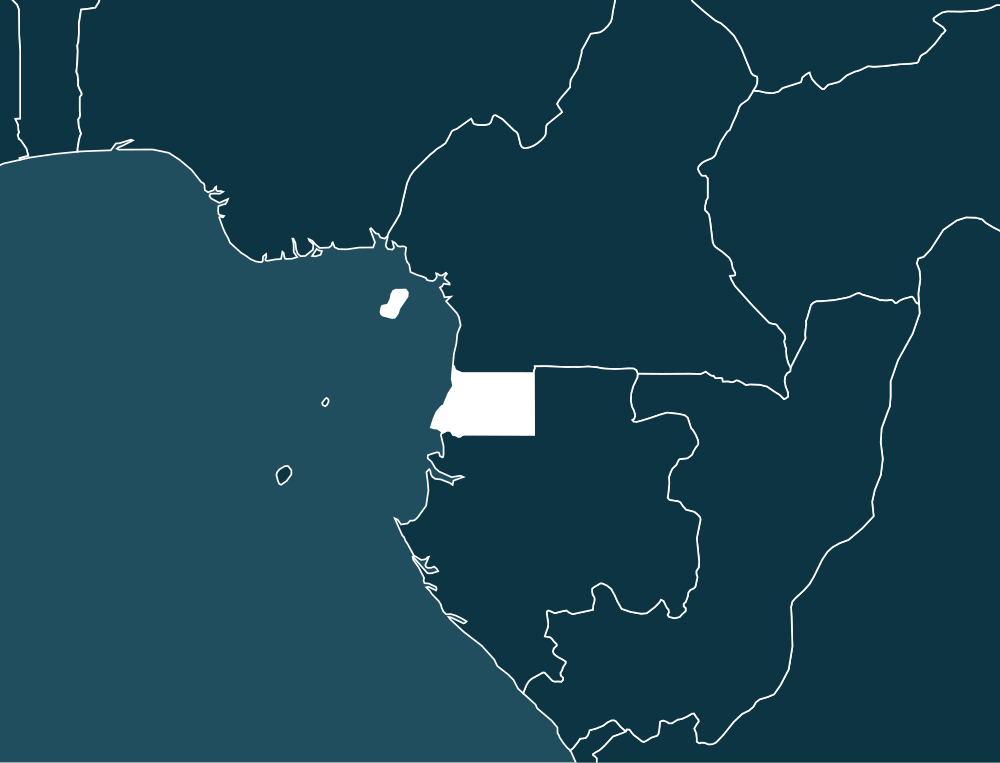
Risk Indicators
- FATF/EU Blacklist/Greylist (Lower Concern)
- Terrorism Financing (Medium Concern)
- US Dept of State INCSR
- Proliferation Financing
- Corruption
- Criminality
- Resilience & Governance
- Financial Transparency
- Offshore Finance Centres
- Sanctions
Background
Equatorial Guinea is a small African state comprising a mainland territory and five inhabited islands, with Bioko—home to Malabo—occupied for millennia before Portuguese and later Spanish rule shaped its modern borders. Independence in 1968 was followed by Francisco Macías Nguema’s brutal consolidation of power, and the 1979 coup that brought Teodoro Obiang Nguema Mbasogo to prominence began a presidency that has continued through repeatedly non-competitive elections. The country’s political system remains highly centralized, while the legacy of repression and limited political competition provides important context for understanding its contemporary institutions.
Offshore oil discoveries in 1996 generated a dramatic surge in state revenues and infrastructure spending, although declining production, systemic corruption, and limited improvements in living standards have sustained pressure for economic diversification and greater foreign investment. Equatorial Guinea’s mainland borders Cameroon and Gabon, linking it to a neighborhood marked by armed conflict, political transitions, financial-crime concerns, and scrutiny over sanctions. Cameroon’s Anglophone Crisis and FATF monitoring, together with Gabon’s post-2023 coup transition and the documented use of both countries’ flags by Russia-linked “ghost fleet” vessels, add further regional complexity.
AML & Terrorist Financing
Equatorial Guinea is not listed by FATF as having strategic AML deficiencies, yet its 2024 mutual evaluation identified low effectiveness across money laundering, terrorist financing, and proliferation-financing outcomes, amid significant exposure linked to corruption, public-fund diversion, extractive industries, cash, porous borders, and informal transfers. ANIF receives and processes suspicious transaction reports, but financial intelligence is narrowly disseminated, investigative and prosecutorial capacity remains limited, beneficial ownership information is not systematically collected, and many non-bank sectors and DNFBPs show weak understanding or implementation of AML/CFT obligations. Terrorist-financing investigations and prosecutions have not been reported, while gaps involving sanctions-list dissemination, asset freezing, NPO oversight, proliferation-financing controls, confiscation, and international cooperation leave important questions around the practical reach of the framework overseen alongside regional bodies such as BEAC and COBAC.
Sanctions
Equatorial Guinea is obligated, as a UN member, to implement applicable Security Council measures, though no sanctions imposed by Equatorial Guinea on other nations are identified here. The country itself is not under comprehensive international sanctions, but foreign authorities—including the UK FCDO, the United States, France, and Switzerland—have targeted Vice President Teodorin Obiang Mangue and associated figures through asset freezes, travel restrictions, prosecutions, and forfeitures. The material also points to offshore structures, luxury properties, private jets, collectibles, and international banking routes, alongside Equatorial Guinea’s rejection of such measures and the closure of its London embassy.
Criminality
Corruption is perceived as widespread in Equatorial Guinea, particularly in public contracting, while high-level officials have been linked to embezzlement and laundering public funds despite Anti-Corruption Law 1/2021 and the involvement of the anti-corruption prosecutor. Human trafficking and related criminal activity remain significant concerns, with limited accountability compounded by weak legal cooperation mechanisms, restricted civil-society oversight, and the recent introduction of the government’s first online reporting portal and hotline, alongside APROFORT’s legal-aid and whistleblower support.
Reports
Equatorial Guinea has moved to Tier 2 after increasing investigations, convictions, victim referrals, official training, and transparency measures related to trafficking, while still lacking sufficient funding and comprehensive legal protections. Domestic servitude, sex trafficking, deceptive recruitment, and forced labor affect both local and foreign workers across cities and industries, with concerns also involving document confiscation, vulnerable children, and alleged complicity among officials and elites.
Industry/Product Sector Risk
Equatorial Guinea’s industry landscape combines oil and gas, public works, banking, transport, forestry, gaming, and cash-based commerce, with significant exposure arising from cross-border flows, informal markets, and concentrated public-sector revenues. Particular attention surrounds banks, remittance and foreign-exchange channels, casinos, legal professionals, telecommunications-linked payments, and NPOs, while bodies such as COBAC, BEAC, COSUMAF, the Ministry of Mines, the General Directorate for Civil Society, the Forestry Guard, and INDEFOR-AP each feature in the wider control environment. Emerging services such as mobile money, limited securities activity, rudimentary precious-stone dealing, and prohibited virtual-asset access add further complexity to risks associated with corruption, customs and tax fraud, environmental crime, trafficking, and procurement abuse.
Economy & Investment Climate
Equatorial Guinea’s economy remains heavily shaped by petroleum and natural gas, with diversification under Agenda 2035 constrained by infrastructure gaps, limited skilled labor, and a large informal sector. Recent measures such as Decree 009/2024, the VUE single-window system, and Law No. 1/2024’s tax changes suggest movement toward reform, although regulatory uncertainty, state influence, foreign-exchange restrictions, and financial-sector weaknesses continue to complicate private investment.
Cryptocurrency Regulations
Equatorial Guinea’s cryptocurrency landscape remains largely undefined: digital assets are not legal tender, yet they are not specifically prohibited, while CEMAC restrictions limit financial institutions’ involvement. The National Agency of Financial Investigation (ANIF) handles broader financial intelligence responsibilities, but the absence of VASP licensing, crypto-specific taxation, transaction tracking, token rules, or ICO safeguards leaves users and businesses navigating considerable uncertainty.
Get full access
The information on this page is a brief summary. Get access to EDD country reports, all risk category scores and customisable weightings for 245 jurisdictions.