
Risk Indicators
- FATF/EU Blacklist/Greylist (Medium Concern)
- Terrorism Financing (Medium Concern)
- US Dept of State INCSR
- Proliferation Financing
- Corruption
- Criminality
- Resilience & Governance
- Financial Transparency
- Offshore Finance Centres
- Sanctions
Background
Eritrea’s modern history was shaped by colonial administration, federation with Ethiopia, and a prolonged independence struggle that culminated in a 1993 referendum. Since then, Isaias Afwerki has presided over a highly militarized political system, while indefinite national service and persistent repression remain defining features of daily life. A later peace opening with Ethiopia followed the Eritrea-Ethiopia Boundary Commission’s long-disputed ruling, but subsequent developments involving Tigray brought renewed condemnation, including findings of war crimes and crimes against humanity.
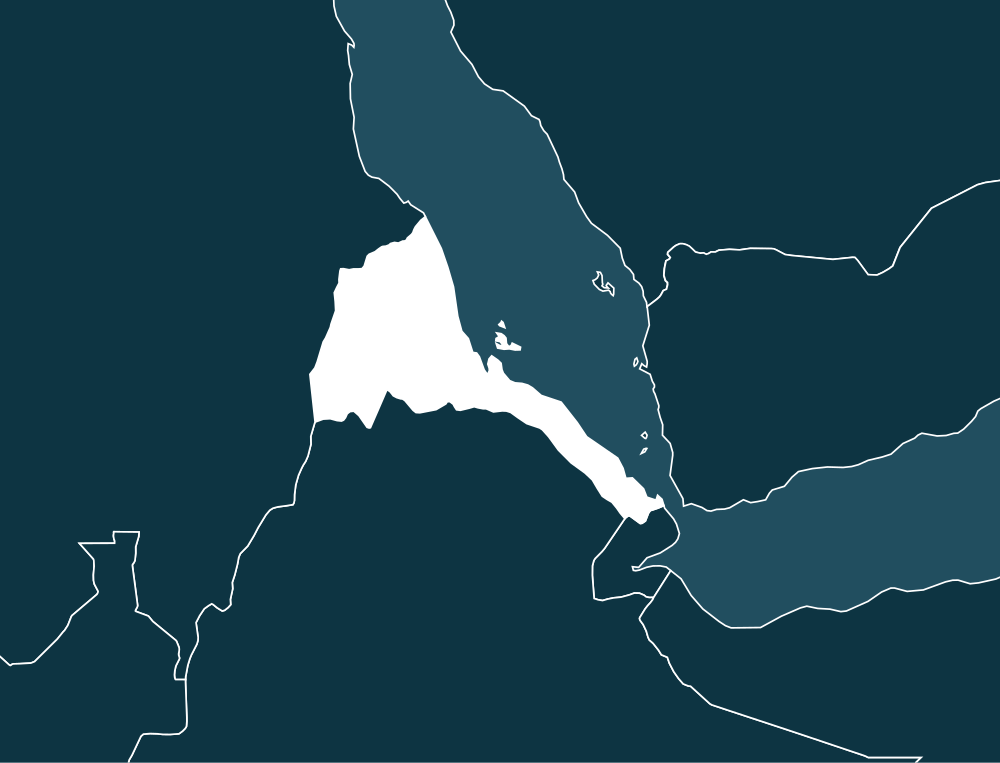
Positioned between Ethiopia, Sudan, and Djibouti, Eritrea remains closely entwined with the Horn of Africa’s shifting conflicts, alliances, and security pressures. Renewed tensions around Tigray and Red Sea access, Sudan’s struggle between the SAF and RSF, and the sensitive Djibouti border all carry implications for Eritrea’s regional posture. Although the UN Somalia-Eritrea Monitoring Group’s findings preceded the lifting of broad UN sanctions in 2018, targeted restrictions, alleged support for armed actors, and reported ties with Russia and China continue to make Eritrea a consequential and closely watched regional actor.
AML & Terrorist Financing
Eritrea’s tightly state-controlled, small, and relatively isolated financial system may limit some exposure to sophisticated money laundering and terrorist financing, yet an informal cash economy, hawala use, smuggling, trafficking, contraband, and regional instability present less easily measured vulnerabilities. The 2025 assessment identified low risk understanding, significant gaps in customer due diligence, beneficial ownership, suspicious transaction reporting, targeted financial sanctions, and international cooperation, alongside an Eritrea Financial Intelligence Unit that was not operational and limited use of financial intelligence by law enforcement. Terrorist financing and proliferation-financing controls were assessed as having low effectiveness, with the Bank of Eritrea, National Police and Security Forces Command, Office of the Attorney General, and other authorities lacking sufficient coordination, resources, procedures, and risk-based oversight.
Sanctions
Eritrea is not identified as imposing formal sanctions on other nations, though its alleged use of regional proxies and informal networks has featured in concerns involving Somalia, Sudan, Ethiopia, and Djibouti. United Nations measures—including an arms embargo, travel ban, and asset freeze—were lifted in 2018, while targeted restrictions remain in place from the United States, European Union, United Kingdom, Australia, and Canada. These measures focus on military and security officials and ruling-party-linked entities such as the Eritrean Defense Forces, Hidri Trust, and Red Sea Trading Corporation, with OFAC Executive Order 14046 and Canada’s Special Economic Measures Act among the cited authorities.
Criminality
Eritrea criminalizes corruption, but government opacity makes enforcement difficult, with significant petty corruption reported locally and the PFDJ and military associated with prominent illicit economic activity. Human trafficking, smuggling, arms and excise-goods trafficking, port-based drug routes, and money laundering risks are compounded by informal finance, restricted movement, and the absence of independent agencies or watchdogs able to receive corruption complaints.
Reports
Eritrea remains associated with significant forced-labor and trafficking risks linked to National Service, local militias, the Warsay-Yikealo/Sawa system, and the Ministry of Education and Ministry of Agriculture’s Maetot program, with vulnerabilities also extending to people fleeing the country and foreign workers. At the same time, 2020 saw no reported terrorist incidents, limited law-enforcement engagement with the United States, participation in regional anti-money-laundering structures, and government efforts focused on community awareness and social inclusion.
Industry/Product Sector Risk
Eritrea’s financial and commercial landscape is small, centrally controlled, and heavily dependent on cash, with state-owned banks, a single foreign exchange bureau, and limited international connectivity shaping most activity. Key exposure areas include cash-intensive commerce, mining exports, trade and transportation routes, public works, and politically connected financial activity, while the Business Licensing Office and other tightly controlled channels provide much of the formal structure. At the same time, restricted real estate activity, the absence of securities and virtual-asset sectors, and the limited scale of professional services constrain some risks, even as weak beneficial-ownership transparency, supervision, and financial-intelligence capacity remain significant themes.
Economy & Investment Climate
Eritrea’s economy remains highly state-directed, with the PFDJ and government-linked enterprises shaping most large-scale activity while mining, food processing, textiles, and basic manufacturing provide limited areas of commercial engagement. Investment and trade are constrained by nonconvertible currency, restricted banking channels through the National Bank of Eritrea, opaque regulation, and a labor market heavily influenced by National Service, even as mineral exports and commercial ties with China and the UAE remain notable.
Cryptocurrency Regulations
Cryptocurrency is not prohibited in Eritrea, but it is neither legal tender nor governed by a dedicated virtual-asset framework, leaving exchanges, token offerings, taxation, and investor protections largely undefined. The Anti-Money Laundering and Combating Financing of Terrorism Proclamation No. 175/2014 provides the broader backdrop, while the Bank of Eritrea, EFIU, and ESAAMLG connections suggest general compliance expectations without clear licensing, Travel Rule, or supervisory mechanisms.
Get full access
The information on this page is a brief summary. Get access to EDD country reports, all risk category scores and customisable weightings for 245 jurisdictions.