
Risk Indicators
- FATF/EU Blacklist/Greylist (Lower Concern)
- Terrorism Financing (Lower Concern)
- US Dept of State INCSR
- Proliferation Financing
- Corruption
- Criminality
- Resilience & Governance
- Financial Transparency
- Offshore Finance Centres
- Sanctions
Background
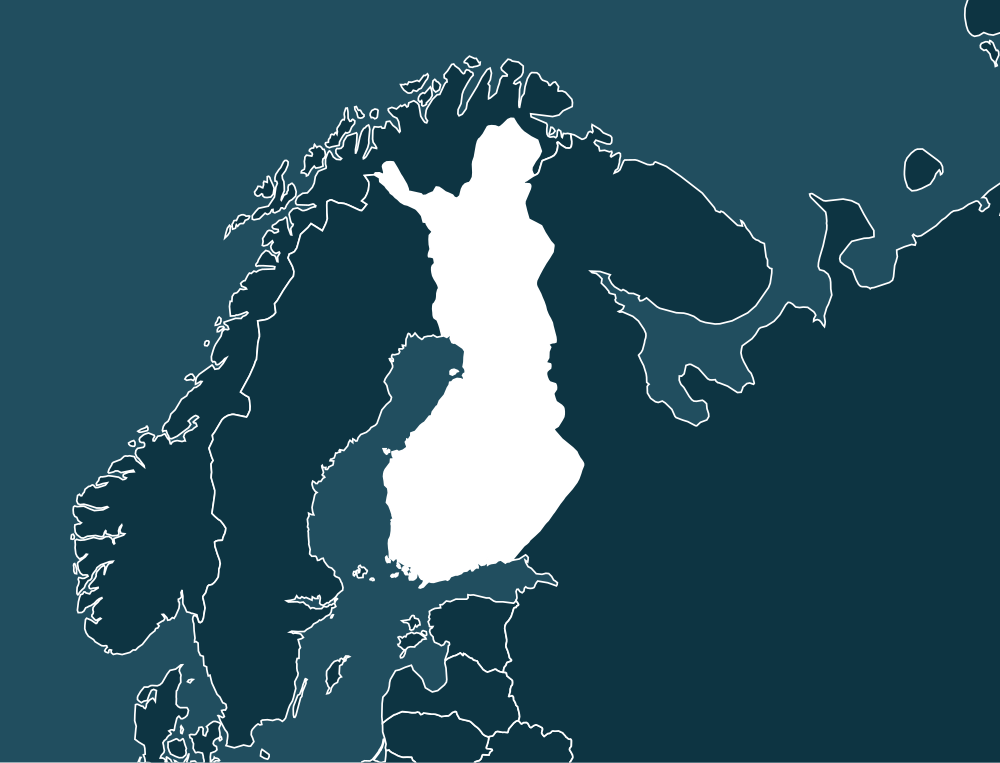
Finland’s history reflects a long passage from Swedish rule and Russian autonomy to full independence in 1917, followed by a determined defense of its sovereignty during World War II. Over the subsequent decades, it evolved from a farm and forest economy into a prosperous, diversified industrial society while building a welfare state centered on education, equality, and social protection. Its European orientation includes EU membership since 1995, early adoption of the euro, and NATO accession in April 2023 amid the changing security environment created by Russia’s invasion of Ukraine.
Finland’s three land neighbors present sharply different regional contexts, with Sweden and Norway remaining stable partners while Russia represents the principal source of military, political, and hybrid security concerns. Alleged GPS interference, exercises simulating attacks on NATO’s eastern flank, and wider risks in the Baltic, Arctic, and Barents Sea regions add weight to these concerns. Finnish authorities have also uncovered sophisticated sanctions-evasion activity involving exports routed through third countries, a contrast to the absence of major publicly identified cases connected to the Swedish or Norwegian borders.
AML & Terrorist Financing
Finland has a broadly developed AML/CFT framework and is not identified by FATF as having strategic deficiencies, with the 2023 follow-up recognising progress while leaving areas requiring continued attention. Key exposure is linked to the grey economy, fraud, drug proceeds, complex corporate structures, cross-border transfers and emerging terrorism-financing risks involving foreign terrorist fighters, hawalas and potentially vulnerable non-profit organisations. Although the National Bureau of Investigation’s FIU, SUPO and other authorities demonstrate strong cooperation and investigative capability, concerns remain around supervisory resources and risk sensitivity, beneficial-ownership transparency, DNFBP reporting, targeted financial sanctions and the limited number of TF convictions.
Sanctions
Finland enforces UN and EU restrictive measures, particularly those concerning Russia and Belarus, through asset freezes, trade and financial restrictions, and controls on sensitive goods. Finnish Customs (Tulli), the FIN-FSA, and the Ministry for Foreign Affairs have pursued suspected diversion of electronics, drones, and defence materiel, while the 2025 amendments to the Criminal Code and Sanctions Act introduced specific sanctions-related offences, including gross negligence. Although Finland faces continuing evasion risks involving Belarus and third-country intermediaries such as China and Kazakhstan, no international sanctions are currently in force against Finland.
Criminality
Finland addresses corruption through its Criminal Code, with offenses ranging from electoral and parliamentary bribery to bribery in business transactions and penalties that can include imprisonment. Oversight is distributed among the Ministry of Justice, Ministry of the Interior, National Bureau of Investigation, and tax authorities, while the OECD has noted concerns about limited enforcement of foreign bribery laws.
Reports
Finland remains a Tier 1 country, with measures including a formalized National Referral Mechanism, its first National Action Plan on labor trafficking, changes to the Seasonal Workers Act, and a conviction linked to the exploitation of Thai berry pickers. At the same time, reduced investigations, convictions, victim identification, and assistance—alongside uneven practices across the 21 wellbeing service counties and limited visibility in Åland and northern regions—highlight continuing concerns affecting migrants, children, domestic workers, and seasonal laborers.
Industry/Product Sector Risk
Finland’s risk landscape spans highly digital banking and payment channels alongside persistent vulnerabilities in cash-intensive activities, real estate, construction, gaming, and cross-border transport. Particular attention surrounds high-risk areas such as retail banking, money remitters, virtual currencies, wealth management, and professional intermediaries, with RSAA and FIN-FSA featuring prominently in the supervisory picture. The underlying typologies connect grey-economy tax offences, fraud, corruption, drug trafficking, and terrorism financing to evolving online services, foreign structures, and regional financial flows.
Economy & Investment Climate
Finland combines a highly educated, digitally advanced workforce and strong institutions with industrial strengths spanning ICT, metals, shipbuilding, forestry, and renewable energy, while services account for the largest share of economic activity. After a recession shaped by inflation, high interest rates, weak exports, and demographic pressures, recovery prospects are improving alongside major clean-transition, defense, data-center, and R&D opportunities supported by agencies such as Business Finland, though talent shortages, labor-market tensions, public-finance concerns, and geopolitical uncertainty remain significant considerations.
Cryptocurrency Regulations
Finland permits cryptocurrency activity under a structured framework requiring virtual asset service providers to register with the FIN-FSA and meet extensive AML, KYC, and transaction-reporting obligations, with MiCA, the Travel Rule, and CARF adding further layers of EU and international oversight. Crypto gains are generally treated as taxable property transactions by Vero, while exchanges, wallets, and token offerings face detailed disclosure, recordkeeping, and consumer-protection expectations whose practical boundaries continue to develop.
Get full access
The information on this page is a brief summary. Get access to EDD country reports, all risk category scores and customisable weightings for 245 jurisdictions.