
Risk Indicators
- FATF/EU Blacklist/Greylist (Lower Concern)
- Terrorism Financing (Lower Concern)
- US Dept of State INCSR
- Proliferation Financing
- Corruption
- Criminality
- Resilience & Governance
- Financial Transparency
- Offshore Finance Centres
- Sanctions
Background
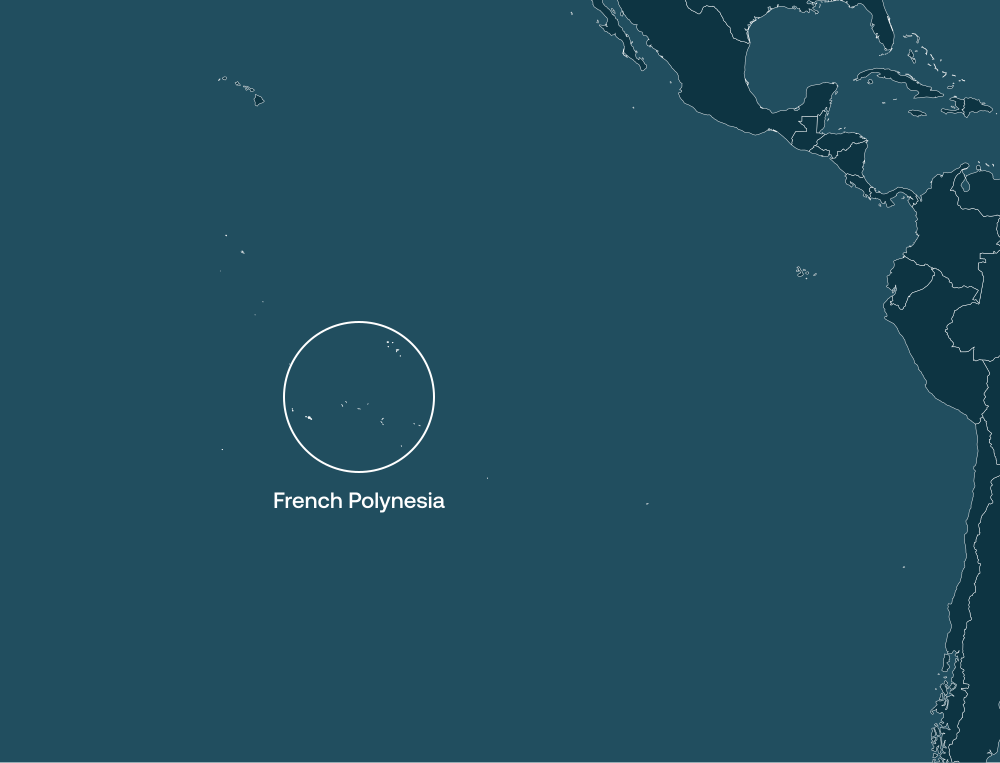
French Polynesia encompasses five archipelagos whose societies developed through centuries of settlement, cultural exchange, European exploration, missionary activity, and changing relationships with France. Tahiti’s unification under the POMARE dynasty preceded its transformation from protectorate to colony, while later political reforms brought French citizenship, overseas-territory status, and varying degrees of internal autonomy. Its twentieth-century history also includes the nuclear testing era at Mururoa and Fangataufa, followed by renewed debate over political status and self-determination.
Situated in the South Pacific, French Polynesia is connected to a broad network of island neighbors whose circumstances range from relative stability to unrest, institutional strain, cybercrime, and financial-transparency concerns. Regional security is also shaped by the use of Pacific ship registries in sanctions-evasion schemes linked especially to North Korea and Russia, with French forces participating in monitoring and enforcement efforts. The territory’s wider significance reflects both its ties to France—a major global and European power—and its position within a strategically sensitive oceanic region.
AML & Terrorist Financing
En tant que collectivité d’outre-mer française, la Polynésie française s’inscrit dans un dispositif AML/CFT national jugé globalement solide, tout en restant exposée à des risques liés aux flux transfrontaliers, à la fraude, aux trafics et à certains secteurs non financiers. TRACFIN, l’ACPR, l’AMF, le Parquet National Financier et l’OCRGDF constituent les principaux acteurs d’un système où la confiscation des avoirs, le registre des bénéficiaires effectifs et la coopération internationale occupent une place importante. Des fragilités subsistent toutefois dans l’application des obligations de déclaration, l’identification des bénéficiaires effectifs et la supervision fondée sur les risques, notamment pour l’immobilier, les professions juridiques, certaines entreprises et les organismes à but non lucratif, tandis que le financement du terrorisme demeure une priorité étroitement suivie.
Sanctions
French Polynesia, as an overseas collectivity of France, applies UN and EU restrictive measures through France’s domestic framework, including targeted asset freezes, travel bans, trade controls, financial restrictions, and arms embargoes involving situations such as Russia, Belarus, Iran, and others. French Customs, financial regulators, and intelligence units investigate evasion through neighboring transit states, intermediaries, shadow fleets, and online networks, while France also participates in the REPO Task Force and is developing new criminal-penalty rules under EU Directive 2024/1226. No international sanctions are currently in force against French Polynesia, although French enforcement activity addresses attempts to circumvent measures imposed on third countries and entities.
Criminality
French Polynesia operates within France’s anti-corruption framework, including measures overseen by the Agence Française Anticorruption and transparency requirements administered by HATVP, while concerns remain about the appointment of officials facing corruption allegations and declining confidence in public institutions. Specific gaps include limited progress on foreign-bribery enforcement, questions about prosecutorial independence and investigative resources, and the unresolved application of rules preventing the tax deductibility of bribes in French Polynesia.
Reports
French Polynesia falls within France’s Tier 1 anti-trafficking framework, which includes increased victim identification and international investigations, while persistent concerns include declining prosecutions, uneven victim referral procedures, and vulnerabilities affecting children and migrants in French territories. France also maintained its highest terrorism alert level, supported by Operation Sentinelle and cooperation with U.S. authorities, as security services focused on lone-actor and small-cell threats and disrupted nine planned attacks in 2024, including several linked to the Olympic and Paralympic Games.
Economy & Investment Climate
French Polynesia has a services-led, tourism-dependent economy supported by France, with opportunities in tourism infrastructure, high-quality vanilla, black pearls, agricultural processing, and handicrafts, while import dependence and exposure to climate hazards remain important considerations. Trade patterns underscore its outward-facing character, with pearls, fish, aircraft parts, and vanilla among leading exports, France supplying the largest share of imports, and the XPF providing monetary continuity.
Cryptocurrency Regulations
French Polynesia does not treat cryptocurrency as legal tender, but its position as an overseas collectivity of France points activity toward the PACTE Act, Autorité des Marchés Financiers (AMF) oversight, and FATF-aligned AML and KYC expectations. Local licensing, enforcement, transaction-tracking, and tax details remain less explicit, leaving exchanges, token offerings, and digital-asset users to navigate a framework that appears closely tied to broader French practice.
Get full access
The information on this page is a brief summary. Get access to EDD country reports, all risk category scores and customisable weightings for 245 jurisdictions.