
Risk Indicators
- FATF/EU Blacklist/Greylist (Lower Concern)
- Terrorism Financing (Medium Concern)
- US Dept of State INCSR
- Proliferation Financing
- Corruption
- Criminality
- Resilience & Governance
- Financial Transparency
- Offshore Finance Centres
- Sanctions
Background
The Gambia’s history reflects its importance as a trans-Saharan and Atlantic trading corridor, shaped by centuries of commerce, colonial rule, and the forced export of millions of people. Independence from the United Kingdom came in 1965, followed by the brief Senegambia confederation and a prolonged period of rule under Yahya JAMMEH after the 1994 coup. The 2016 election of Adama BARROW marked a political turning point, with subsequent US engagement supporting democratic institutions, economic development, and security-sector capacity.
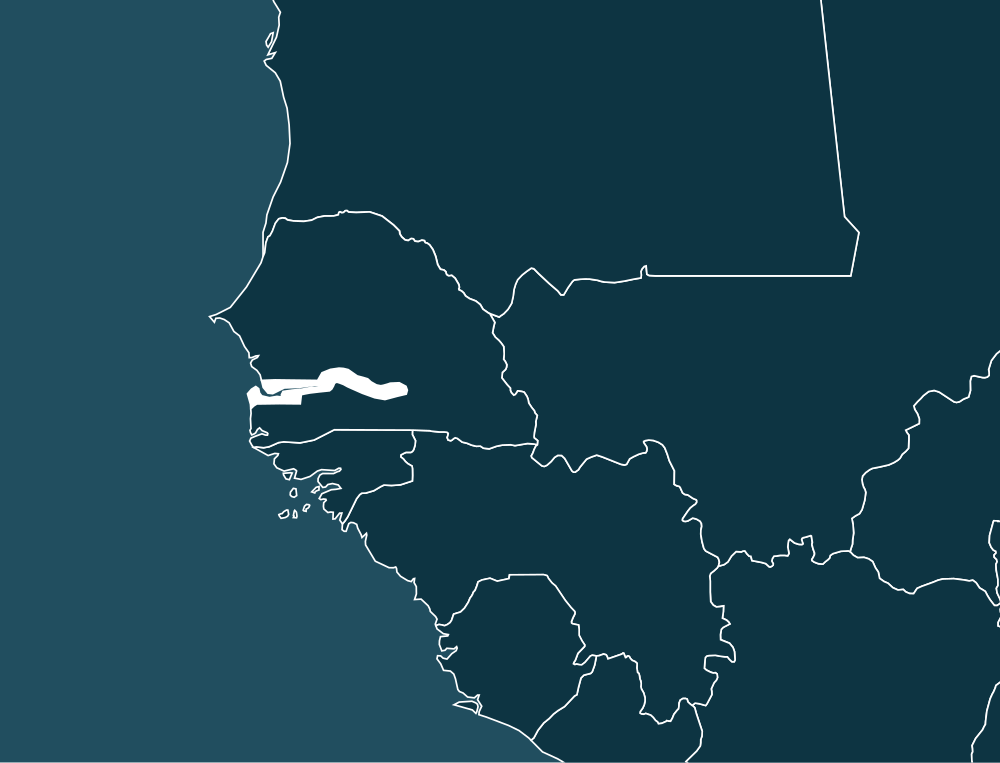
Nearly enclosed by Senegal, The Gambia remains closely affected by instability in the surrounding region, particularly violence linked to the MFDC in Casamance and Guinea-Bissau’s organized-crime and trafficking environment. Refugee movements, porous borders, and cross-border threats—including trafficking, arms proliferation, and environmental crime—create persistent security concerns for Gambian communities. Domestic pressures, including an alleged 2022 coup attempt and EU visa measures connected to deportation cooperation, add further complexity to the country’s governance and regional outlook.
AML & Terrorist Financing
The Gambia is not subject to FATF enhanced monitoring, yet the 2022 Mutual Evaluation identified broad weaknesses in effectiveness, risk understanding, supervision, confiscation, and money-laundering enforcement. Risks linked to drug trafficking, cash-based commerce, real estate, informal remitters, porous borders, and limited beneficial-ownership information continue to challenge the FIU, CBG, law-enforcement bodies, and other authorities. Terrorist-financing and proliferation-financing controls remain particularly underdeveloped, with gaps involving STR reporting, UN sanctions implementation, NPO oversight, inter-agency coordination, and the practical application of preventive measures outside the banking sector.
Sanctions
Gambia is required to implement United Nations Security Council sanctions, though no international sanctions are currently in force against the country itself. Its maritime, financial, and aviation frameworks have nevertheless been associated with sanctions-evasion activity involving Russia, Belarus, Iran, and Venezuela, including provisional vessel registration, shell accounts, and opaque aircraft transactions routed toward destinations such as the UAE. Following pressure from the United States and European Union, the Gambia Maritime Administration reportedly deregistered 72 vessels in 2025, while the IMO identified additional ships falsely using the Gambian flag.
Criminality
The Gambia continues to face corruption involving bribery, embezzlement, nepotism, and alleged cooperation between public officials and private-sector actors, while delays in staffing the Anti-Corruption Commission have slowed implementation of the 2023 Anti-Corruption Act. Criminal activity also includes human trafficking and smuggling, drug transit, counterfeit goods, illegal logging and fishing, money laundering in tourist areas, and rising cybercrime, with the Fraud & Commercial Crime Unit, Office of the Ombudsman, and civil society organizations such as Gambia Participates involved in accountability efforts.
Reports
The Gambia remains on Tier 2, with increased anti-trafficking funding, awareness efforts, front-line and diplomatic training, and a new victim shelter, while investigations, victim identification, and specialized judicial capacity remain limited. Trafficking risks span sex trafficking, forced begging, domestic and agricultural labor, tourism-related exploitation, fraudulent overseas recruitment, migrant abuse, and abuses documented by the Truth, Reconciliation, and Reparations Committee, with vulnerabilities extending from rural children and prospective migrants to workers abroad.
Industry/Product Sector Risk
The Gambia’s financial and commercial landscape is shaped by a predominantly cash-based economy, with banks, remitters, foreign exchange bureaux, real estate, casinos, hospitality, and cross-border trade presenting varying degrees of exposure. Particular insights emerge from the contrasting roles of commercial banks and informal channels, the limited oversight of DNFBPs, and vulnerabilities involving beneficial ownership, mobile money, precious metals, and property transactions. The involvement of institutions such as the FIU, Tourism Board, companies registry, customs authorities, and the Commission of Inquiry into public assets points to a complex environment where corruption, fraud, trafficking, tax offences, and smuggling risks intersect across sectors.
Economy & Investment Climate
The Gambia offers a strategically positioned, broadly open investment environment supported by GIEPA incentives, recovering tourism, strong remittances, and opportunities in agriculture, energy, manufacturing, ICT, and regional trade. At the same time, investors must weigh promising growth and financial-sector resilience against corruption concerns, procurement changes involving the GPPA, infrastructure and skills constraints, inconsistent regulation, and unresolved governance challenges affecting state-owned enterprises and market access.
Cryptocurrency Regulations
Cryptocurrency in The Gambia occupies an evolving regulatory gray area: it is not legal tender, yet the Central Bank of The Gambia is using a fintech sandbox while AML/CFT and KYC expectations increasingly shape digital-asset activity. With no clearly established VASP registry, dedicated crypto-tax treatment, or detailed ICO disclosure regime, the Anti-Money Laundering Act, FATF alignment, and the roles of the Gambia Revenue Authority point toward a framework still taking shape.
Get full access
The information on this page is a brief summary. Get access to EDD country reports, all risk category scores and customisable weightings for 245 jurisdictions.