
Risk Indicators
- FATF/EU Blacklist/Greylist (Medium Concern)
- Terrorism Financing (Medium Concern)
- US Dept of State INCSR
- Proliferation Financing
- Corruption
- Criminality
- Resilience & Governance
- Financial Transparency
- Offshore Finance Centres
- Sanctions
Background
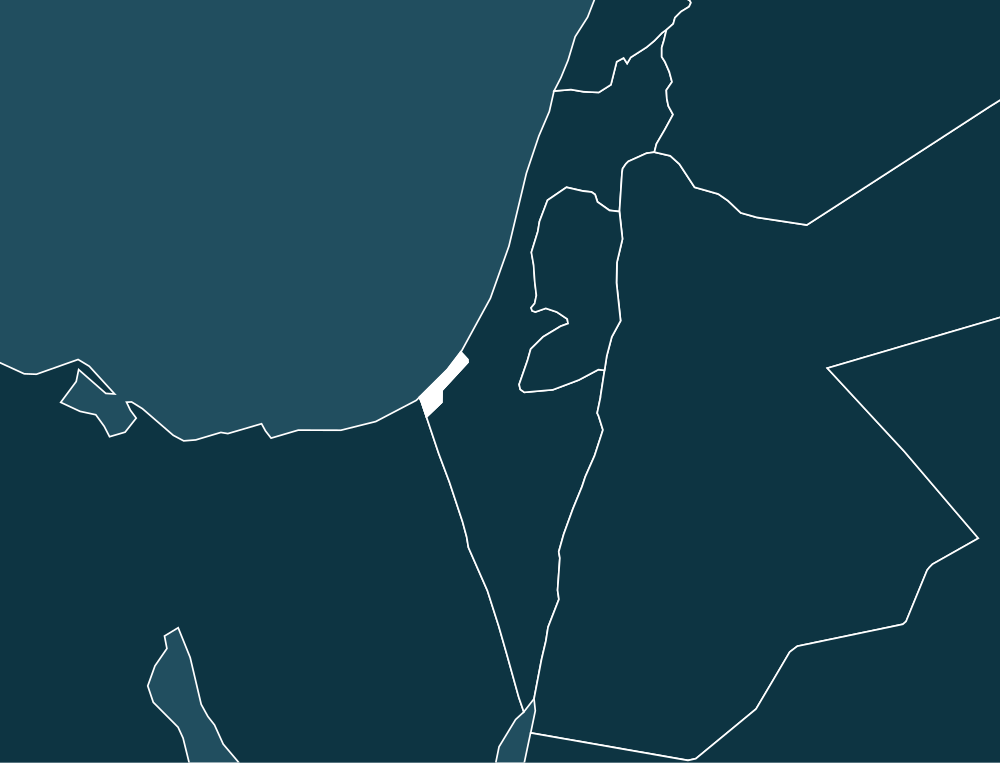
The Gaza Strip has a long history shaped by successive empires, the British Mandate, Egyptian administration, Israeli occupation, and the Oslo-era transfer of limited responsibilities to the Palestinian Authority. Since HAMAS assumed de facto control in 2007 following political rupture and violence with Fatah, the territory has endured recurring conflict, poverty, humanitarian crises, and stringent movement and trade restrictions. Although Israel withdrew its settlers and soldiers in 2005, it continues to control key aspects of Gaza’s borders, waters, airspace, telecommunications, and cyberspace, while Egypt maintains tight oversight of the Rafah crossing.
Gaza’s circumstances are inseparable from the wider security environment involving Israel, Egypt, Lebanon, and Syria. Israel faces armed confrontation with HAMAS, rocket threats, northern-border tensions involving Hezbollah, and targeted U.S. sanctions related to extremist activity, while Egypt confronts risks involving humanitarian access, displacement, Sinai security, and economic strain. Beyond Gaza’s immediate borders, regional energy arrangements connected to Syria and Lebanon raise additional concerns under measures such as the U.S. Caesar Syria Civilian Protection Act.
AML & Terrorist Financing
The Gaza Strip operates within a fragmented AML/CFT environment in which the Palestine Monetary Authority and Financial Follow-Up Unit provide formal oversight, while Hamas-controlled local authorities limit consistent enforcement and information sharing. A largely cash-based economy, widespread licensed and unlicensed hawala activity, limited beneficial-ownership transparency, and vulnerabilities involving trade-based laundering, customs fraud, bulk cash movement, counterfeit currency, and terrorist financing complicate detection of illicit finance. Although the West Bank/Gaza Strip is not currently listed by FATF for strategic deficiencies, the absence of a completed mutual evaluation and the limited ability of Palestinian institutions to operate in Gaza leave important questions about supervisory effectiveness and financial crime coordination.
Sanctions
No sanctions imposed by the Gaza Strip on other nations are identified, although Hamas-linked networks are described as using charities, cryptocurrency, front companies, and regional transit routes for financing and goods. Gaza is subject to Israel’s unilateral blockade, including restrictions on food, fuel, water, movement, and crossings, while Egypt has also sealed its crossing; these measures are distinguished from an international sanctions regime. International actions largely target Hamas and associated individuals or entities through mechanisms such as U.S. OFAC designations—including Gaza-based Buy Cash—alongside varying arms restrictions and targeted measures by the UK, Canada, Australia, and several European states, with humanitarian exemptions or permissions in some cases.
Criminality
In Gaza, corruption concerns are associated with nepotism, favoritism, embezzlement, abuse of power, bribery, and breaches of trust, with government institutions, security services, local authorities, and service-delivery bodies viewed as particularly vulnerable. Although Palestinian anti-graft laws and the Anti-Corruption Commission provide formal safeguards, perceptions that access to power influences business success remain significant, while AMAN and other civil-society actors continue to promote accountability.
Reports
Gaza’s trafficking risks have intensified amid displacement, deprivation, limited victim services, inactive courts, and legal gaps, while Hamas authorities reported no investigations, prosecutions, or victim referrals and international organizations remained among the few groups able to provide assistance. The U.S. State Department’s terrorism coverage also describes Israel’s expanded campaign against Hamas, ongoing hostage and missile-related violence, and a wider regional conflict that has further shaped conditions in Gaza.
Economy & Investment Climate
Gaza’s economy has been pushed into near-total suspension by conflict, infrastructure damage, movement and trade restrictions, with PCBS figures indicating exceptionally high unemployment and a dramatic contraction in economic output. Private investment remains further constrained by disrupted banking and commercial systems, while future activity is likely to center on reconstruction, essential infrastructure, and cautiously identified opportunities in sectors such as energy, agriculture, and information technology.
Cryptocurrency Regulations
Cryptocurrency in the Gaza Strip operates in a largely unregulated environment, with no formal licensing, compliance registry, tax framework, or recognized legal-tender status, leaving exchanges, token offerings, and users without clear legal protections or obligations. Although FATF standards point toward measures such as customer due diligence, suspicious-transaction reporting, and the Travel Rule, Gaza’s political and humanitarian conditions have left their local application—and the prospects for meaningful oversight—highly uncertain.
Get full access
The information on this page is a brief summary. Get access to EDD country reports, all risk category scores and customisable weightings for 245 jurisdictions.