
Risk Indicators
- FATF/EU Blacklist/Greylist (Lower Concern)
- Terrorism Financing (Lower Concern)
- US Dept of State INCSR
- Proliferation Financing
- Corruption
- Criminality
- Resilience & Governance
- Financial Transparency
- Offshore Finance Centres
- Sanctions
Background
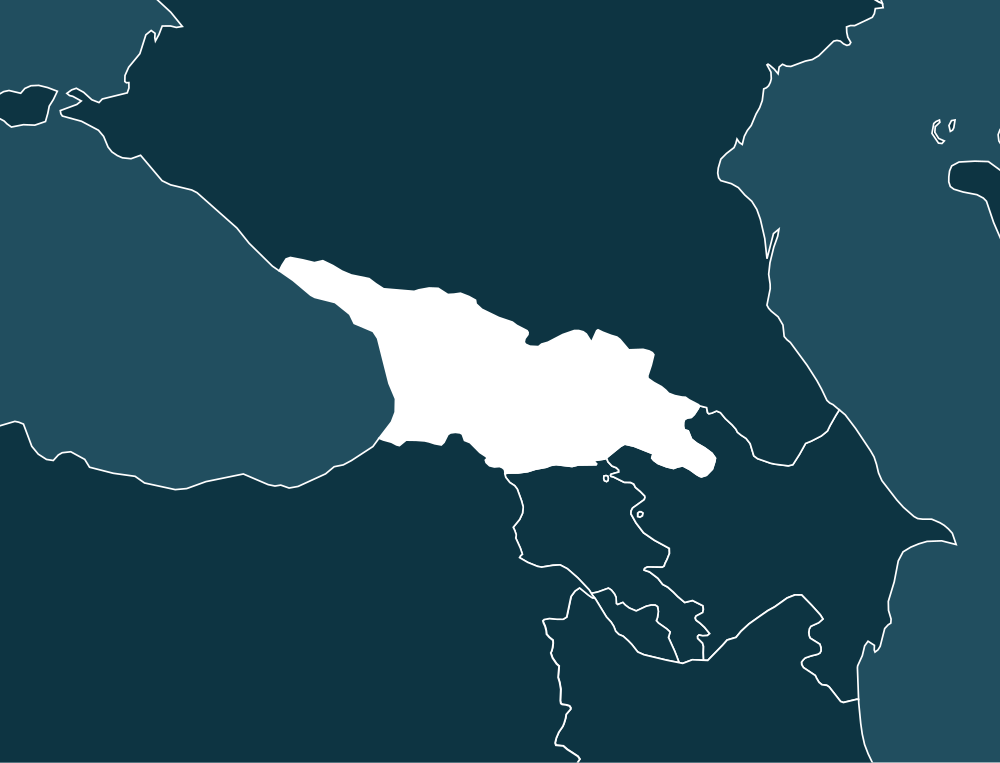
Georgia’s history stretches from Colchis and Kartli-Iberia through Roman, Persian, Arab, Ottoman, and Russian influence, followed by brief independence and incorporation into the USSR before independence was restored in 1991. The 2003 Rose Revolution brought Mikheil Saakashvili and the United National Movement to power amid public anger over corruption, while later political change elevated Bidzina Ivanishvili’s Georgian Dream coalition. The country’s Western orientation remains prominent through its EU and NATO ambitions, its Deep and Comprehensive Free Trade Agreement with the EU, and visa-free access to the Schengen area.
Georgia’s security environment is shaped most directly by Russia’s presence in Abkhazia and South Ossetia, alongside unresolved tensions involving Armenia and Azerbaijan. Regional trade routes connecting Russia, Turkey, Armenia, Azerbaijan, Iran, and Georgia have also drawn attention for potential sanctions-evasion risks and technology transfers. EU candidacy, Russian military pressure, and the wider networks surrounding sanctioned goods and entities create a setting where political, commercial, and security developments are closely intertwined.
AML & Terrorist Financing
Georgia is not listed by FATF as having strategic AML deficiencies and has strengthened its framework through legislative reforms, including improvements involving politically exposed persons, risk assessment, virtual asset service providers, and the Financial Monitoring Service (FMS). Nevertheless, MONEYVAL continues to identify areas of partial compliance, particularly targeted financial sanctions concerning terrorism and proliferation financing, while risks linked to cash, gambling, real estate, virtual assets, and the misuse of legal persons remain relevant. Although the FMS, National Bank of Georgia, General Prosecutor’s Office, and State Security Service have demonstrated important capabilities, uneven supervision, limited beneficial ownership reliability, delayed sanctions implementation, and resource constraints leave significant issues for further scrutiny.
Sanctions
Georgia is obligated to implement UN sanctions measures and reports that its customs authorities and National Bank apply controls aligned with international restrictions, while the government maintains it does not impose sanctions on Russia. Although no international sanctions are currently in force against Georgia, its role in alleged transit and re-export networks involving Russia, EAEU states, Azerbaijan, and Iran has drawn scrutiny from the US State Department, the European Union, OLAF, and the UK’s OFSI, NCA, and FCDO. EU and UK warnings—including calls to halt re-exports of economically critical goods and cautions about possible secondary designations—underscore the risk of future measures against Georgian entities involved in vehicles, dual-use goods, financial services, or Russian-origin petroleum flows.
Criminality
Georgia has an established legal framework criminalizing bribery and official misconduct, yet concerns remain about high-level corruption, vested interests, and the independence of the Anti-Corruption Bureau, while the Prosecutor’s Office and State Security Service retain investigative responsibilities. Criminal activity includes trafficking, heroin transit, counterfeit goods, illegal environmental exploitation, tax offenses, embezzlement, fraudulent investment schemes, and emerging cybercrime, with occasional indications of organized groups and state-linked procurement abuses.
Reports
Georgia remains a significant Caucasus Route transit point for synthetic drugs while the Ministry of Interior, National Drug Observatory, and EU4MD-supported monitoring efforts expand, even as treatment access and prevention face constraints; trafficking risks span domestic and foreign victims, with the General Prosecutor’s Office and anti-trafficking shelters reflecting stronger official responses alongside persistent gaps in sex-trafficking investigations and civil-society coordination. Counterterrorism measures also advanced through the 2022–26 strategy, MONEYVAL-recognized AML/CFT reforms, Europol cooperation, and convictions for terrorism-related offenses, offering a detailed picture of evolving security and enforcement priorities.
Industry/Product Sector Risk
Georgia’s industry landscape presents notable exposure across cash-intensive activities, with gambling, real estate, and retail banking standing out amid extensive cross-border flows and the use of legal persons. Channels involving casinos, currency exchange offices, remittances, virtual assets, and trade through free industrial zones create additional complexity, while the National Agency of Public Registry and other supervisory bodies face varying gatekeeping and oversight challenges. At the same time, sectors such as insurance and securities remain comparatively limited, whereas professional intermediaries, non-profits, construction, logistics, and digital services reflect more specific vulnerabilities linked to beneficial ownership, fraud, corruption, tax evasion, and organised crime.
Economy & Investment Climate
Georgia’s open, service-led economy has maintained strong growth, supported by tourism, trade, remittances, and its strategic role in the Middle Corridor, while Enterprise Georgia and the National Bank of Georgia help underpin investment and financial activity. Despite streamlined business registration, broad trade links, and generally favorable market conditions, investor confidence is tempered by declining FDI, judicial and governance concerns, ongoing political tensions, and uncertainty surrounding the country’s European integration path.
Cryptocurrency Regulations
Georgia permits cryptocurrency as a regulated virtual asset rather than legal tender, with the National Bank of Georgia supervising VASPs under AML/CFT rules introduced on January 1, 2023, including registration, customer due diligence, transaction monitoring, and Travel Rule obligations. The framework combines increased oversight—including a 5,000 GEL registration fee and restrictions involving privacy coins—with a comparatively favorable tax position for individuals, while corporate treatment and emerging areas such as ICOs and tokenization leave important details to be explored.
Get full access
The information on this page is a brief summary. Get access to EDD country reports, all risk category scores and customisable weightings for 245 jurisdictions.