
Risk Indicators
- FATF/EU Blacklist/Greylist (Lower Concern)
- Terrorism Financing (Medium Concern)
- US Dept of State INCSR
- Proliferation Financing
- Corruption
- Criminality
- Resilience & Governance
- Financial Transparency
- Offshore Finance Centres
- Sanctions
Background
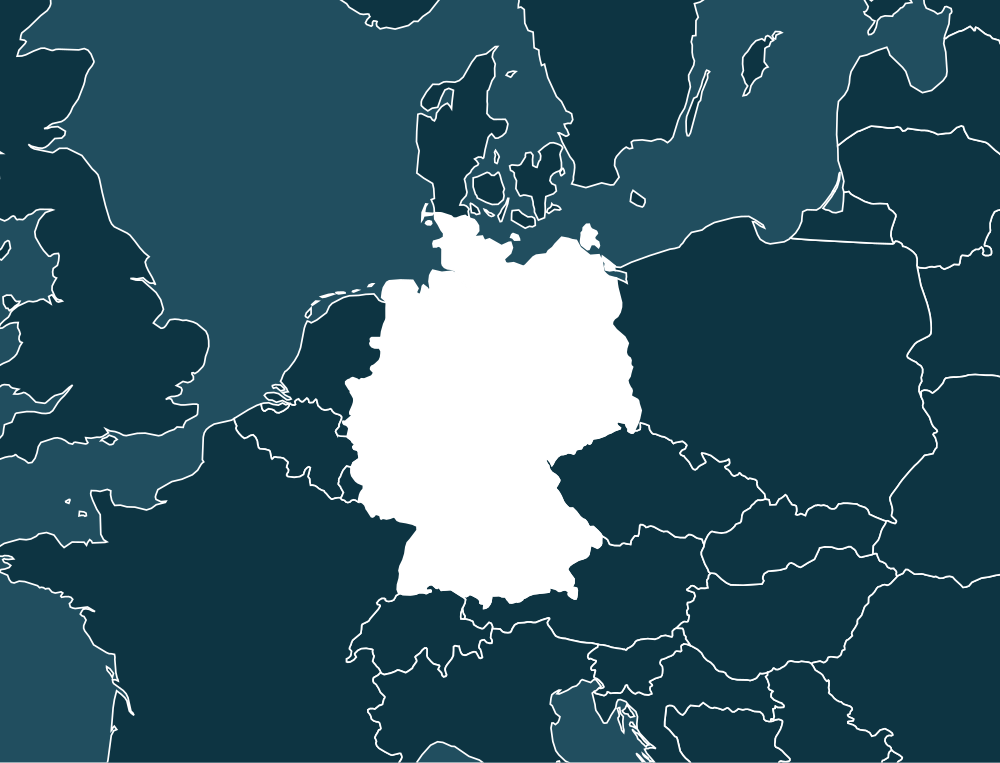
Germany, Europe’s largest economy and second-most-populous nation, remains central to the continent’s economic, political, and defense institutions. Its modern trajectory was shaped by occupation after 1945, division into the western FRG and eastern GDR, and reunification in 1990 following the Cold War. Deep integration through the European Community—now the EU—NATO, and the euro continues to define its regional role, alongside efforts to narrow the economic divide between eastern and western states.
Although none of Germany’s nine neighbors faces an active armed conflict, the surrounding region is marked by migration disputes, border-management friction, and heightened concern over Russian espionage, cyber threats, and hybrid activity. Poland, Austria, Switzerland, and others have raised concerns about the effects of Germany’s tightened border policies, while France remains closely focused on the security implications of Russia’s actions in Ukraine. Across the EU neighborhood, enforcement of sanctions against Russia and Belarus is complicated by re-exports, third-country intermediaries, falsified customs data, and complex supply chains, issues reflected in prosecutions in Germany and the Netherlands.
AML & Terrorist Financing
Germany has strengthened its AML/CFT framework through the National Risk Assessment, the Transparency Register, increased capacity at BaFin and FIU-Deutschland, and initiatives such as the Anti-Financial Crime Alliance, yet its cash-intensive, internationally connected economy remains exposed to real estate, legal entities, virtual assets, and cross-border laundering risks. The 2023 FATF evaluation found generally strong technical compliance, but highlighted uneven effectiveness, including low suspicious transaction reporting among DNFBPs, coordination difficulties across the Länder and more than 300 non-financial supervisors, gaps in beneficial ownership information, and limited progress from investigations to prosecutions. Terrorist financing is investigated and disrupted comparatively effectively by the BKA, FIU, and other authorities, while concerns remain around the limited use of proactive domestic designations, low frozen amounts, uneven sanctions monitoring, and the operational integration of financial intelligence.
Sanctions
Germany primarily enforces EU and UN restrictive measures rather than imposing unilateral sanctions, with national export controls administered by BAFA and enforcement supported by the ZfS and BBF. Its measures focus especially on Russia and Iran, alongside Belarus, North Korea, Syria, Venezuela, and others, with attention to asset freezes, sectoral restrictions, shadow-fleet activity, shell companies, and complex financial transit networks. No international sanctions are currently in force against Germany, while recent vessel seizures, raids, and the January 2026 legislation indicate a tightening response to evasion and violations.
Criminality
Germany maintains a substantial legal and enforcement framework against corruption, yet the BKA’s Bundeslagebild Korruption identifies persistent exposure in business, public administration, and law enforcement, with a notable rise in cases involving the judiciary and increased financial damage. Criminal activity remains broad, encompassing organized drug and trafficking networks, cybercrime, fraud, and money laundering risks linked especially to real estate and large cash transactions, while the absence of a central anti-corruption agency leaves responsibility largely with the federal states.
Reports
Germany remained a Tier 1 performer in efforts to combat human trafficking, with a new National Action Plan, increased NGO support, and broader data analysis accompanying persistent concerns over victim identification, shelter capacity, labor recruitment, and lenient convictions. Counterterrorism activity included 486 new investigations by the Federal Prosecutor’s Office, attacks linked to ISIS and extremist networks, and continued cooperation with international partners amid legal and institutional constraints on intelligence and illicit-finance enforcement.
Industry/Product Sector Risk
Germany’s financial and non-financial sectors present a varied risk landscape, with retail banking, correspondent banking, cash-intensive activities, real estate, trade finance, virtual assets, casinos, and wealth management attracting particular attention. BaFin’s role, Länder-level supervision, the Transparency Register, and issues surrounding hawala, beneficial ownership, cross-border transactions, and limited STR reporting point to important differences in control maturity across sectors. At the same time, Germany’s globally connected, export-oriented economy remains exposed to proceeds linked to fraud, tax crime, corruption, organised crime, drug trafficking, human trafficking, cyber-enabled offences, and foreign predicate crimes.
Economy & Investment Climate
Germany remains a highly open, export-oriented economy with strong infrastructure, skilled labor, advanced research capabilities, and substantial U.S. investment across manufacturing, technology, finance, and professional services, while a €1 trillion spending package signals major new opportunities in infrastructure, defense, climate, and digital capacity. At the same time, investors face high energy and tax costs, labor shortages, manufacturing pressures, complex compliance requirements, and increasingly attentive screening by the BMWE, with Germany Trade and Invest offering guidance through the country’s sophisticated but demanding business environment.
Cryptocurrency Regulations
Germany permits cryptocurrency within a closely supervised financial framework, with BaFin licensing, GwG and 5AMLD obligations, and Travel Rule requirements shaping how exchanges and Virtual Asset Service Providers operate. Tax treatment, token classifications, and offerings are subject to evolving oversight involving the BZSt, WpHG, eWpG, and the forthcoming MiCA and DAC8 frameworks, creating both compliance demands and notable distinctions for long-term holders and digital-asset issuers.
Get full access
The information on this page is a brief summary. Get access to EDD country reports, all risk category scores and customisable weightings for 245 jurisdictions.