
Risk Indicators
- FATF/EU Blacklist/Greylist (Lower Concern)
- Terrorism Financing (Lower Concern)
- US Dept of State INCSR
- Proliferation Financing
- Corruption
- Criminality
- Resilience & Governance
- Financial Transparency
- Offshore Finance Centres
- Sanctions
Background
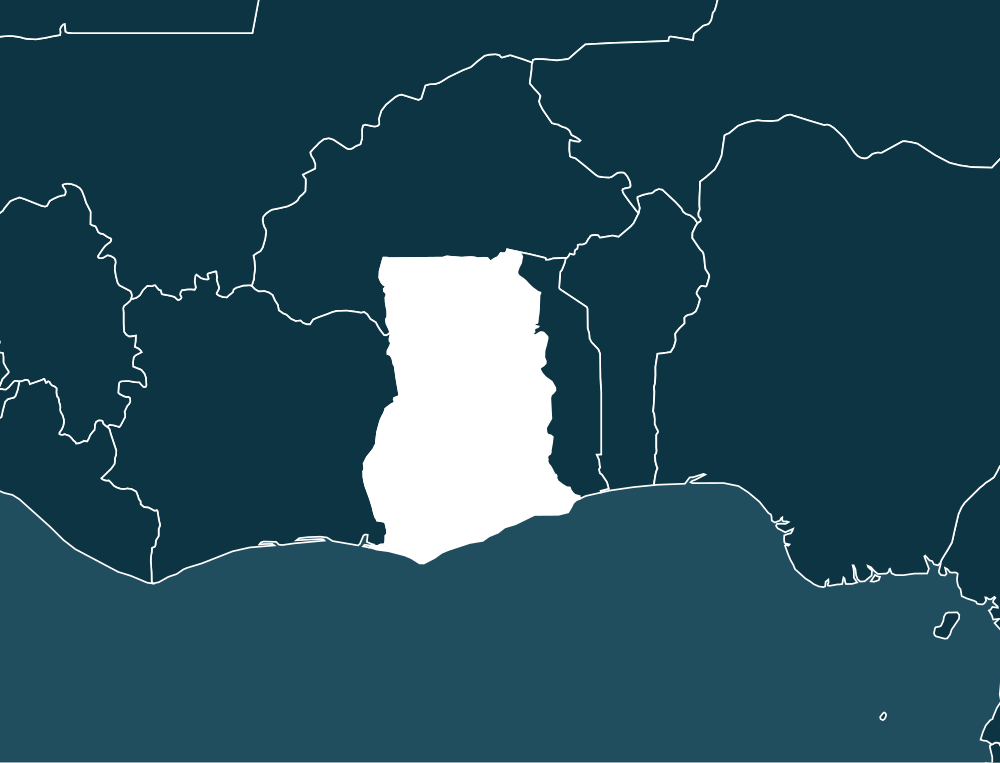
Ghana is a resource-rich, multiethnic democracy whose history was shaped by the gold trade, powerful states such as Dagbon and Asante, and successive European trading powers. Its transition from the Gold Coast and Togoland trust territory to independence in 1957 marked a significant moment in Sub-Saharan Africa, followed by periods of military rule and constitutional renewal. Since the return to multiparty politics in 1992, leadership has alternated between the National Democratic Congress and the New Patriotic Party, while Ghana has expanded its regional and international engagement.
Ghana’s stability is set against a challenging neighborhood, with Côte d’Ivoire, Burkina Faso, and Togo facing varying degrees of political tension, armed violence, displacement, and extremist spillover. Conditions ranging from Sahelian insurgencies and contested elections to constitutional changes and ECOWAS-related disputes create potential implications for Ghana’s security and economy. Concerns identified by bodies such as the Financial Action Task Force and regional anti-money-laundering institutions also point to wider risks involving illicit financial flows and sanctions evasion.
AML & Terrorist Financing
Ghana has made notable progress in strengthening its AML/CFT framework and is no longer subject to FATF increased monitoring, although its 2022 follow-up and continued engagement with GIABA indicate that implementation remains a work in progress. Significant vulnerabilities persist across cash-intensive and informal sectors, including DNFBPs, real estate, casinos, illegal mining, virtual assets, NPOs and cross-border activity, with supervisory gaps involving the SEC, NIC and other authorities. The FIC, EOCO and Bank of Ghana play central roles in intelligence, oversight and enforcement, yet limited money-laundering and terrorist-financing prosecutions, uneven customer due diligence, weak NPO monitoring and low effectiveness ratings for Immediate Outcomes 9–11 leave important questions around financial intelligence use, sanctions and confiscation.
Sanctions
Ghana implements United Nations sanctions measures, supported by domestic compliance frameworks overseen by the Bank of Ghana and Financial Intelligence Centre, with administrative and judicial penalties available for violations. Although no international sanctions are currently in force against Ghana, concerns center on possible evasion involving North Korean medical personnel, joint healthcare arrangements, and the movement of goods or funds through the Port of Tema, informal crossings, and financial networks. Continued weaknesses in port monitoring, trade documentation, and the informal economy could expose Ghana to reputational or broader economic repercussions, including reduced external support.
Criminality
Ghana faces persistent corruption, with bribery reported across public services and the judiciary, lengthy proceedings, slow convictions, and continuing concerns over procurement transparency despite a substantial legal framework. Criminal activity spans trafficking, illicit trade, environmental crimes, drug markets, cybercrime, and financial fraud, while institutions including the Office of the Special Prosecutor, CHRAJ, and EOCO continue to address these challenges with uneven results.
Reports
Ghana remains a significant regional focus for drug control, with Tema Port, diverted pharmaceutical substances, synthetic-drug precursors, and substantial seizures supported by U.S. assistance to the Narcotics Control Commission and other agencies. Trafficking vulnerabilities span Lake Volta fishing, cocoa production, mining, domestic work, online scam operations, commercial fishing fleets, and overseas recruitment, while stronger investigations and funding under the 2022–2026 National Action Plan coexist with gaps in victim identification, screening, and specialized enforcement capacity.
Industry/Product Sector Risk
Ghana’s financial and non-financial sectors present a varied risk landscape, with particular exposure arising from cash-intensive activity, cross-border flows, informal markets, and weaknesses in customer and beneficial-ownership transparency. Casinos, real estate, mining, high-value dealers, retail banking, charities and NPOs, and politically connected activity stand out alongside emerging pressures linked to mobile money, cybercrime, trade finance, and underground remittance channels. The roles of institutions such as the Bank of Ghana, Gaming Commission, National Insurance Commission, Securities and Exchange Commission, Ghana Police Service Cybercrime Unit, ICAG, General Legal Council, Registrar-General, and GREDA provide important context for understanding supervisory gaps and sector-specific vulnerabilities.
Economy & Investment Climate
Ghana combines renewed economic growth and political stability with promising opportunities in agribusiness, ICT, mining, energy, and construction, supported by reform efforts involving the GIPC, digital public services, and AfCFTA integration. Yet elevated inflation, debt obligations, energy-sector arrears, foreign-exchange pressures, infrastructure gaps, and complex local-content and regulatory requirements continue to shape the investment landscape, with agencies such as the Bank of Ghana, GRA, Minerals Commission, and Energy Commission central to its evolving outlook.
Cryptocurrency Regulations
Ghana is moving toward a more structured digital-asset regime, with the Bank of Ghana’s August 2024 draft guidelines pointing VASPs toward registration, FATF-aligned controls, customer verification, and Travel Rule obligations, while cryptocurrencies remain outside legal tender status. Tax treatment already places crypto gains within a 15% capital-gains framework overseen by the Ghana Revenue Authority, but questions around licensing, ICOs, tokenization, transaction tracking, and the Financial Intelligence Centre’s role remain part of an evolving landscape.
Get full access
The information on this page is a brief summary. Get access to EDD country reports, all risk category scores and customisable weightings for 245 jurisdictions.