
Risk Indicators
- FATF/EU Blacklist/Greylist (Lower Concern)
- Terrorism Financing (Lower Concern)
- US Dept of State INCSR
- Proliferation Financing
- Corruption
- Criminality
- Resilience & Governance
- Financial Transparency
- Offshore Finance Centres
- Sanctions
Background
Greece’s modern identity was shaped by independence from the Ottoman Empire, territorial expansion, wartime occupation, civil conflict, and the transition from military rule to a parliamentary republic in 1974. Its subsequent integration into NATO, the European Community, and the European Economic and Monetary Union marked a broader European orientation. A prolonged economic crisis beginning in 2009 led to three assistance arrangements involving the European Commission, the European Central Bank, the IMF, and later the European Stability Mechanism, followed by a notable recovery and early IMF repayment in 2022.
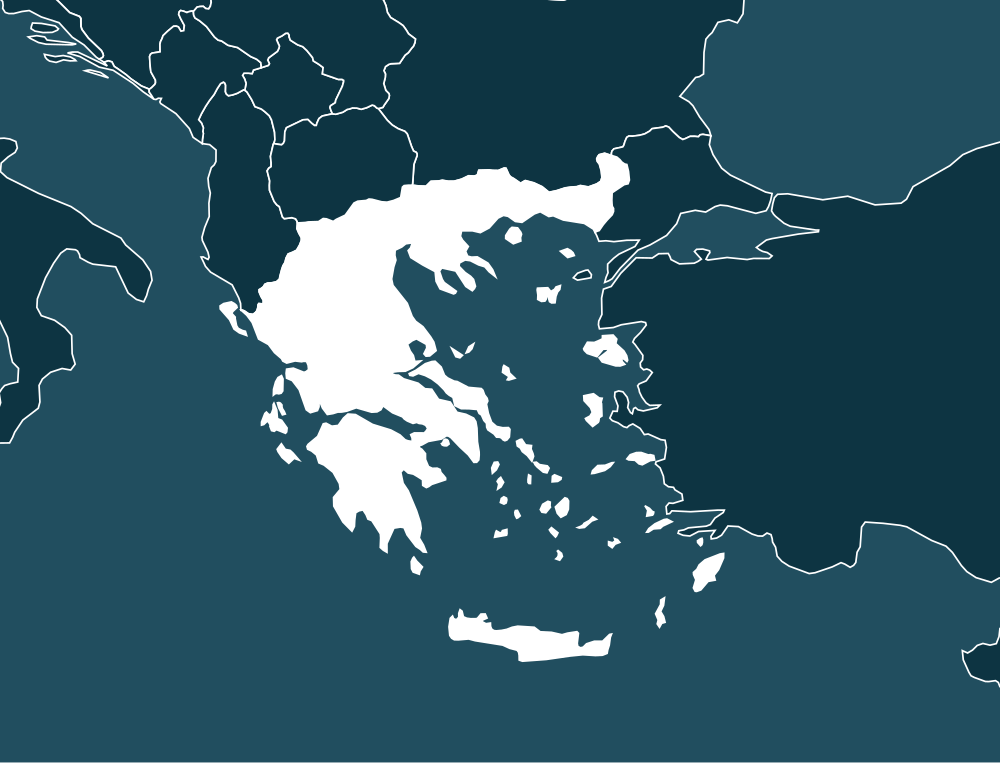
Greece’s surrounding security environment is generally stable but remains heavily influenced by its relationship with Turkey, particularly disputes involving the Aegean, Eastern Mediterranean energy rights, borders, and migration. Albania, North Macedonia, and Bulgaria are described as comparatively cooperative neighbors, with limited bilateral concerns and strong alignment with EU sanctions policies. Turkey presents a more complex regional picture, combining periodic military and political tensions with sanctions concerns involving Syria, Russia, Iran, and cases such as Halkbank.
AML & Terrorist Financing
Greece is not identified by FATF as having strategic AML deficiencies, yet its medium-high money-laundering risk reflects exposure to corruption, tax crime, smuggling, organised crime, and its role as a gateway to the EU. The Hellenic Financial Intelligence Unit, S.D.O.E., and law-enforcement bodies make effective use of financial intelligence, while judicial delays, limited statistics, and weaknesses in confiscation and prosecution continue to affect outcomes. Terrorist-financing controls and targeted sanctions are comparatively strong, but gaps remain among DNFBPs, in non-profit-organisation risk assessment, beneficial-ownership transparency, and the consistent application of preventive supervision.
Sanctions
Greece implements UN and EU restrictive measures domestically, including asset freezes, travel bans, sectoral controls, and maritime or financial restrictions targeting activities and responsible individuals or entities connected to situations such as Russia, Iran, Syria, and Libya. While no international sanctions are currently in force against Greece itself, the U.S. Treasury’s OFAC has sanctioned Greek national Antonios Margaritis and associated businesses and vessels over alleged Iranian petroleum facilitation. Greek shipping’s links to Russia’s shadow fleet—including former Greek tankers, ship-to-ship transfers near Greek and Cypriot waters, and Greece’s opposition to the proposed EU maritime-services ban—have placed the country’s maritime sector under heightened sanctions-evasion scrutiny.
Criminality
Greece has established anti-corruption structures, including the National Transparency Authority under Law 4622/2019, yet concerns persist over favoritism, conflicts of interest, tax evasion, online fraud, and corruption affecting public and private sectors. Criminal activity spans human trafficking and migrant smuggling, counterfeit goods and tobacco, drug transit through major ports, cybercrime, and entrenched domestic and foreign-linked networks, with police involvement and vulnerabilities in telecommunications, energy, and pharmaceuticals also noted.
Reports
Greece increased efforts against trafficking, including more investigations and convictions, new victim-identification procedures involving the Hellenic Police and Labor Inspectorate, and work toward a national action plan, while gaps remained in screening, specialized services, shelter capacity, and protection at migrant reception centers. In 2024, the National Intelligence Service (EYP) highlighted continued vigilance over internet-enabled radicalization and regional risks, as Greece recorded fewer than 12 mainly anarchist attacks, including IED incidents claimed by Revolutionary Class Self-Defense.
Industry/Product Sector Risk
Greece’s highest-exposure areas include retail banking, money or value transfer services, real estate, cash-intensive businesses, hospitality, construction, and professional gatekeepers, with recurring concerns involving tax offences, corruption, smuggling, and organised crime. Supervisory attention spans institutions such as the Bank of Greece, Hellenic Gaming Commission, Hellenic Capital Market Commission, Independent Authority for Public Revenue, HAASOB, and the Ministry of Justice, though the strength of oversight and sectoral understanding varies considerably. Cross-border flows, migrant and refugee routes, opaque corporate structures, high-value assets, public procurement, and cash-based activity create a complex risk landscape with important distinctions between established controls and significant implementation gaps.
Economy & Investment Climate
Greece’s economy is gaining momentum through reform, digitized public services, renewed investment-grade status, and substantial European Recovery and Resilience Facility funding, with Enterprise Greece highlighting opportunities across energy, tourism, technology, infrastructure, and other strategic sectors. At the same time, investors must weigh persistent bureaucracy, judicial delays, labor shortages, and evolving scrutiny of foreign investment in sensitive areas against improving banks, expanding private-sector interest, and a generally open capital regime.
Cryptocurrency Regulations
Greece permits cryptocurrency activity while placing exchanges and other VASPs under the oversight of the Hellenic Capital Market Commission, with Law 4557/2018, Law 4734/2020, and the EU Travel Rule shaping registration, customer checks, and transaction transparency. With fewer than 20 VASPs registered as of December 2024, forthcoming MiCAR implementation and a 15% capital-gains tax from January 2025 point to a rapidly formalizing market whose tokenization and reporting requirements are still developing.
Get full access
The information on this page is a brief summary. Get access to EDD country reports, all risk category scores and customisable weightings for 245 jurisdictions.