
Risk Indicators
- FATF/EU Blacklist/Greylist (Lower Concern)
- Terrorism Financing (Lower Concern)
- US Dept of State INCSR
- Proliferation Financing
- Corruption
- Criminality
- Resilience & Governance
- Financial Transparency
- Offshore Finance Centres
- Sanctions
Background
Grenada’s history spans Indigenous Carib settlement, French and British colonial rule, plantation agriculture, and the transformation of its export economy from sugar to cacao and later nutmeg. Internal autonomy preceded independence in 1974, after which the 1979 rise of the New Jewel Movement under Maurice BISHOP ushered in a turbulent revolutionary period. The 1983 overthrow and killing of BISHOP, followed by a US-led regional intervention, preceded the restoration of the rule of law and the return of democratic elections.
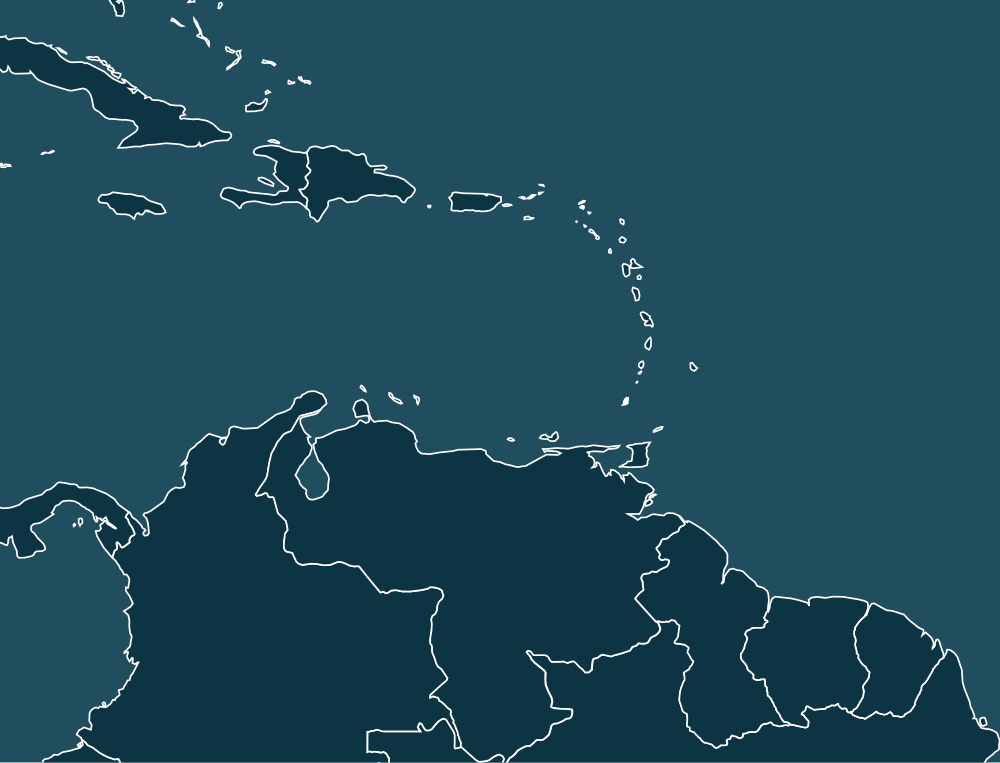
Situated in the southeastern Caribbean, Grenada is near Venezuela, Trinidad and Tobago, and Saint Vincent and the Grenadines, placing it alongside countries with notably different political and security conditions. Venezuela’s repression, humanitarian crisis, sanctions, and alleged evasion networks form the most significant source of regional instability, while Trinidad and Tobago faces gang violence, illicit trafficking, and economic exposure to Venezuela-related sanctions. Saint Vincent and the Grenadines remains comparatively stable, underscoring the varied pressures surrounding Grenada’s regional environment.
AML & Terrorist Financing
Grenada is not on the FATF list of jurisdictions with strategic AML deficiencies, yet it remains in enhanced follow-up, with identified exposure linked to fraud, theft, robbery, drug trafficking, foreign predicates, and aspects of its citizenship-by-investment framework. While the Financial Intelligence Unit, the AML/CTF Commission, the Eastern Caribbean Central Bank, and other authorities have established important safeguards, supervision, beneficial ownership access, DNFBP due diligence, STR coverage, and cross-border currency controls remain areas of concern. Terrorist financing and proliferation financing controls appear particularly underdeveloped, reflected in low-effectiveness findings, no recorded TF investigations or prosecutions, limited training and coordination, and gaps in targeted financial sanctions and asset-freezing mechanisms.
Sanctions
Grenada is required, as a UN member, to implement Security Council sanctions, including measures such as arms embargoes, travel bans, and financial restrictions, although no international sanctions are currently in force against Grenada itself. FATF assessments identify gaps in Grenada’s targeted financial sanctions and new-technology controls, creating potential exposure to schemes involving Iran, Venezuela, Russia, and Syria through offshore structures, intermediaries, ports, and cryptoassets. The example of Venezuelan state airline Conviasa’s former Caribbean routes offers a glimpse into the region-specific transit concerns, while the details of Grenada’s compliance obligations and vulnerabilities warrant closer examination.
Criminality
Grenada has a formal anti-corruption framework, including the Integrity in Public Life Act, the Integrity Commission, and reporting channels through the Financial Intelligence Unit and Office of the Ombudsman, although complaints and isolated bribery allegations point to continuing oversight concerns. Crime is generally characterized by localized gang activity, drug trafficking, human smuggling, cyber incidents, and financial scams, with the Royal Grenada Police Force and other authorities confronting vulnerabilities that include porous maritime routes and risks associated with the citizenship-by-investment program.
Reports
Grenada’s counternarcotics efforts include maritime interdiction and intelligence-led cooperation with CARICOM IMPACS, highlighted by a joint operation that intercepted more than 200 kilograms of cocaine. Wider regional initiatives involving the RSS, U.S.-supported technologies, and judicial coordination are strengthening responses, while limited resources, corruption risks, and gaps in treatment capacity remain significant concerns.
Industry/Product Sector Risk
Grenada’s industry profile spans a tourism-led economy, maritime trade, agriculture, construction, banking, money services, real estate, and professional services, with risk shaped by cash intensity, cross-border flows, and investment linked to the citizenship-by-investment programme. Higher-risk areas include retail banking, money remitters, hospitality, transportation and storage, politics, and public works, while sectors such as securities dealing, virtual currencies, and precious metals remain more limited or currently inactive. Oversight involving the ECCB, FIU, AML/CFT Commission, GARFIN, Casino Gaming Commission, Eastern Caribbean Securities Regulatory Commission, and Integrity Commission provides important context for understanding vulnerabilities involving fraud, drug trafficking, corruption, tax offences, and beneficial-ownership opacity.
Economy & Investment Climate
Grenada’s economy is service-led and anchored by tourism, with agriculture, light industry, remittances, and emerging renewable-energy opportunities adding breadth to a small but stable market supported by the Eastern Caribbean dollar’s U.S. dollar peg. The Grenada Investment Development Corporation and Customs and Inland Revenue Department help underpin an incentive-oriented investment environment, although limited scale, exposure to natural disasters, infrastructure and administrative constraints, and dependence on imported goods remain important considerations.
Cryptocurrency Regulations
Grenada permits virtual asset activity under its 2021 Virtual Asset Business Act, with GARFIN overseeing registration, AML/CFT controls, and exchange compliance, though cryptocurrencies remain outside legal tender status. The framework provides notable structure—including KYC expectations and a stated EC$12,500 registration fee—while leaving important questions around the Travel Rule, token offerings, tax treatment, and market supervision open to further clarification.
Get full access
The information on this page is a brief summary. Get access to EDD country reports, all risk category scores and customisable weightings for 245 jurisdictions.