
Risk Indicators
- FATF/EU Blacklist/Greylist (Lower Concern)
- Terrorism Financing (Lower Concern)
- US Dept of State INCSR
- Proliferation Financing
- Corruption
- Criminality
- Resilience & Governance
- Financial Transparency
- Offshore Finance Centres
- Sanctions
Background
Guatemala’s history extends from the flourishing Maya civilization of the first millennium A.D. through nearly three centuries of Spanish rule and independence in 1821. The country later moved through alternating military and civilian governments before enduring a 36-year guerrilla conflict that formally ended with the 1996 peace agreement. This historical context continues to intersect with regional pressures involving security, governance, and illicit activity.
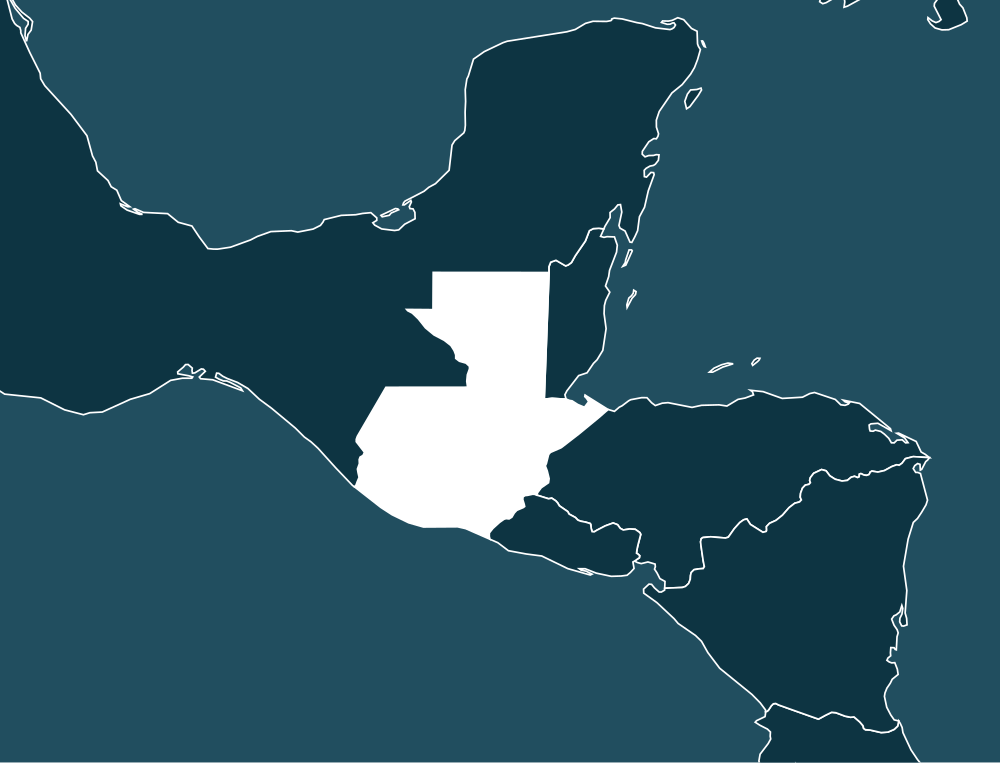
Bordering Mexico, Belize, Honduras, and El Salvador, Guatemala is situated within a region shaped by organized crime, trafficking, corruption, and uneven state capacity. Its unresolved territorial dispute with Belize, currently before the International Court of Justice, exists alongside cross-border networks and vulnerabilities affecting arms, money, and goods. Targeted measures associated with the United States, European Union, Canada, and the Engel List further highlight the regional significance of sanctions, democratic concerns, and enforcement gaps.
AML & Terrorist Financing
Guatemala has established a broad AML/CFT framework and is not listed by FATF as having strategic deficiencies, yet the 2018 evaluation found uneven effectiveness and continuing gaps in implementation. Drug trafficking, illicit cash movement, smuggling, extortion, corruption, and opaque ownership structures remain important concerns, particularly across sectors such as real estate, construction, ranching, casinos, and certain professional services. The IVE and Public Ministry play central roles, but limited beneficial-ownership information, incomplete coverage of higher-risk activities, legislative delays, weak sanctions, and the absence of meaningful terrorist-financing investigations continue to pose challenges.
Sanctions
Guatemala supports applicable United Nations sanctions regimes but is not identified as maintaining significant autonomous sanctions against other nations. It faces targeted measures from the United States through OFAC, the EU and Switzerland, the United Kingdom, and Canada, including asset freezes, travel or visa restrictions, and transaction or dealings bans directed at individuals and entities linked to corruption, human rights abuses, or attacks on democratic processes. Designations involving figures such as Alberto Pimentel Mata, Alejandro Giammattei, María Consuelo Porras, and others—as well as OFAC’s treatment of MS-13—illustrate the primarily individual-focused nature of these restrictions, with no comprehensive trade or arms embargo currently identified.
Criminality
Corruption remains deeply rooted in Guatemala, particularly in public procurement and customs, where allegations of bribery, nepotism, and opaque transactions persist despite mechanisms such as Guatecompras and reforms by the Tax and Customs Authority (SAT). Although CICIG previously exposed major schemes, including customs graft, subsequent investigations have been weakened, while the Public Ministry has pursued few cases and made no arrests over SAT’s B410 tax-fraud findings; meanwhile, organized criminal networks, state-linked actors, and illicit markets continue to affect areas ranging from drug trafficking and human smuggling to financial and environmental crime.
Reports
Under President Bernardo Arévalo, Guatemala intensified cooperation with U.S.-vetted units and agencies including SGAIA, producing sharply higher narcotics seizures and new activity against precursor chemicals, while porous borders, corruption, and limited institutional coordination remain significant concerns. Guatemala stayed on Tier 2 for trafficking in persons, with increased victim identification, investigations, and shelter capacity alongside persistent vulnerabilities affecting children, migrants, and workers in sectors such as agriculture, domestic service, and manufacturing, as well as gaps in regional services and official accountability.
Industry/Product Sector Risk
Guatemala’s financial and business landscape shows concentrated exposure across cash-intensive activities, with casinos, money remitters, real estate, retail banking, and transportation and storage presenting especially notable vulnerabilities. Informality, cross-border flows, limited beneficial-ownership transparency, and trade- or property-related transactions create avenues for proceeds linked to drug trafficking, extortion, smuggling, corruption, and public-sector embezzlement to enter the legitimate economy. The Superintendence of Banks, specialized prosecutorial units, and international commissions feature within a broader control environment where some sectors have established safeguards while others remain lightly supervised or lack reliable records.
Economy & Investment Climate
Guatemala, Central America’s largest economy, combines steady growth, rising foreign investment, and a broadening reform agenda supported by CAFTA-DR and initiatives such as the National Strategy for Attracting Foreign Direct Investment. Opportunities span manufacturing, services, energy, and trade, though investors must weigh complex administration, uneven legal enforcement, corruption, infrastructure needs, and labor and environmental concerns highlighted by institutions including ProGuatemala, SAT, Banguat, and the SIB.
Cryptocurrency Regulations
Cryptocurrency in Guatemala occupies a largely unregulated space: it is not legal tender, yet virtual assets and service providers are not prohibited or subject to dedicated licensing, taxation, or exchange rules. The Central Bank, Superintendencia de Bancos, and Unit of Financial Intelligence operate within broader financial-crime frameworks, while Bill No. 5820 and evolving FATF-related expectations may shape a still-uncertain future for digital wallets, tokens, and trading platforms.
Get full access
The information on this page is a brief summary. Get access to EDD country reports, all risk category scores and customisable weightings for 245 jurisdictions.