
Risk Indicators
- FATF/EU Blacklist/Greylist (Lower Concern)
- Terrorism Financing (Medium Concern)
- US Dept of State INCSR
- Proliferation Financing
- Corruption
- Criminality
- Resilience & Governance
- Financial Transparency
- Offshore Finance Centres
- Sanctions
Background
Guinea’s history reflects successive layers of Islamic influence, regional empire-building, smaller kingdoms, and French colonial rule, with the Fulani state in central Guinea standing out for its written constitution and alternating leadership. Independence from France in 1958 ushered in decades of authoritarian rule under Sekou TOURE and Lansana CONTE, followed by further military intervention after CONTE’s death. A brief period of competitive elections and civilian administration under Alpha CONDE ended with the 2021 coup led by Col Mamady DOUMBOUYA, whose CNRD suspended the constitution and dissolved the government and legislature.
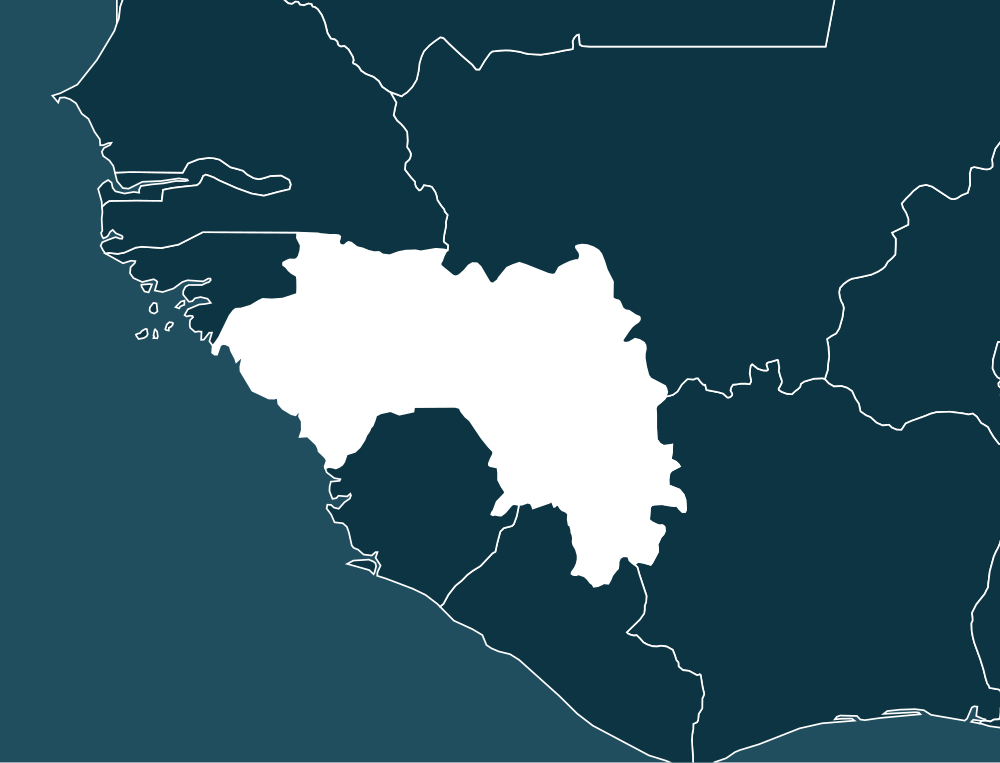
Today, Guinea’s transition is administered through a military-led structure that includes Mohamed BEAVOGUI as transition prime minister and the appointed National Transition Council as its legislative body. Its six neighbors present a varied regional backdrop, ranging from Mali’s extremist conflict, junta rule, and extensive sanctions exposure to the comparatively lower-risk post-conflict environments of Sierra Leone and Liberia. Political uncertainty and sanctions-related concerns are particularly pronounced around Guinea-Bissau, while Senegal and Côte d’Ivoire combine relative stability with unresolved tensions, security pressures, or targeted international measures.
AML & Terrorist Financing
Guinea has strengthened its AML/CFT framework through the 2021 law and institutions such as CENTIF, CRIEF, and AGRASC, yet the 2023 assessment found low effectiveness across all eleven outcome areas despite a number of technically compliant recommendations. Cash usage, financial exclusion, informal activity, porous borders, corruption, and limited understanding of national risk findings continue to complicate detection, investigations, confiscation, beneficial ownership transparency, and coordination beyond the banking sector supervised by the BCRG. Terrorist-financing and proliferation-financing controls remain particularly uncertain, with limited investigations, no recorded convictions, an inactive CCGA, weak risk-based oversight of NPOs, and ineffective dissemination of sanctions lists.
Sanctions
Guinea has no identified autonomous sanctions regime against other nations, but as a UN member it is expected to implement applicable Security Council measures, including those concerning North Korea. Regional pressure following the 2021 coup was lifted by ECOWAS on January 28, 2026, while targeted restrictions linked to the 2009 violence and other conduct remain associated with OFAC, the EU under Council Regulation (EU) No 1284/2009, the UK’s 2019 regulations, and Switzerland. These measures generally focus on asset freezes and travel bans rather than broad trade embargoes, with named US designations including Alpha Condé, Ali Saade, and Ibrahim Taher, alongside continuing scrutiny of Guinea’s alleged facilitation of North Korean military cooperation.
Criminality
Guinea continues to face entrenched corruption, with bribery commonly reported in public services and concerns surrounding opaque land sales, business contracts, and diversion of public funds. Although the ANLC and the Court to Repress Economic and Financial Crimes have pursued cases, limited resources, few convictions, weak asset-declaration compliance, and alleged links between state actors and illicit markets continue to complicate enforcement.
Reports
Guinea remains on Tier 2 as authorities have adopted an anti-trafficking law, introduced mining regulations addressing child labor and labor trafficking, increased convictions and victim identification, yet still face shortcomings in referrals, services, and institutionalized training. Children and adults continue to face exploitation in domestic service, begging, mining, agriculture, fishing, and sex trafficking, with risks extending from Conakry and mining regions through migration routes and overseas destinations.
Industry/Product Sector Risk
Guinea’s industry landscape is shaped by a predominantly cash-based and informal economy, with mining, real estate, transport, public works, currency exchange, remittances, and mobile money presenting particularly significant exposure to illicit financial flows. Across banks, DNFBPs, and other sectors, vulnerabilities include limited customer and beneficial ownership information, weak supervision, informal operators, and uneven implementation of AML/CFT controls, while corruption, illegal mining, fraud, tax offences, smuggling, and related crimes recur as major sources of risk. Recent institutional developments, including the Gaming and Related Practices Regulatory Authority, the FIU’s supervisory role, and the specialised Court for the Repression of Economic and Financial Offences, provide important clues to the evolving control environment.
Economy & Investment Climate
Guinea presents significant investment potential anchored by exceptional bauxite, gold, iron ore, and other natural resources, while initiatives such as Simandou 2040 and APIP’s investor services seek to encourage diversification into agriculture, infrastructure, finance, energy, and technology. The transition-era environment combines openness to foreign investment and ongoing administrative reforms with political uncertainty, limited institutional capacity, opaque procedures, infrastructure constraints, difficult access to finance, and a business climate where regulatory and legal outcomes can be slow and unpredictable.
Cryptocurrency Regulations
Cryptocurrency in Guinea occupies an uncertain space: it is not legal tender and lacks dedicated rules for exchanges, tokens, taxation, or VASPs, while the BCRG and CRF apply broader AML/KYC expectations under Money Laundering Law No. L/2006/010/AN. With no compliance registry, documented crypto risk assessment, or clear adoption of measures such as the FATF Travel Rule, participants must navigate a largely undefined framework shaped by international standards and possible future regulation.
Get full access
The information on this page is a brief summary. Get access to EDD country reports, all risk category scores and customisable weightings for 245 jurisdictions.