
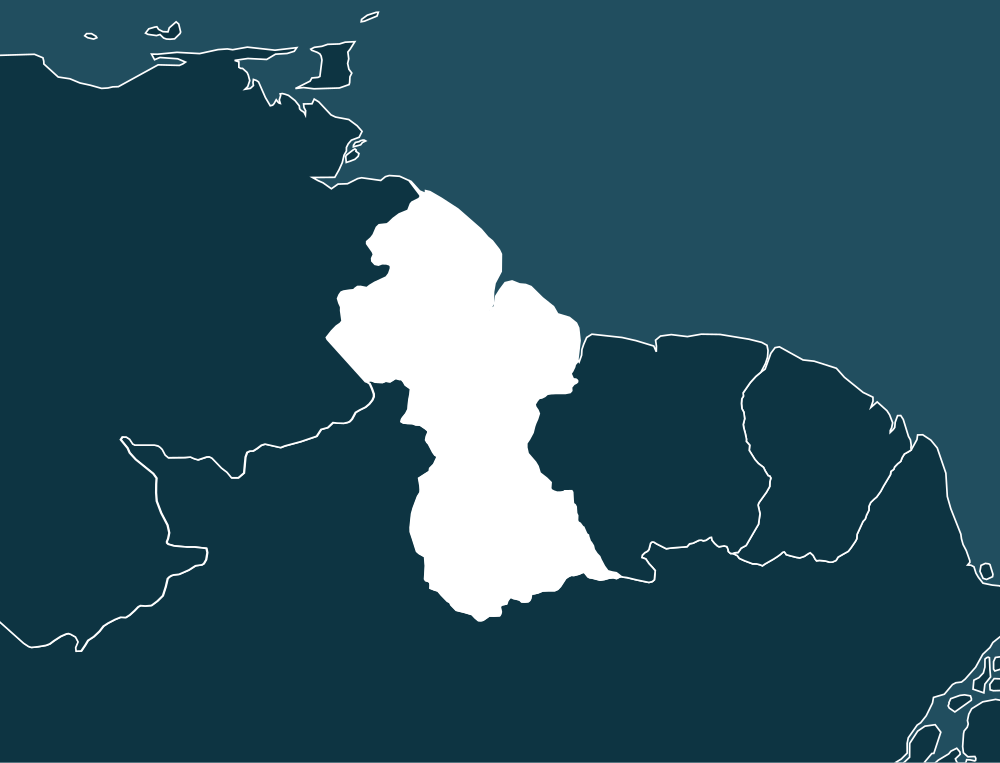
Risk Indicators
- FATF/EU Blacklist/Greylist (Lower Concern)
- Terrorism Financing (Lower Concern)
- US Dept of State INCSR
- Proliferation Financing
- Corruption
- Criminality
- Resilience & Governance
- Financial Transparency
- Offshore Finance Centres
- Sanctions
Background
Guyana’s history reflects Dutch and British colonial rule, emancipation, Indian indentureship, and an enduring ethnocultural divide that has shaped its turbulent politics. Since independence in 1966, power has passed through several socialist-oriented administrations and major political transitions, including the presidencies of Cheddi JAGAN, Janet JAGAN, Bharrat JAGDEO, David GRANGER, and Irfaan ALI. The discovery of massive offshore oil reserves in 2015 has since become central to expectations for economic transformation in one of the region’s poorest countries.
As South America’s only English-speaking country, Guyana maintains distinctive cultural and historical ties with the Anglophone Caribbean while navigating a challenging neighborhood. Venezuela presents the most acute concern through political repression, extensive US, EU, and UK sanctions, oil-sector evasion networks, and a border dispute, while Suriname brings risks linked to instability, corruption, illicit finance, and sanctioned commercial activity. Brazil is less associated with direct conflict or sanctions, though porous borders contribute to smuggling involving gold and drugs.
AML & Terrorist Financing
Guyana has made notable progress in strengthening its AML/CFT framework and is no longer subject to FATF monitoring, yet the 2024 evaluation still points to uneven effectiveness, particularly in supervision, beneficial ownership, confiscation, international cooperation, and terrorist-financing controls. Risks remain linked to drug trafficking, gold smuggling, tax evasion, corruption, cash-based activity, and the country’s expanding extractive industries, with agencies such as the FIU, SOCU, GRA, Guyana Gold Board, and GGMC playing central but differently developed roles. Terrorist-financing investigations and convictions remain limited, while delays in sanctions implementation, gaps affecting NPO oversight, low reporting from several non-financial sectors, and continuing enforcement constraints leave important questions around practical results.
Sanctions
Guyana supports United Nations Security Council sanctions regimes, including measures involving financial restrictions, arms controls, travel bans, and other non-military enforcement tools. No international sanctions are currently in force against Guyana as a state, although U.S. OFAC actions under Executive Orders 13818 and 14059 have targeted Guyanese nationals and businesses, including the Mohamed family and associated entities. The country’s gold trade and shipping registry have nevertheless featured in sanctions-evasion concerns, highlighted by the fraudulent Guyana flagging of the OFAC-listed M/T Skipper and the subsequent action by Guyana’s maritime authority to notify the IMO of its de-listing.
Criminality
Guyana continues to face corruption and criminal activity spanning public procurement, financial schemes, drug trafficking, human exploitation, illegal mining, and cyberattacks, with informal networks and weak oversight complicating enforcement. The Auditor General’s 2023 findings pointed to procurement breaches and overpayments, while the Integrity Commission and National Coordinating Committee on Anti-corruption remain central to an institutional response criticized for limited investigative capacity and slow prosecutions.
Reports
Guyana is strengthening cooperation with the United States, CARICOM, and regional security partners as cocaine trafficking expands through its coast, waterways, airstrips, and legitimate cargo networks, highlighted by major 2024 seizures involving the Guyana Defence Force and Joint Interagency Task Force. Alongside drug-control challenges involving limited resources, corruption, and domestic marijuana use, the Ministry of Human Services and Social Security and other agencies are addressing trafficking through prosecutions, victim services, and awareness efforts, while vulnerabilities remain among migrants, Indigenous communities, and workers in remote mining and other sectors.
Industry/Product Sector Risk
Guyana’s financial and commercial landscape is shaped by a largely cash-based economy, substantial cross-border activity, and fast-moving growth in mining, oil and gas, construction, and real estate. Particular attention surrounds gold and mineral channels overseen by the Guyana Gold Board and Guyana Geology and Mines Commission, alongside banks supervised by the Bank of Guyana, money transfer agencies, cambios, casinos, and professional intermediaries. As newer frameworks develop through bodies such as the Gaming Authority, Guyana Revenue Authority, and Compliance Commission, vulnerabilities involving beneficial ownership, corruption, smuggling, trade-based transactions, and uneven AML/CFT supervision remain significant areas for deeper examination.
Economy & Investment Climate
Guyana’s economy is undergoing an extraordinary oil-fueled expansion, with offshore production, the Natural Resource Fund, and the planned gas-to-energy project reshaping national wealth while highlighting the need to diversify beyond extractive exports. Opportunities across agriculture, manufacturing, ICT, tourism, and infrastructure are supported by the Guyana Office for Investment, yet investors must navigate local-content rules, skills shortages, costly electricity, land and financing constraints, and complex processes involving agencies such as the GRA and the Local Content Secretariat.
Cryptocurrency Regulations
Guyana’s cryptocurrency landscape remains cautious and ambiguous, with the Bank of Guyana warning of risks while the AML/CFT framework and 2023 Compliance Commission Act provide only partial direction rather than a dedicated digital-asset regime. With commercial virtual-asset activity paused through December 31, 2025, and the Guyana Revenue Authority offering no specific guidance on taxation, exchanges, tokens, or offerings, users and investors face substantial uncertainty as the country undergoes CFATF evaluation.
Get full access
The information on this page is a brief summary. Get access to EDD country reports, all risk category scores and customisable weightings for 245 jurisdictions.