
Risk Indicators
- FATF/EU Blacklist/Greylist (Higher Concern)
- Terrorism Financing (Medium Concern)
- US Dept of State INCSR
- Proliferation Financing
- Corruption
- Criminality
- Resilience & Governance
- Financial Transparency
- Offshore Finance Centres
- Sanctions
Background
Iraq’s modern history has been shaped by the end of Ottoman and British rule, successive periods of strongman governance, and major conflicts involving Iran, Kuwait, and the United States-led coalition. Since 2003, the country has pursued a constitutional political order centered on the Council of Representatives, with the Kurdistan Regional Government administering three northern governorates. Although victory over ISIS was declared in 2017, security operations and unresolved disputes between Baghdad and the KRG continue to influence Iraq’s political landscape.
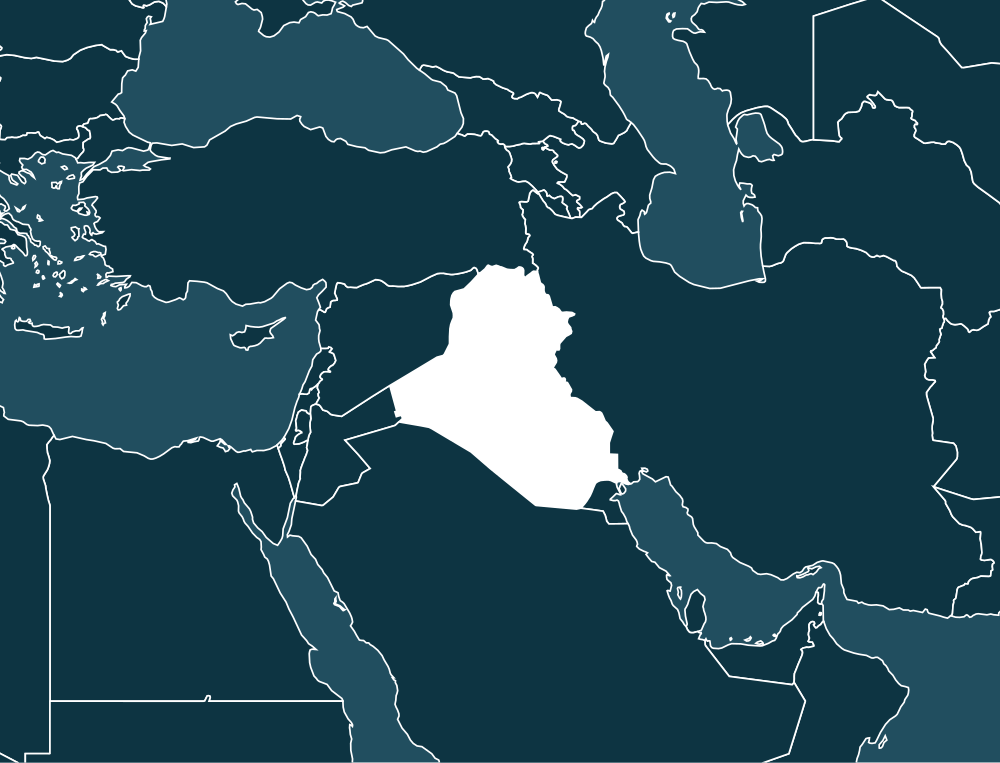
Iraq’s position between Iran, Syria, Turkey, and the comparatively stable states of Saudi Arabia, Jordan, and Kuwait exposes it to overlapping conflicts, border pressures, and regional rivalries. Particular scrutiny surrounds the country’s financial and energy links with Iran, including allegations involving Rafidain Bank and Al-Huda Bank, while instability along the Syrian border creates additional concerns over smuggling and militant movements. Turkey’s operations against the PKK in northern Iraq add another layer of tension, leaving Baghdad under pressure to manage both domestic institutions and a complicated sanctions environment.
AML & Terrorist Financing
Iraq’s AML/CFT framework has a substantial legal and institutional foundation, but persistent reliance on cash, informal hawala networks, corruption, cross-border smuggling, and uneven supervisory capacity continue to create significant exposure. Following its June 2026 FATF listing, Iraq has committed to addressing weaknesses involving risk understanding, suspicious transaction reporting, beneficial ownership, targeted financial sanctions, and the investigation and prosecution of money laundering and terrorist financing, with particular attention to risks beyond ISIL. The Central Bank of Iraq and its AML/CFT Office have supported notable reforms, yet gaps remain across non-bank institutions, DNFBPs, NPO oversight, proliferation-financing controls, and coordination among agencies including customs, law enforcement, and the judiciary.
Sanctions
Iraq’s sweeping UN sanctions regime following the 1990 invasion of Kuwait has largely given way to targeted restrictions involving arms controls, former-regime assets, cultural property, and related financial requirements. Measures administered through UN Security Council resolutions and reflected in programs such as U.S. OFAC Executive Orders 13315 and 13438, EU Regulation 1210/2003, and the UK’s Iraq (Sanctions) (EU Exit) Regulations 2020 continue to affect designated individuals, entities, and transactions. No significant sanctions imposed by Iraq on other nations are identified, although Iraqi ports, banks, oil networks, and agencies linked to the former regime have featured in alleged evasion schemes involving Iran and other countries.
Criminality
Iraq faces pervasive corruption across procurement, licensing, customs, payrolls, and dispute settlement, with bribery, kickbacks, politically connected businesses, and port extortion compounded by opaque records and a largely cash-based economy. Organized criminal activity includes trafficking in people, arms, drugs, oil, and illicit financial flows, while the Commission of Integrity, Board of Supreme Audit, and Kurdistan Region oversight bodies continue investigating cases amid allegations involving senior officials and politically linked networks.
Reports
Iraq is confronting expanding synthetic-drug activity, including a dramatic rise in Captagon seizures and early indications of domestic production, while the General Directorates of Anti-Narcotics in Erbil and Sulaymaniyah point to possible clandestine laboratories near border areas and cities. At the same time, the Central Committee to Combat Human Trafficking faces persistent protection gaps affecting displaced people, migrants, women, and children, as ISIS remnants and Iran-aligned militia groups remain security concerns despite fewer terrorist attacks and continued Iraqi cooperation with international partners.
Industry/Product Sector Risk
Iraq’s industry landscape presents pronounced exposure to money laundering and terrorism financing through cash-heavy commerce, informal value-transfer channels, cross-border transportation, oil and derivatives smuggling, and conflict-linked activities. High-risk concerns are especially associated with arms and military activity, politics, oil and gas, public works and construction, and transportation and storage, while corruption, procurement abuse, tax and customs evasion, fraud, and terrorist financing recur across sectors. The NGOs Department’s risk-based oversight of charities and the expanding role of supervised e-payment and telecommunications services point to developing controls, although several areas—including civilian aerospace, education, fisheries, forestry, marketing, media and entertainment, mining, outsourcing, and sport—receive little or no sector-specific treatment.
Economy & Investment Climate
Iraq’s state-led, oil-dependent economy offers substantial opportunities in energy, electricity, infrastructure, technology, and consumer markets, supported by initiatives from the National Investment Commission, Central Bank of Iraq, and Kurdistan Board of Investment. At the same time, shifting regulations, state-owned enterprise dominance, limited financing, administrative complexity, security risks, and unresolved Baghdad–Erbil hydrocarbons and payment disputes continue to make market entry and investment highly challenging.
Cryptocurrency Regulations
Iraq’s cryptocurrency landscape remains marked by caution and uncertainty, with Central Bank of Iraq warnings, a 2017 prohibition on bank-related crypto activity, and no clear framework for legal tender, exchanges, VASPs, or token offerings. Although Anti-Money Laundering and Countering Terrorist Financing Law No. 39 of 2015 provides a broader compliance backdrop involving the Financial Intelligence Unit, taxation, transaction tracking, ICOs, and consumer protections remain largely undefined.
Get full access
The information on this page is a brief summary. Get access to EDD country reports, all risk category scores and customisable weightings for 245 jurisdictions.