
Risk Indicators
- FATF/EU Blacklist/Greylist (Lower Concern)
- Terrorism Financing (Lower Concern)
- US Dept of State INCSR
- Proliferation Financing
- Corruption
- Criminality
- Resilience & Governance
- Financial Transparency
- Offshore Finance Centres
- Sanctions
Background
Ireland’s history reflects layers of Celtic, Norse, Norman, and Anglo-Irish influence, followed by famine-driven population loss and a later emergence as one of the European Union’s youngest societies. The modern state grew from the 1916 Easter Rising, independence in 1921, partition, and the Irish Civil War, with Fine Gael and Fianna Fáil tracing their roots to the treaty dispute. The republic’s subsequent path included military neutrality, European integration, and the economic transformation—and later banking crisis—associated with the Celtic Tiger.
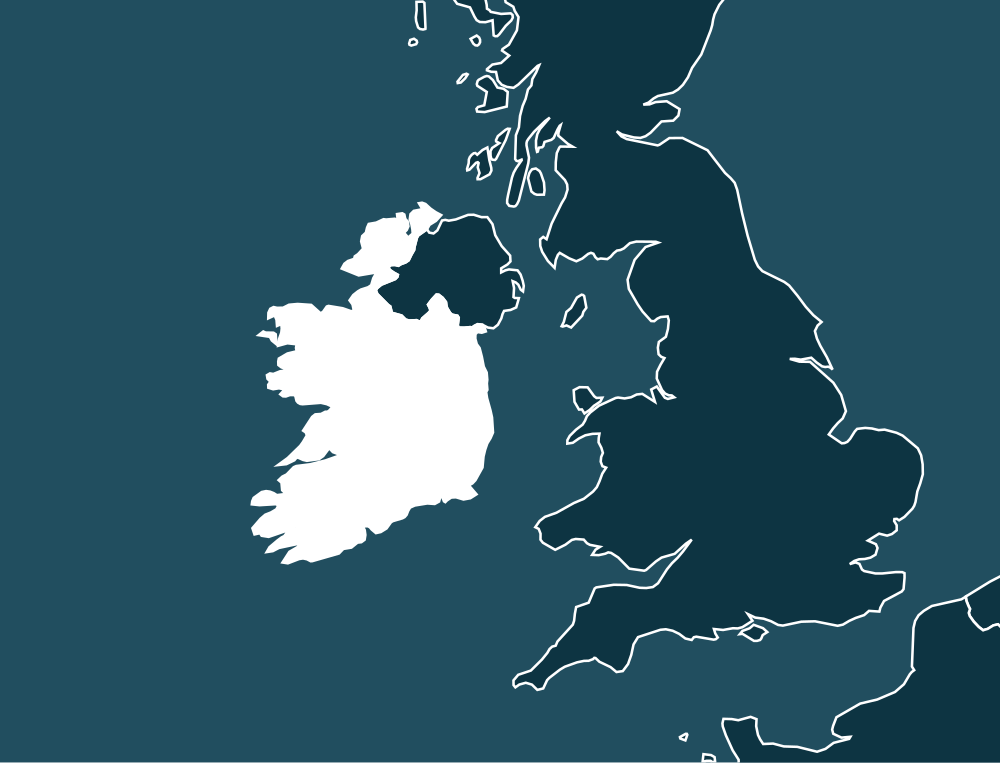
Ireland’s sole land border is with the United Kingdom through Northern Ireland, where the Belfast/Good Friday Agreement ushered in a more cooperative era without eliminating all security concerns. Residual paramilitary activity, social unrest, organized crime, cyber threats, and terrorism-related risks remain part of the wider British security environment, alongside sanctions administered through the Office of Financial Sanctions Implementation. Ireland itself is not identified as facing an armed conflict with its neighbor or as a primary center for international sanctions evasion, though developments across the border retain clear relevance.
AML & Terrorist Financing
Ireland has a broadly sound AML/CFT framework and remains outside the FATF list of jurisdictions with strategic deficiencies, yet its role as an interconnected financial centre leaves continuing questions around international risks, complex ownership structures, gatekeepers, and supervision of higher-risk non-financial sectors. Although the Central Bank of Ireland, Garda National Economic Crime Bureau, Financial Intelligence Unit, Criminal Assets Bureau, and Corporate Enforcement Authority contribute to a substantial institutional network, limitations have been noted in resources, financial analysis, beneficial ownership access, and the conversion of intelligence into complex money-laundering prosecutions and confiscation results. Terrorist-financing risks are generally viewed as comparatively low but evolving, with no TF prosecutions or convictions identified, while delays in targeted financial sanctions and vulnerabilities involving charities and other non-profit organisations add areas requiring continued attention.
Sanctions
Ireland enforces UN and EU restrictive measures domestically, with particular attention to measures concerning Russia, Iran, Belarus, and North Korea, covering areas such as finance, energy, dual-use goods, shipping, and targeted individuals or entities. The Central Bank of Ireland oversees compliance, transaction monitoring, reporting, and authorization requirements, while recent actions—including a €21,464,734 penalty against Coinbase Europe Limited and an earlier fine against a Dublin stockbrokers firm—signal increasing scrutiny of sanctions-related controls and evasion risks. No international sanctions are currently in force against Ireland, although its financial system remains exposed to complex circumvention networks involving shell companies, offshore jurisdictions, and third-country transit routes.
Criminality
Corruption is generally not viewed as a major barrier to investment, with the Criminal Justice (Corruption Offences) Act 2018, whistleblower protections, and agencies including An Garda Síochána, the Director of Public Prosecutions, and the Criminal Assets Bureau forming a substantial enforcement framework, though some public concern persists. Ireland nevertheless faces significant criminal-market pressures, including drug trafficking and consumption, human trafficking and smuggling, arms and counterfeit-goods trade, paramilitary-linked fuel laundering, organized-crime activity, and rising cyber-enabled financial crime.
Reports
Ireland has strengthened its response to human trafficking through increased investigations, convictions, victim identification, funding, and the creation of a statutory framework for a revised National Referral Mechanism, while significant gaps remain in labor-trafficking convictions, child and national-victim identification, accommodation, judicial training, and compensation. Counterterrorism efforts have involved An Garda Síochána, the Garda Special Branch, the Criminal Assets Bureau, and cross-border cooperation with the United Kingdom, combining disruption of dissident republican activity with enhanced border security, financial oversight, community engagement, and measures addressing violent extremism.
Industry/Product Sector Risk
Ireland’s financial and professional services landscape presents varied exposure, with retail banking, investment funds, electronic money, remittance, gaming, and cash-intensive businesses attracting particular attention alongside property and high-value goods activity. The Central Bank, Department of Justice, Property Services Regulatory Authority, and designated accountancy bodies each feature in the supervisory picture, while cross-border structures, agents, digital channels, and beneficial-ownership challenges recur across sectors. Beyond finance, risks touch agriculture, hospitality, technology, construction, telecommunications, and transport through cash commingling, fraud, smuggling, organised crime, and selected terrorist-financing concerns.
Economy & Investment Climate
Ireland combines a highly internationalized, export-oriented economy with strong U.S. investment, particularly in pharmaceuticals, med-tech, technology, digital services, and financial services, supported by EU market access, a skilled English-speaking workforce, and agencies such as IDA Ireland and Enterprise Ireland. Continued growth prospects are tempered by tight labor conditions, elevated operating and housing costs, infrastructure and planning constraints, and mounting energy pressures affecting areas such as data-center expansion, while the OECD Economic Survey of Ireland and the Central Bank of Ireland provide further insight into the country’s evolving economic landscape.
Cryptocurrency Regulations
Ireland permits cryptocurrency activity without recognizing it as legal tender, while the Central Bank of Ireland requires Virtual Asset Service Providers to register and meet evolving AML/CFT, KYC, and transaction-tracing obligations. Tax treatment through the Irish Revenue Commissioners, a 33% Capital Gains Tax framework, MiCAR developments, and forthcoming CARF commitments point to a market becoming more structured—though consumer warnings and significant compliance risks remain.
Get full access
The information on this page is a brief summary. Get access to EDD country reports, all risk category scores and customisable weightings for 245 jurisdictions.