
Risk Indicators
- FATF/EU Blacklist/Greylist (Lower Concern)
- Terrorism Financing (Medium Concern)
- US Dept of State INCSR
- Proliferation Financing
- Corruption
- Criminality
- Resilience & Governance
- Financial Transparency
- Offshore Finance Centres
- Sanctions
Background
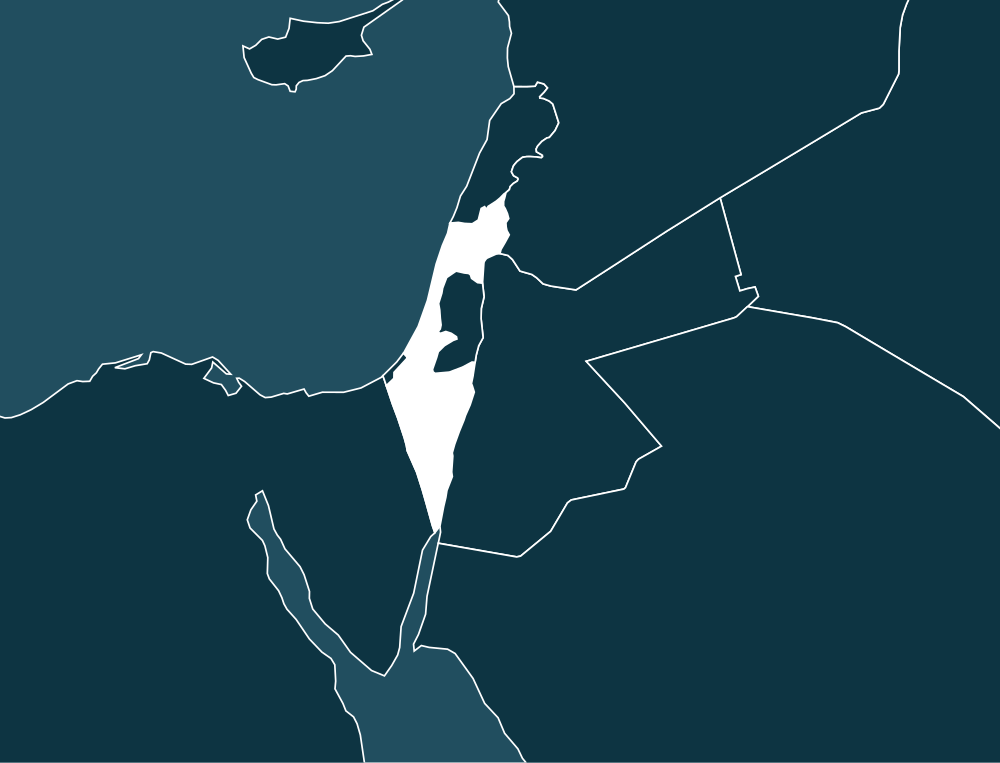
Established in 1948 following the UN General Assembly’s partition proposal, Israel developed amid successive wars, territorial changes, refugee-driven population growth, and evolving agreements with neighboring states and Palestinian representatives. Its modern political landscape has been shaped by Benjamin Netanyahu’s repeated premierships, the Abraham Accords, and the continuing administration of territories captured in 1967, alongside the Palestinian Authority’s limited self-rule arrangements. The 7 October 2023 Hamas attack and Israel Defense Forces’ subsequent operations in Gaza further transformed the country’s security environment.
Israel’s economic rise has been driven by advanced technology, defense capabilities, and Mediterranean gas discoveries, though housing costs, inequality, productivity, and workforce participation remain significant concerns. Its borders reflect sharply different conditions, from Hezbollah-linked confrontation and sanctions-related financial networks involving Al-Qard Al-Hassan in Lebanon to Iranian-backed activity and illicit trade connected to Syria. Egypt and Jordan retain formal peace, while Gaza and the West Bank remain central to conflict, political instability, and efforts to circumvent restrictions through tunnels, cryptocurrency, and informal channels.
AML & Terrorist Financing
Israel is not identified by FATF as having strategic AML deficiencies, and its 2022 follow-up showed a generally strong framework with notable effectiveness in financial intelligence, investigations, confiscation, and terrorist-financing disruption. Key risks include fraud, tax offences, organised crime, cash and money-service businesses, complex corporate structures, and externally sourced terrorist financing, with IMPA, Shin-Bet, the Israel National Police, and the Israel Tax Authority playing central roles. Important vulnerabilities remain around risk-based supervision, certain DNFBPs, nonprofit-sector coordination, preventive controls, beneficial-ownership transparency, and the timely delivery of international assistance—areas that merit closer examination.
Sanctions
Israel does not appear to face comprehensive international sanctions, but targeted measures by the EU, UK, Canada, Australia, Japan, New Zealand, Norway, and others have focused on settlers, settlement-linked organizations, and officials including Itamar Ben-Gvir and Bezalel Smotrich, while the United States revoked its OFAC West Bank designations in January 2025. A Hague Group initiative, Arab League boycott actions, partial weapons restrictions, suspended trade talks, and proposed European measures add pressure, although no UN-mandated arms embargo or broad trade embargo is in force. Israel has also aligned aspects of its regulatory framework with U.S. and European restrictions—particularly concerning Russia—while scrutiny of Israeli banks, charities, fintech platforms, and asset-transit channels highlights continuing enforcement concerns; no substantial Israeli sanctions against other nations are specifically identified.
Criminality
Israel maintains laws and institutions addressing corruption, with the Israeli National Police, State Comptroller, Attorney General, and Accountant General described as operating effectively and independently, while political figures nevertheless face allegations involving fraud and bribery. Crime concerns include entrenched mafia-style groups, human trafficking, illicit arms and drug markets, sophisticated online fraud and phishing, and a growing cybercrime sector, with additional allegations of state-embedded involvement in diamond-related activity and cyber-surveillance.
Reports
Israel’s security environment remained shaped by a widening regional conflict, with 103 Israelis and foreigners killed in terrorist attacks during 2024, direct Iranian barrages, clashes involving Hamas and Hizballah, and intensified West Bank operations, while the Knesset also acted against UNRWA and the Israel Money Laundering and Terror Financing Prohibition Authority continued its international financial-security role. At the same time, the country remained Tier 2 for trafficking concerns as the Government of Israel expanded victim services, recruitment safeguards, and enforcement resources, yet persistent vulnerabilities affected Palestinian workers, foreign caregivers, agricultural students, asylum-seekers, and women and children exposed to online-facilitated sexual exploitation and forced labor.
Industry/Product Sector Risk
Israel’s industry risk landscape is shaped by elevated exposure in arms and security-linked activities, cash-intensive businesses, and cross-border transportation, with smuggling, trade-based laundering, and terrorism financing recurring concerns. Medium-risk areas include charities and NPOs overseen in part by the Israel Companies Authority (ICA), hospitality, consumer services, politics, construction, and real estate, where cash, opaque ownership, fictitious invoicing, corruption, and misuse of funds create varied vulnerabilities. Technology-linked fraud—particularly binary options and related online schemes—also illustrates how platforms, international marketing, complex companies, and financial channels can combine to move illicit proceeds, while several other industries have limited publicly identified risk detail.
Economy & Investment Climate
Israel combines a highly educated, entrepreneurial workforce with a globally connected, innovation-led economy, as reflected in the high-tech sector’s substantial role in employment, GDP, and exports and the involvement of the Israel Innovation Authority. Although the conflicts in Gaza and Lebanon slowed growth and increased fiscal pressures, the country remains broadly open to foreign investment, supported by institutions such as the Bank of Israel and the Ministry of Economy and Industry, while monopolies, labor shortages, regulatory complexities, and security considerations continue to shape commercial prospects.
Cryptocurrency Regulations
Israel permits cryptocurrency activity within an evolving framework that treats digital assets primarily as financial assets rather than legal tender, with licensing, AML/KYC controls, and capital-gains taxation shaping participation. Oversight is shared among bodies including the Capital Market Authority, Israeli Securities Authority, Israel Tax Authority, Bank of Israel, and IMPA, while token offerings, exchange operations, transaction reporting, and future CARF implementation remain areas of active development.
Get full access
The information on this page is a brief summary. Get access to EDD country reports, all risk category scores and customisable weightings for 245 jurisdictions.