
Risk Indicators
- FATF/EU Blacklist/Greylist (Lower Concern)
- Terrorism Financing (Lower Concern)
- US Dept of State INCSR
- Proliferation Financing
- Corruption
- Criminality
- Resilience & Governance
- Financial Transparency
- Offshore Finance Centres
- Sanctions
Background
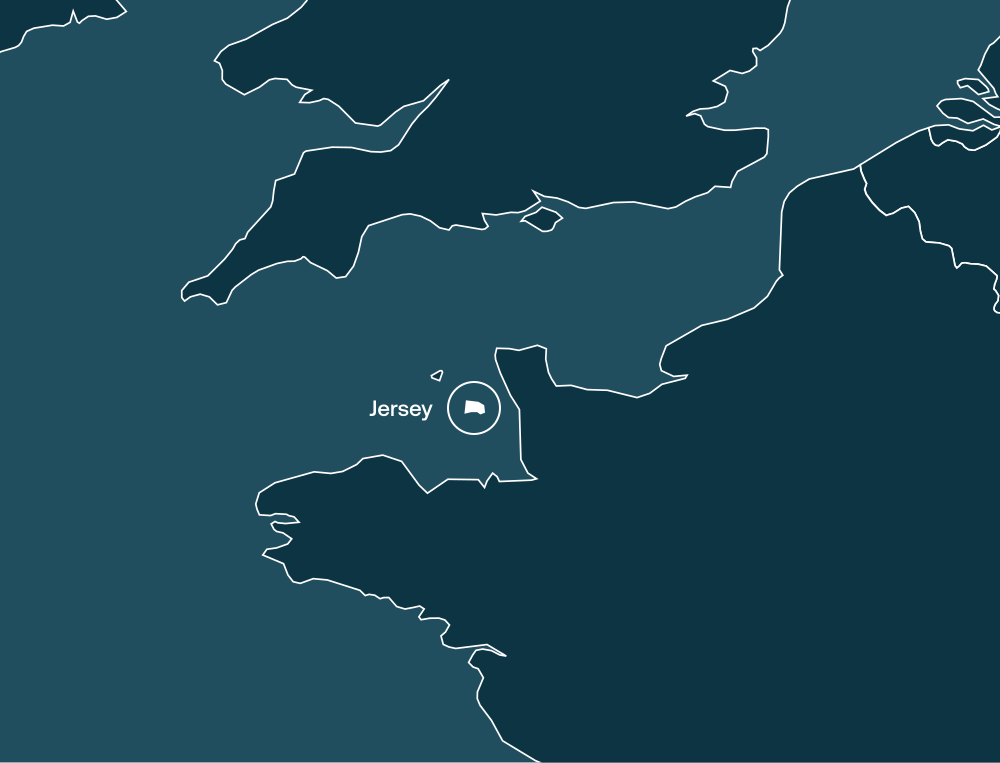
Jersey and the wider Channel Islands are historic remnants of the medieval Duchy of Normandy and the only British territory occupied by Germany during the Second World War. Today, the Bailiwick is a self-governing British Crown dependency, with the United Kingdom retaining responsibility for defense and international representation. Positioned in the English Channel roughly 14 miles from France and 85 miles from England, Jersey operates within a distinctive constitutional and regional setting.
Its closest relationships involve stable but security-conscious France and the United Kingdom, alongside less obvious financial and political connections such as the 2016 Memorandum of Understanding with Rwanda. These links bring attention to issues ranging from terrorism and civil unrest to allegations surrounding Rwanda, the M23 rebellion, and conflict minerals connected to the Democratic Republic of Congo. Jersey applies UN and UK sanctions through the Sanctions and Money Laundering Act 2018 and related laws, while authorities focus on proxy transfers, alternative payment systems, crypto-assets, Russia-related circumvention, and the possibility of inadvertent facilitation through its financial sector.
AML & Terrorist Financing
Jersey is not listed by FATF as having strategic AML deficiencies, and its 2024 evaluation reflects a generally strong framework, including substantial effectiveness in terrorism-financing and proliferation-financing controls. Yet its international financial-centre profile, non-resident clientele, complex wealth-management structures, and exposure to fraud, corruption, tax offences, drug trafficking, and emerging virtual-asset risks create continuing challenges for the JFSC, FIU, and JFCU. Areas attracting particular attention include the limited use of third-party and tax-related money-laundering prosecutions, uneven reporting and compliance capabilities, beneficial-ownership vulnerabilities involving trusts, and the difficulty of detecting indirect links to sanctioned persons.
Sanctions
Jersey enforces UN Security Council measures and autonomous UK sanctions through the SAFL framework and the 2021 Sanctions Order, with new UK prohibitions now automatically applying across 36 regimes. These measures encompass targeted financial restrictions, asset freezes, arms and trade controls, and other tools addressing threats ranging from terrorism and proliferation to international conflicts, supported by the JFSC, Jersey’s Financial Intelligence Unit, and reporting mechanisms informed by NCA Red Alerts. No international sanctions are currently in force against Jersey, although its financial-services sector remains exposed to sophisticated evasion involving Russian, DPRK, Iranian, and Belarusian-linked networks, including proxy ownership, virtual assets, and complex maritime routes.
Criminality
Jersey appears to have a comparatively well-controlled corruption environment. The available information is limited, leaving the specific nature of corruption risks and enforcement activity unclear.
Industry/Product Sector Risk
Jersey’s financial centre is shaped by cross-border private banking, wealth management, funds, and trust and company services, with the Jersey Private Fund sector and complex international structures presenting particularly significant areas of exposure. The NRA and MER highlight vulnerabilities involving non-resident clients, foreign PEPs, beneficial ownership, source-of-wealth verification, and the movement of proceeds linked to corruption, tax offences, and major fraud. Smaller sectors—including money services, virtual assets, gaming, real estate, charities, and extractive-industry-related structures—add more focused risks, creating a nuanced landscape in which the strength of controls and oversight remains central.
Economy & Investment Climate
Jersey’s highly developed, services-led economy is anchored by financial services, tourism, and a stable investment environment, with agriculture contributing distinctive products such as Jersey Royal potatoes and dairy. Its close trading relationship with the United Kingdom, parliamentary democracy through the Assembly of the States of Jersey, and ongoing scrutiny of tax transparency shape an economy that combines international appeal with distinctive regulatory and environmental considerations.
Cryptocurrency Regulations
Jersey permits cryptocurrency activity under a structured framework overseen by the Jersey Financial Services Commission (JFSC), with registration, AML/CFT controls, Travel Rule obligations, and a 2024 VASP risk assessment shaping the responsibilities of businesses. While crypto is not legal tender, the island’s treatment of exchanges, token offerings, real-world asset tokenization, and forthcoming CARF reporting—alongside no capital gains tax—reveals a carefully balanced approach that rewards further investigation.
Get full access
The information on this page is a brief summary. Get access to EDD country reports, all risk category scores and customisable weightings for 245 jurisdictions.