
Risk Indicators
- FATF/EU Blacklist/Greylist (Higher Concern)
- Terrorism Financing (Medium Concern)
- US Dept of State INCSR
- Proliferation Financing
- Corruption
- Criminality
- Resilience & Governance
- Financial Transparency
- Offshore Finance Centres
- Sanctions
Background
Kenya’s history reflects centuries of Indian Ocean commerce centered on Mombasa, the emergence of Swahili culture, European competition, and British colonial rule through the East Africa Protectorate. Political tensions with Britain culminated in the Mau Mau Uprising and ultimately independence in 1963. This historical setting provides context for a country positioned at the intersection of coastal trade, regional diplomacy, and persistent security pressures.
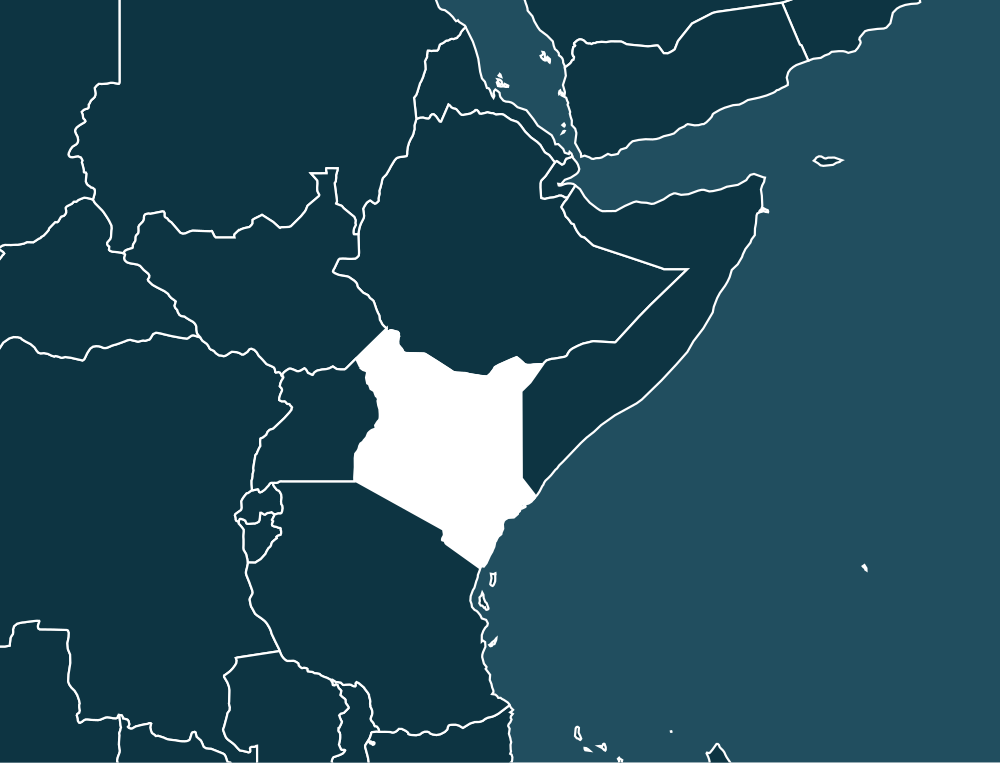
Kenya’s borders connect it to environments shaped by al-Shabaab activity in Somalia, unrest involving the OLA in Ethiopia, instability in South Sudan, and recurring incidents along the Ugandan frontier, while Tanzania is comparatively stable. Wider regional concerns extend to Sudan’s SAF–RSF conflict and eastern DRC, where armed groups, sanctions, illicit financial flows, and cross-border arms movements remain significant themes. The UN, US, and EU measures affecting neighboring actors—and questions surrounding Kenya’s contacts with figures linked to the RSF and regional rebel movements—add further complexity to its security and compliance landscape.
AML & Terrorist Financing
Kenya remains subject to strategic AML/CFT concerns, despite legislative and institutional improvements involving the Financial Reporting Centre (FRC), Asset Recovery Agency (ARA), and enhanced beneficial ownership measures, and was added to the European Commission’s high-risk list in August 2025. Key vulnerabilities include cross-border and trade-based laundering, informal remittance channels, mobile money, DNFBPs, limited beneficial ownership verification, and uneven risk-based supervision beyond banks and microfinance institutions. Terrorist financing controls remain comparatively weak, with limited prosecutions, delayed targeted financial sanctions, insufficiently risk-based oversight of NPOs, and continuing gaps in financial intelligence, virtual asset regulation, and proliferation-financing measures.
Sanctions
Kenya is obligated to implement UN Security Council measures, yet no international sanctions are currently in force against the country itself. Its enforcement profile includes Kenya Revenue Authority seizures involving diverted cargo and scrutiny of trade, logistics, financial, and gold networks linked to sanctions evasion involving Russia and, less frequently, Iran or North Korea. Although Kenya is not a primary target, the EU’s continuing high-risk designation and UK sanctions against Kenyan businessmen connected to illicit gold activity highlight external pressure surrounding its role as a regional transit and financial hub.
Criminality
Corruption remains a persistent challenge in Kenya, with allegations involving high-level health and infrastructure contracts, government tenders, and senior officials, although the Ethics and Anti-Corruption Commission has secured convictions and recovered public assets. Kenya also faces extensive criminal activity spanning human trafficking, arms and drug transit, counterfeit and illicit goods, wildlife and mineral trafficking, cybercrime, and money laundering, with corrupt officials and politically connected actors sometimes enabling these networks.
Reports
Kenya remains a significant regional focus for counternarcotics, trafficking prevention, and counterterrorism, with NACADA documenting widespread cannabis and prescription-drug use, while authorities and a DEA-supported Sensitive Investigations Unit achieved a notable methamphetamine-lab seizure in Namanga. At the same time, trafficking risks extend from local communities and refugee settings to Gulf migration routes and online recruitment networks, as Kenyan security services confront persistent al-Shabaab activity, uneven institutional capacity, and concerns over victim protection and official complicity.
Industry/Product Sector Risk
Kenya’s financial and commercial landscape presents a varied risk profile, with heightened exposure in mobile money, commercial banking, foreign exchange, casinos, real estate, trade finance, precious-minerals dealing, remittances, and virtual assets. Oversight is distributed among bodies including the Central Bank of Kenya, Capital Markets Authority, Betting Control and Licensing Board, Insurance Regulatory Authority, SASRA, the Ministry of Petroleum and Mining, and ICPAK, while gaps among intermediaries, informal operators, and professional gatekeepers create areas of particular interest. Cross-border corridors, cash-intensive activity, complex ownership structures, digital payments, and links to corruption, fraud, smuggling, environmental crime, and regional terrorism-financing concerns point to a market where sector-specific detail is essential.
Economy & Investment Climate
Kenya offers a generally favorable platform for regional investment, supported by Mombasa’s market access, strong telecommunications and financial infrastructure, expanding digital systems, and opportunities spanning agriculture, energy, logistics, technology, healthcare, and creative industries. Growth and investor confidence faced pressures in 2024 from fiscal consolidation, political unrest, high financing costs, taxation changes, bureaucratic delays, and security concerns, even as KenInvest, the Central Bank of Kenya, and other institutions continued efforts to improve facilitation, regulation, and macroeconomic stability.
Cryptocurrency Regulations
Kenya is moving from caution toward formal cryptocurrency oversight, with the CBK, CMA, National Treasury, and KRA each shaping different aspects of a framework that remains under development. Between the 2023 national risk assessment, the proposed Virtual Asset Service Providers Bill, and the 3% Digital Asset Tax, the country’s approach combines emerging licensing and AML expectations with growing scrutiny of exchanges, tokens, and transaction reporting.
Get full access
The information on this page is a brief summary. Get access to EDD country reports, all risk category scores and customisable weightings for 245 jurisdictions.