
Risk Indicators
- FATF/EU Blacklist/Greylist (Medium Concern)
- Terrorism Financing (Medium Concern)
- US Dept of State INCSR
- Proliferation Financing
- Corruption
- Criminality
- Resilience & Governance
- Financial Transparency
- Offshore Finance Centres
- Sanctions
Background
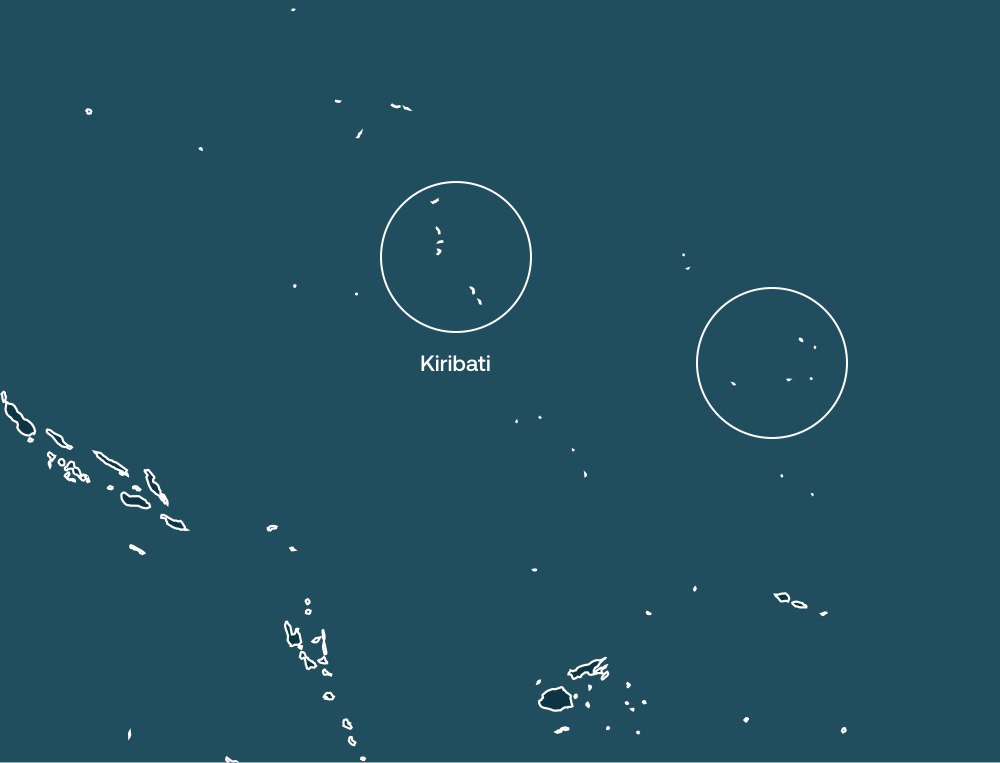
Kiribati comprises the Gilbert, Line, and Phoenix Islands, with a history shaped by Austronesian, Micronesian, Polynesian, and Melanesian movement before sustained European contact and British colonial administration. Its path to independence included the separation of Tuvalu, self-government in 1977, and independence in 1979, while the 1979 treaty with the United States settled claims over the Phoenix and Line Islands. Climate pressures have added a new dimension to its history, including the purchase of land in Fiji for possible future resettlement.
Today, Kiribati occupies a sensitive position in a Pacific region marked by maritime vulnerabilities, sanctions-evasion concerns, and competition between China and Western powers. Its 2019 shift in diplomatic recognition from Taiwan to China has been associated with increased Chinese investment and security cooperation, while Australia, New Zealand, and the United States have reassessed their regional engagement. Relationships with Fiji, the Solomon Islands, Nauru, Tuvalu, and Papua New Guinea further place Kiribati within a web of political realignment, local instability, and strategic concern.
AML & Terrorist Financing
Kiribati is not identified by FATF as having strategic AML deficiencies, although it has not yet undergone a mutual evaluation of its AML/CFT implementation. Its framework relies on coordination among the Kiribati Financial Supervisory Authority, the Financial Intelligence Unit, the Kiribati Revenue Authority, and the Kiribati Police Force and Customs Office, with responsibilities spanning supervision, intelligence, taxation, investigation, and enforcement. Transparency around company ownership is being strengthened through the Registrar of Companies and developing Ultimate Beneficial Owner requirements, while limited resources and access to information remain relevant considerations.
Sanctions
Kiribati has no international sanctions currently imposed against it and, as a UN member, supports the Security Council’s sanctions regimes. Its principal enforcement role is preventive, with the maritime registry applying enhanced screening, AIS/LRIT monitoring, and registration removals to stop flagged vessels from facilitating sanctions evasion, especially involving North Korea and also potentially Iran, Syria, or Russia. Kiribati’s official circulars and vessel-bar lists reflect a tightening response to ship-to-ship transfers, flag switching, falsified tracking, and other deceptive practices linked to the global shadow fleet.
Criminality
Kiribati’s criminal landscape is relatively limited in scale but includes growing concerns over human trafficking, counterfeit and excise-goods markets, financial scams, and illegal, unreported, and unregulated fishing across its difficult-to-monitor waters. Corruption and oversight weaknesses affect access to resources and the justice system, while local networks and foreign actors exploit gaps in monitoring and financial-crime controls.
Reports
U.S. State Department materials indicate that human trafficking crimes may have occurred in Kiribati, while available information on the scale and nature of the issue remains limited. Further information is being gathered on the Government of Kiribati’s anti-trafficking efforts to support a more complete assessment.
Economy & Investment Climate
Kiribati’s small, import-dependent economy is anchored by fishing, copra, and a service sector that accounts for nearly two-thirds of GDP, while remittances and assistance from partners such as Australia and Japan remain important sources of stability. Investment prospects are tied to infrastructure, tourism, and retail, but limited resources, South Tarawa’s environmental pressures, climate vulnerability, and reliance on overseas trade continue to shape the country’s economic outlook.
Cryptocurrency Regulations
Kiribati’s cryptocurrency landscape remains largely undefined: digital assets are neither legal tender nor expressly prohibited, while rules for exchanges, VASPs, taxation, ICOs, and tokenized assets are not clearly established. Recent AML/CFT coordination involving the UNODC and Kiribati’s observer relationship with the Asia Pacific Group on Money Laundering suggest emerging engagement, but significant questions remain around licensing, transaction monitoring, consumer protection, and international standards such as FATF guidance and CARF.
Get full access
The information on this page is a brief summary. Get access to EDD country reports, all risk category scores and customisable weightings for 245 jurisdictions.