
Risk Indicators
- FATF/EU Blacklist/Greylist (Lower Concern)
- Terrorism Financing (Medium Concern)
- US Dept of State INCSR
- Proliferation Financing
- Corruption
- Criminality
- Resilience & Governance
- Financial Transparency
- Offshore Finance Centres
- Sanctions
Background
Lesotho emerged from the state-building efforts of Paramount Chief Moshoeshoe I and became independent from British rule in 1966, retaining a constitutional monarchy under the Kingdom of Lesotho. Its subsequent political history included military rule, contested elections, coalition governments, leadership changes involving Moshoeshoe II, Letsie III, Pakalitha Mosisili, Motsoahae Thomas Thabane, Moseketsi Majoro, and Ntsokoane Samuel Matekane, as well as intervention by SADC forces in 1998. These shifts provide important context for understanding the country’s evolving governance and political stability.
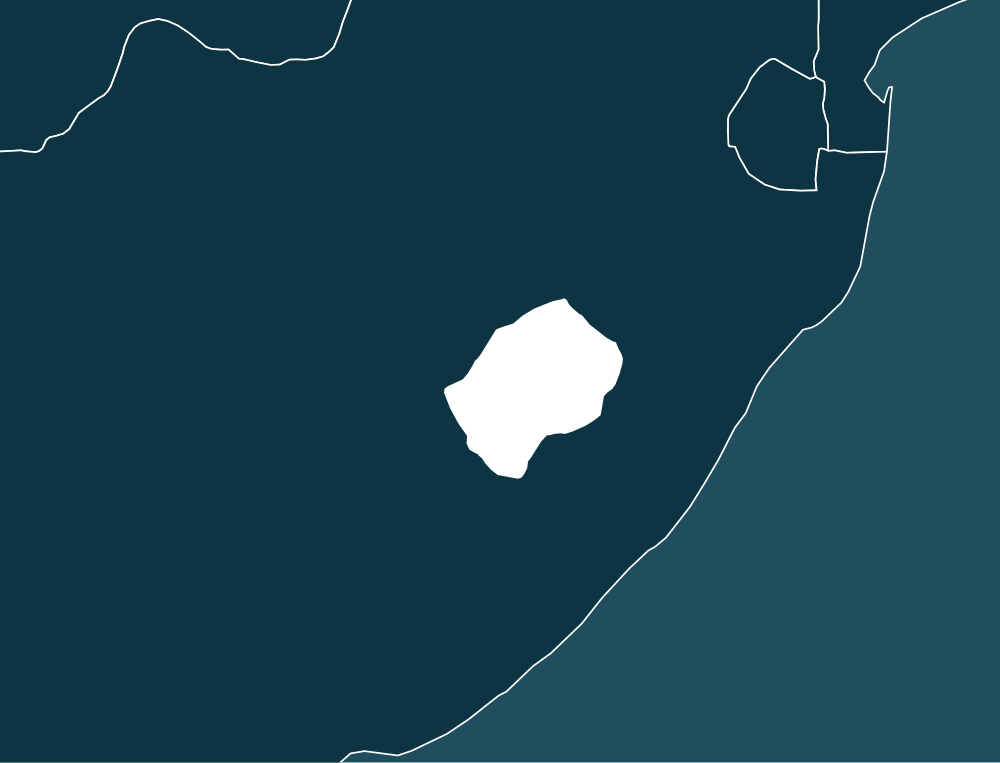
As a landlocked enclave entirely surrounded by South Africa, Lesotho’s immediate external environment is shaped almost exclusively by developments across that border. South Africa’s Government of National Unity, ANC divisions, violent crime, financial offenses, and regional security commitments—including involvement in the DRC—create a complex setting for Lesotho’s stability and economic access. Its FATF greylisting, reliance on United Nations sanctions, exposure to illicit financial flows, and strained relations with the United States add further dimensions to the relationship.
AML & Terrorist Financing
Lesotho has strengthened its AML/CFT framework through measures involving the FIU, Central Bank of Lesotho, DCEO, updated legislation, and asset-recovery initiatives, but implementation remains uneven despite the country not appearing on the FATF list of jurisdictions with strategic deficiencies. Key vulnerabilities include proceeds linked to corruption, fraud, forgery, tax crimes, and cross-border activity with South Africa, alongside weaknesses in beneficial-ownership information, DNFBP supervision, reporting, asset recovery, and international cooperation. Terrorist-financing controls remain particularly limited, with low effectiveness in Immediate Outcomes 9 and 10, gaps in NPO risk assessment and targeted financial sanctions, and an undeveloped framework for proliferation-financing obligations.
Sanctions
Lesotho implements United Nations sanctions but maintains no autonomous sanctions list or additional international measures of its own. There are currently no international sanctions in force against Lesotho, while its Money Laundering and Proceeds of Crime Regulations, 2019, support primarily domestic anti-money-laundering enforcement. Its potential exposure is indirect, arising from South African-linked routes through Durban, Cape Town, and Gqeberha, as well as the Maputo and Trans-Kalahari Corridors, where regional trade involving countries such as Zimbabwe, North Korea, Iran, and Russia could create sanctions-evasion vulnerabilities.
Criminality
Lesotho has a substantial framework for addressing corruption, including the Directorate on Corruption and Economic Offences (DCEO), financial-disclosure requirements, and asset-forfeiture powers, yet concerns persist about official impunity, limited investigative resources, and corruption in procurement, licensing, and permits. Crime also includes human trafficking, diamond smuggling, illicit alcohol and tobacco trading, cattle theft, drug activity, and increasingly prevalent mobile-money scams, with allegations that political connections and groups such as the Famo gangs complicate enforcement.
Reports
Lesotho remains on Tier 2 as authorities increase trafficking investigations, prosecutions, victim identification, awareness efforts, and funding, while shelter capacity—particularly for men—and protections against worker-paid recruitment fees remain concerns. Vulnerabilities span domestic servitude, herding, sex trafficking, and forced labor, with Basotho exploited within Lesotho, in South Africa, and farther abroad through deceptive job or education offers, migration pressures, organized crime, and certain institutional or commercial settings.
Industry/Product Sector Risk
Lesotho’s financial and non-financial sectors present a varied risk landscape, with heightened exposure in banking, casinos, remittances, real estate, mining, accountancy, legal services, and trust and company structures amid substantial cash use and close economic links to South Africa. Oversight is distributed among bodies such as the Central Bank of Lesotho, Casino Board, Mining Board, Lesotho Institute of Accountants, and Law Society of Lesotho, though supervision, beneficial-ownership transparency, reporting, and cross-border controls remain uneven in several areas. The underlying threats span corruption, fraud, tax evasion, stock theft, diamond and illegal-mining offences, smuggling, and potential terrorism-financing risks, with channels ranging from mobile payments and correspondent banking to property, commodities, construction, and informal commerce.
Economy & Investment Climate
Lesotho’s economy combines a services-led base with important manufacturing, mining, agriculture, and tourism activity, supported by access to South African and wider regional markets and substantial remittance flows. While the Lesotho National Development Corporation and One Stop Business Facilitation Centre signal efforts to attract investment and streamline operations, policy gaps, reserved sectors, regulatory delays, labor concerns, climate pressures, and limited financial-market depth remain significant considerations alongside opportunities in exports and renewable energy.
Cryptocurrency Regulations
In Lesotho, cryptocurrencies occupy an uncertain space: the Central Bank of Lesotho (CBL) does not recognize them as legal tender or regulate them, while exchanges, VASPs, ICOs, and tokenization activities operate without dedicated licensing, registration, or compliance rules. With no clear tax treatment, Travel Rule, CARF commitment, or established supervisory framework, the CBL’s warnings about potential tax, exchange-control, AML/CFT, and consumer risks remain central to understanding the market.
Get full access
The information on this page is a brief summary. Get access to EDD country reports, all risk category scores and customisable weightings for 245 jurisdictions.