
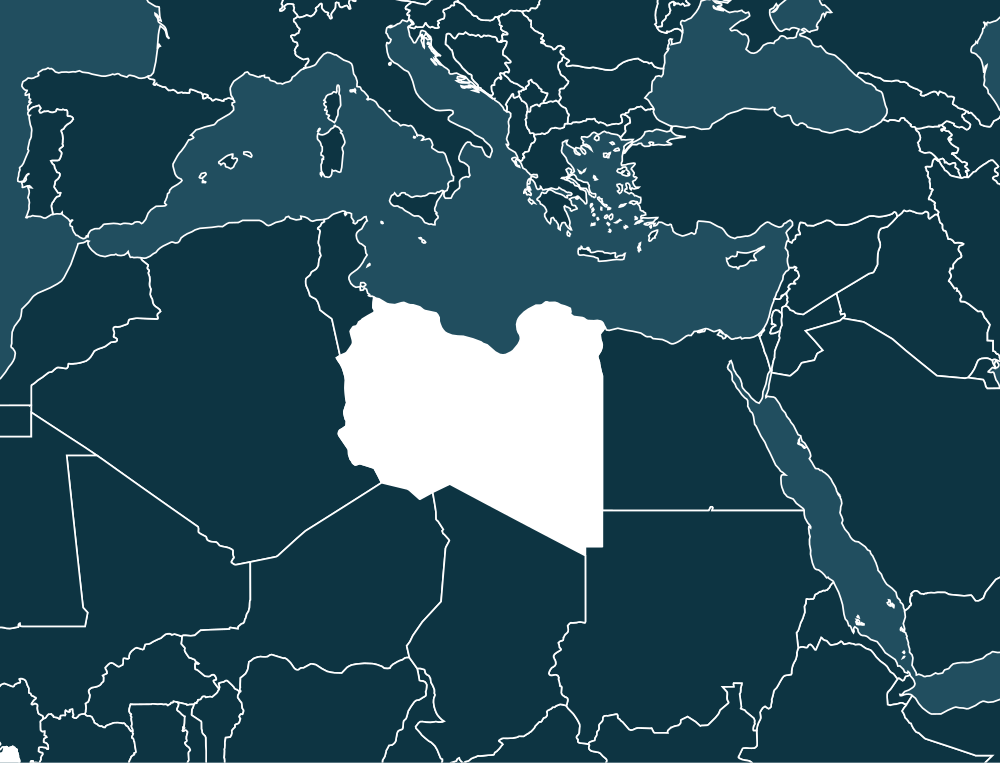
Risk Indicators
- FATF/EU Blacklist/Greylist (Medium Concern)
- Terrorism Financing (Medium Concern)
- US Dept of State INCSR
- Proliferation Financing
- Corruption
- Criminality
- Resilience & Governance
- Financial Transparency
- Offshore Finance Centres
- Sanctions
Background
Libya’s modern history reflects layers of Berber, Mediterranean, Ottoman, Italian, and Arab influence, followed by independence in 1951 and Muammar al-QADHAFI’s lengthy rule after the 1969 coup. Oil wealth supported an ambitious ideology and controversial activity abroad, while UN sanctions and later commitments on the Lockerbie-related bombings and weapons programs reshaped Libya’s international position. The 2011 uprising ended QADHAFI’s rule but opened a prolonged struggle over political authority and national institutions.
Since then, transitions from the National Transitional Council to the GNC and House of Representatives have been accompanied by rival administrations, failed election plans, and intermittent armed confrontation. The UN-backed cease-fire and 2021 Government of National Unity, involving figures such as Abdul Hamid DUBAYBAH, Fathi BASHAGHA, and Osma HAMAD, have not resolved the country’s political divide, with Abdoulaye BATHILY continuing efforts to advance elections. Libya’s instability is closely tied to its neighbors, porous borders, and persistent allegations involving arms transfers, illicit fuel movements, trafficking, and evasion of the UN arms embargo and asset-freeze measures.
AML & Terrorist Financing
Libya is not currently listed by FATF for strategic AML deficiencies, yet the absence of a completed mutual evaluation and limited reliable data leave significant uncertainty around the effectiveness of its AML/CFT framework. Political fragmentation, armed groups, porous borders, cash-based commerce, informal value transfers, currency controls, alleged trade-invoicing schemes, and smuggling create a complex risk environment, while terrorist-financing concerns are illustrated by reported ISIL activity affecting banks in Sirte. The Central Bank of Libya, its Financial Information Unit and goAML system, and the National Committee for Combating Money Laundering and Terrorist Financing are pursuing reforms, although enforcement capacity, beneficial ownership transparency, and international cooperation remain developing areas.
Sanctions
Libya is described primarily as the subject of a multilayered international sanctions regime, rather than as a country imposing documented sanctions on other nations. UN measures extended by Resolution 2819 (2026), alongside regimes administered by OFAC, the EU’s Operation IRINI, the UK, Canada, Australia, Japan, and others, include arms restrictions, asset freezes, travel bans, maritime enforcement, and controls targeting illicit petroleum activity. Recent adjustments involving the Libyan Investment Authority, security-sector assistance, and designated vessels such as MARAYA point to narrowly tailored exemptions amid persistent evasion concerns linked to actors and transit networks spanning Turkey, Russia, Egypt, the UAE, and Malta.
Criminality
Corruption remains pervasive across Libya’s economy, particularly in government procurement, with graft, bribery, nepotism, money laundering, and fraudulent use of letters of credit reportedly occurring with limited enforcement; the Libyan Audit Bureau has made some progress on transparency and accountability, while the Libyan Transparency Association provides a channel for reporting abuses. Criminal markets span human trafficking and smuggling, arms and drug transit, subsidized-goods smuggling, wildlife and fishing violations, tax evasion, and public-funds embezzlement, often involving militias, politically connected networks, state-embedded actors, and foreign armed groups.
Reports
Libya’s fragmented governance, inactive courts, and the influence of armed groups continue to create conditions in which migrants, refugees, and other vulnerable people face trafficking, forced labor, sexual violence, and severe abuses, including in facilities linked to the DCIM and other authorities. At the same time, the GNU and LNA remain counterterrorism partners despite limited coordination, with ISIS and AQIM degraded and no confirmed terrorist incidents recorded in 2024, while porous borders and fractured security institutions remain significant concerns.
Economy & Investment Climate
Libya’s economy offers substantial potential through reconstruction, consumer demand, and extensive hydrocarbon resources, yet remains heavily state-dominated and vulnerable to political fragmentation, security disruptions, and oil-production interruptions. Institutions such as the National Oil Corporation, Central Bank of Libya, and Privatization and Investment Board are central to commercial activity, while opaque procedures, limited financing, currency pressures, and uncertain enforcement continue to shape the investment landscape.
Cryptocurrency Regulations
Libya maintains a restrictive stance toward cryptocurrency, with the Central Bank of Libya’s 2018 prohibition leaving digital assets, exchanges, mining, and token offerings in a largely undefined legal space. The absence of a formal compliance registry, unclear Financial Information Unit oversight, and undeveloped tax and VASP frameworks point to substantial uncertainty, even as more precise rules may emerge.
Get full access
The information on this page is a brief summary. Get access to EDD country reports, all risk category scores and customisable weightings for 245 jurisdictions.