
Risk Indicators
- FATF/EU Blacklist/Greylist (Lower Concern)
- Terrorism Financing (Lower Concern)
- US Dept of State INCSR
- Proliferation Financing
- Corruption
- Criminality
- Resilience & Governance
- Financial Transparency
- Offshore Finance Centres
- Sanctions
Background
Lithuania’s historical arc runs from the consolidation of its lands under Mindaugas and the formation of the Polish-Lithuanian Commonwealth to independence, Soviet annexation, and the restoration of statehood in 1990–1991. Its subsequent western integration included accession to NATO and the European Union in 2004, adoption of the euro in 2015, and membership in the Organisation for Economic Co-operation and Development in 2018. The withdrawal of Russian troops in 1993 marked another milestone in a transformation shaped by both historical sovereignty and contemporary European alignment.
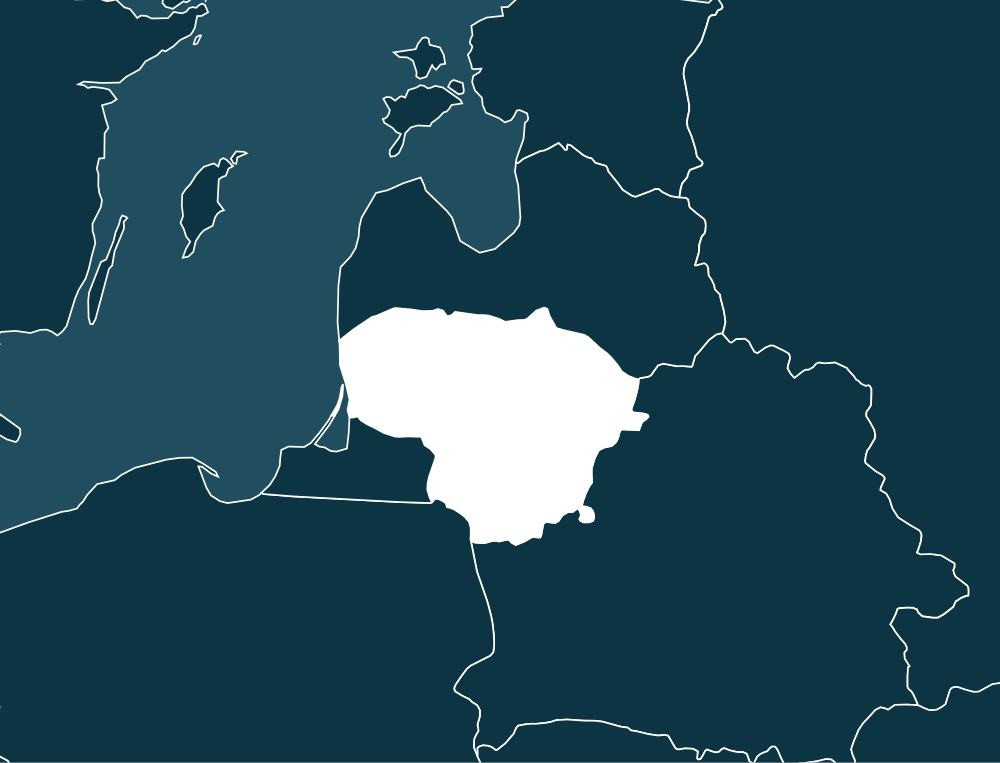
Today, Lithuania’s strategic environment is defined by borders with Latvia, Belarus, Poland, and Russia’s militarized Kaliningrad exclave, where political pressure, hybrid activity, and regional instability intersect. EU, UN, and US sanctions targeting Russia and Belarus have made enforcement, border controls, financial monitoring, and the detection of intermediary routes especially consequential. From Latvian investigations into re-exports through Central Asia to Polish customs cases and Kaliningrad-linked maritime pathways, the surrounding landscape offers a revealing picture of the security and compliance challenges facing Lithuania.
AML & Terrorist Financing
Lithuania is not identified by FATF as having strategic AML deficiencies, yet MONEYVAL assessments continue to point to areas requiring attention, including risk assessment, targeted financial sanctions, proliferation financing, and supervision of designated non-financial businesses. The FNTT/FIU and Bank of Lithuania have strengthened coordination, financial investigations, supervision, and beneficial-ownership arrangements through systems such as JANGIS, although concerns remain around the quality and prioritisation of suspicious transaction reporting, cash-border controls, fictitious companies, and uneven private-sector expertise. Terrorist-financing risk is considered low, but limited case experience, gaps affecting MVTS providers, non-profit organisations and DNFBPs, and delays in implementing UN designations leave the effectiveness of Lithuania’s broader AML/CFT framework an area worth examining closely.
Sanctions
Lithuania applies UN and EU restrictive measures domestically, with enforcement focused especially on Russia and Belarus and covering sensitive goods, financial activity, travel, and assets. Lithuanian Customs Criminal Service (MKT), the Vilnius Regional Prosecutor’s Office, and OLAF have pursued more than 50 investigations into evasion routes running through Lithuania and Central Asia, including an April 2025 operation involving a Vilnius-based company and approximately €1.5 million in seized goods. No international sanctions are currently identified as being in force against Lithuania, while arrests, travel bans, and cross-border cooperation signal the seriousness of its enforcement role.
Criminality
Lithuania has made progress in addressing corruption, with the Special Investigation Service investigating roughly 100 alleged cases annually, although nepotism, cronyism, bureaucratic “grease payments,” and vulnerabilities involving local officials and medical personnel remain concerns. Criminal activity includes human trafficking, illicit tobacco production, synthetic-drug distribution, money laundering, VAT fraud, and increasingly complex cybercrime, with both established groups and smaller networks adapting their operations.
Reports
Lithuania remains in Tier 1 after strengthening investigations, implementing an updated NAP, expanding frontline training, and increasing the independence of its national rapporteur, though concerns persist over prosecutions, victim-centered policing, and identifying vulnerable children and adults. Trafficking risks span online recruitment, commercial sex, criminal exploitation, and labor sectors such as transportation and construction, with particular exposure among migrants, refugees, institutionalized children, and people facing poverty, addiction, homelessness, or past abuse.
Industry/Product Sector Risk
Lithuania’s industry risk landscape spans cash-intensive casinos, currency exchange, real estate, construction, transportation and fast-growing fintech channels, alongside lower-risk domestic sectors such as insurance, investment funds and lending. The FIU, Gaming Control Authority and Lithuanian Assay Office feature prominently in oversight, while cross-border payments, non-resident activity, fictitious companies and beneficial-ownership opacity create recurring vulnerabilities. Particular attention is drawn to shadow-economy proceeds, tax and VAT fraud, corruption, smuggling, cyber-enabled crime and the evolving use of electronic money and virtual currencies.
Economy & Investment Climate
Lithuania combines resilient growth, EU and OECD-aligned institutions, a highly educated multilingual workforce, and a diversified base spanning services, manufacturing, technology, and emerging defense and energy opportunities. While Invest Lithuania and the Bank of Lithuania point to a generally open investment environment with expanding incentives, investors still encounter labor shortages, rising wages, regulatory complexities, procurement concerns, and transportation constraints.
Cryptocurrency Regulations
Lithuania permits cryptocurrency activity within an evolving framework that treats digital assets as non-legal tender while placing exchanges and other VASPs under FCIS oversight, KYC obligations, Travel Rule requirements, and a public registration regime. Tax treatment, token classifications, ICO disclosures, and forthcoming alignment with MiCA and the OECD’s CARF suggest a market balancing fintech innovation with increasingly detailed transparency and compliance expectations.
Get full access
The information on this page is a brief summary. Get access to EDD country reports, all risk category scores and customisable weightings for 245 jurisdictions.