
Risk Indicators
- FATF/EU Blacklist/Greylist (Lower Concern)
- Terrorism Financing (Lower Concern)
- US Dept of State INCSR
- Proliferation Financing
- Corruption
- Criminality
- Resilience & Governance
- Financial Transparency
- Offshore Finance Centres
- Sanctions
Background
Portuguese ships reached Macau in 1513, and by the 1550s the settlement had become a pivotal entrepôt linking China, Japan, and Europe. Its history includes Portuguese administration under enduring Chinese influence, wartime neutrality and refuge, and designation as an overseas province in 1951. The 1987 Portugal–China agreement set the framework for Macau’s 1999 return and promised a high degree of autonomy under “one country, two systems,” although later political developments narrowed that space.
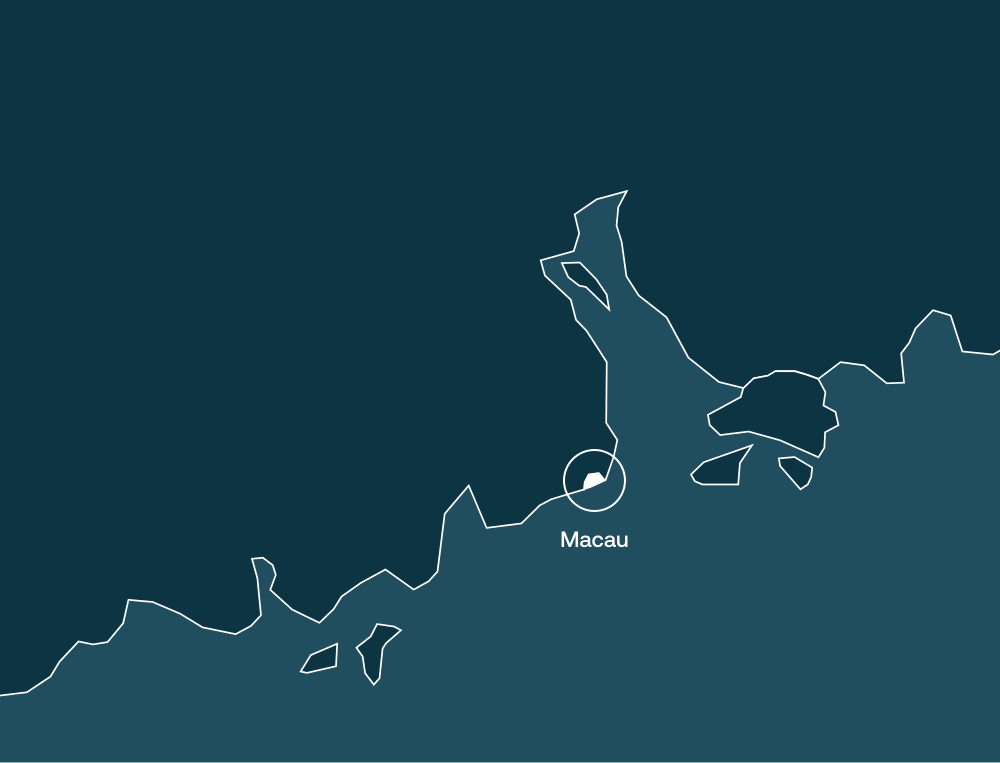
Macau borders only mainland China, with Zhuhai in Guangdong Province, and lies close to Hong Kong, leaving its wider security environment closely connected to both. Across these neighboring jurisdictions, concerns range from repression, territorial and cyber tensions, and economic pressures to the erosion of civil liberties and expanding national-security laws. While Macau is not itself a direct sanctions target or widely identified as an evasion hub, U.S. Treasury findings on Chinese facilitation of Russian sanctions evasion and scrutiny of Hong Kong’s financial networks illustrate the regional dynamics that may affect it indirectly.
AML & Terrorist Financing
Macau is not FATF-listed and has strengthened its AML/CFT framework, yet its dependence on casino gaming, tourism, and mainland-linked capital flows continues to expose it to foreign proceeds, underground finance, fraud, and organized crime. Findings associated with the APG evaluations and the U.S. Department of State highlight persistent challenges involving junkets, cash-intensive activity, high reporting thresholds, beneficial ownership transparency, and the comparatively limited number of money laundering prosecutions and confiscations. The Financial Intelligence Office (GIF), Monetary Authority of Macao (AMCM), and Gaming Inspection and Coordination Bureau (DICJ) have expanded supervision and reporting, while terrorist-financing risk remains assessed as low but is subject to certain legal, investigative, and sanctions-implementation limitations.
Sanctions
Macau primarily enforces United Nations Security Council measures through its Asset Freezing Coordination Commission, covering active regimes involving counter-terrorism, North Korea, and Afghanistan, while former Iran-related restrictions were removed in 2024. External restrictions are limited but include the United Kingdom’s longstanding partial arms embargo and U.S. Bureau of Industry and Security controls on advanced computing and semiconductor-related items, alongside Japan-linked aquatic product restrictions characterized as trade-related rather than formal sanctions. The European Union, Canada, Australia, New Zealand, Switzerland, and other major jurisdictions are not identified as maintaining broad Macau-specific sanctions, although concerns surrounding Macau’s role in financial and trade-based sanctions evasion have drawn attention to microelectronics, dual-use goods, and opaque corporate structures.
Criminality
Macau maintains a formal anti-corruption framework covering public officials and the private sector, with measures described as effectively and non-discriminatorily enforced. The Commission Against Corruption (CCAC) provides prevention guidance and reporting channels, while the 2021 Public Procurement Law introduced standardized procedures intended to strengthen transparency in government contracting.
Reports
Macau remains a challenging environment for combating human trafficking, with concerns involving sex trafficking, forced labor among migrant workers, and fraudulent recruitment into forced criminality, while victim identification and prosecutions remain limited despite some official training and awareness efforts. Counterterrorism capabilities include the Judiciary Police’s Terrorism Crimes Alert Division, the Police Intervention Tactical Unit, and the Financial Intelligence Office, supported by regional cooperation and AML/CFT initiatives, although information-sharing could be strengthened and no terrorist incidents were recorded.
Industry/Product Sector Risk
Macao’s industry profile is dominated by high-risk, cash-intensive gaming and hospitality activities, with VIP arrangements, junket promoters, extensive visitor flows and historical card or ATM misuse creating significant exposure to foreign proceeds. Real estate, retail banking, cash-intensive dealers and cross-border payment channels add further layers of risk, while accountants, lawyers, notaries, insurers, investment firms and company service providers may be exposed through complex ownership structures and international transactions. At the same time, oversight by the financial regulator, customs authorities and the investment promotion authority, together with low assessed risk in most non-profit activity, provides important controls against corruption, fraud, gaming-related crime, drug trafficking and other illicit financial flows.
Economy & Investment Climate
Macau’s highly service-oriented economy remains anchored by gaming and tourism, with 2024 casino revenues rebounding strongly and major concessionaires committing substantial funds to non-gaming diversification in areas such as MICE travel, financial services, traditional Chinese medicine, and technology. Its free-port framework, open investment regime, RMB finance links, CEPA access, and support from agencies including IPIM and the Macau Monetary Authority create notable opportunities, while labor shortages, sector concentration, evolving national-security rules, and limited progress beyond gaming remain important considerations.
Cryptocurrency Regulations
Macau takes a cautious, restrictive stance toward cryptocurrency, with the Monetary Authority of Macau (AMCM) classifying virtual currencies as commodities rather than legal tender or supervised financial instruments and limiting financial institutions’ involvement. Although its AML posture broadly aligns with many FATF recommendations, the absence of a dedicated VASP registry, clear exchange licensing rules, cryptocurrency tax treatment, or ICO and tokenization framework leaves businesses facing considerable uncertainty.
Get full access
The information on this page is a brief summary. Get access to EDD country reports, all risk category scores and customisable weightings for 245 jurisdictions.