
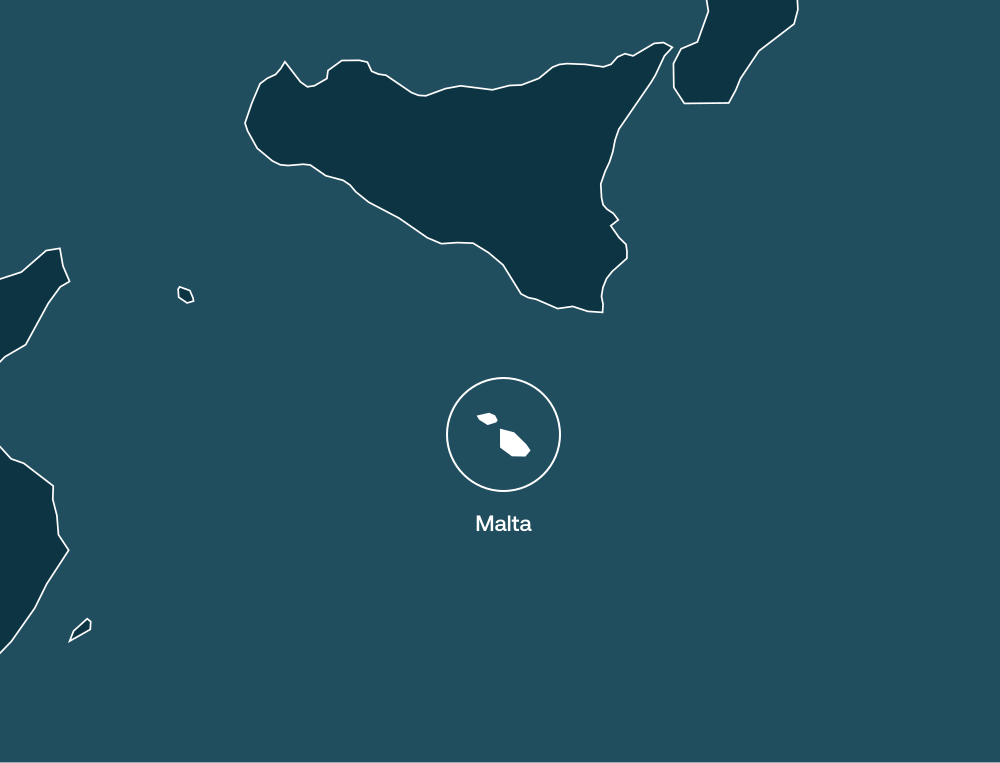
Risk Indicators
- FATF/EU Blacklist/Greylist (Lower Concern)
- Terrorism Financing (Lower Concern)
- US Dept of State INCSR
- Proliferation Financing
- Corruption
- Criminality
- Resilience & Governance
- Financial Transparency
- Offshore Finance Centres
- Sanctions
Background
Malta’s history stretches from ancient megalithic civilization through successive periods of Phoenician, Roman, Norman, Hospitaller, French, and British influence. After supporting the United Kingdom through two world wars, the islands became independent in 1964 and a republic in 1974. Since the 1980s, Malta has developed as a Mediterranean hub for freight transshipment, finance, and tourism, later joining the European Union and eurozone.
Positioned near Italy, Tunisia, and Libya, Malta operates within a region shaped by political division, authoritarian pressures, civil conflict, and illicit economic activity. Libya’s rival governments, militia networks, and oil smuggling have drawn continuing attention from the UN Security Council, while Italy and Tunisia present different challenges involving sanctions implementation, civil liberties, and institutional weakness. As an EU member, Malta faces its own scrutiny over enforcement, particularly where complex corporate structures and profit-driven businesses may facilitate sanctions evasion.
AML & Terrorist Financing
Malta has made significant AML/CFT progress and is no longer subject to FATF increased monitoring, although MONEYVAL follow-up continues and important effectiveness gaps remain. The FIAU, MFSA, Malta Gaming Authority and Malta Police have strengthened oversight, intelligence and enforcement, but concerns have included beneficial ownership accuracy, low or uneven suspicious reporting, complex cross-border risks and limited investigation of sophisticated or tax-related laundering. Terrorist-financing controls and proliferation-sanctions arrangements are supported by the Sanctions Monitoring Board, yet the absence of FT prosecutions, uneven awareness among DNFBPs and vulnerabilities linked to remote gaming, non-resident finance, investment schemes and newer technologies leave areas requiring close attention.
Sanctions
Malta applies United Nations and European Union restrictive measures domestically, including targeted asset freezes, travel bans, arms controls, and sectoral trade or financial restrictions involving jurisdictions such as Russia, Libya, Syria, Iran, and others. As of mid-2026, Malta is not subject to country-specific sanctions imposed by the UN, EU, United States, or United Kingdom, although concerns remain regarding sanctions-evasion channels connected to Russian networks, Maltese shell companies, maritime routes, and former citizenship-by-investment arrangements. Enforcement combines the Joint Economic Financial Sanctions Implementation Task Force, customs screening, and the Malta Centre for Maritime Security’s cooperation with the EU’s MUSE project, while delayed citizenship revocations and limited investigative powers present continuing vulnerabilities.
Criminality
Malta has formal criminal penalties for official corruption and dedicated bodies including the Malta Police Force, Attorney General’s Office, Permanent Commission Against Corruption, and FIAU, yet GRECO’s findings and continuing MONEYVAL monitoring point to unresolved integrity and anti-money-laundering concerns. Criminal activity spans human trafficking, drug and fuel smuggling, illicit fishing, financial crime, and rising cyber-attacks, with organized networks and violent gangs contributing to a complex risk environment.
Reports
Malta was upgraded to Tier 2 after increasing prosecutions, victim assistance, survivor engagement, and protections for vulnerable witnesses, while adopting a new national strategy and action plan. Significant challenges remain, including no trafficking convictions in 2024, gaps in identifying Maltese, child, and asylum-seeking victims, and continued exploitation risks affecting migrants and foreign workers in sectors such as construction, hospitality, domestic work, and nightlife.
Industry/Product Sector Risk
Malta’s industry profile reflects a highly international, cash-intensive economy in which banking, remote gaming, real estate, correspondent banking, trade finance, wealth management and trust and company services present notable exposure to cross-border money laundering risks. Emerging virtual-asset and fintech activity, alongside vulnerabilities identified by the Commissioner for Voluntary Organisations and concerns involving cash controls, transport links and property-related investment, adds complexity to the wider risk landscape. Key threats include foreign organised crime, fraud, tax evasion, corruption, drug and human trafficking, smuggling and the potential misuse of corporate structures and professional gatekeepers.
Economy & Investment Climate
Malta’s compact, services-led economy has sustained strong post-pandemic growth, supported by finance, online gaming, tourism, shipping, and other internationally oriented activities, while its EU, Eurozone, and Schengen ties reinforce its position between European and North African markets. Foreign investors encounter a generally open and English-speaking business environment, with Malta Enterprise, the Malta Business Registry, and the MFSA supporting investment and incorporation, alongside targeted incentives and screening requirements, though banking access for certain sectors and the pace of judicial proceedings warrant careful attention.
Cryptocurrency Regulations
Malta permits cryptocurrency activity within a structured framework shaped by the Virtual Financial Assets Act, with the MFSA and FIAU overseeing licensing, AML/KYC controls, and market conduct. From the MFSA’s licensed VASP list and the 2023 National Risk Assessment to Travel Rule, DAC8, and forthcoming CARF obligations, the country combines detailed supervision with evolving EU and international standards.
Get full access
The information on this page is a brief summary. Get access to EDD country reports, all risk category scores and customisable weightings for 245 jurisdictions.