
Risk Indicators
- FATF/EU Blacklist/Greylist (Lower Concern)
- Terrorism Financing (Lower Concern)
- US Dept of State INCSR
- Proliferation Financing
- Corruption
- Criminality
- Resilience & Governance
- Financial Transparency
- Offshore Finance Centres
- Sanctions
Background
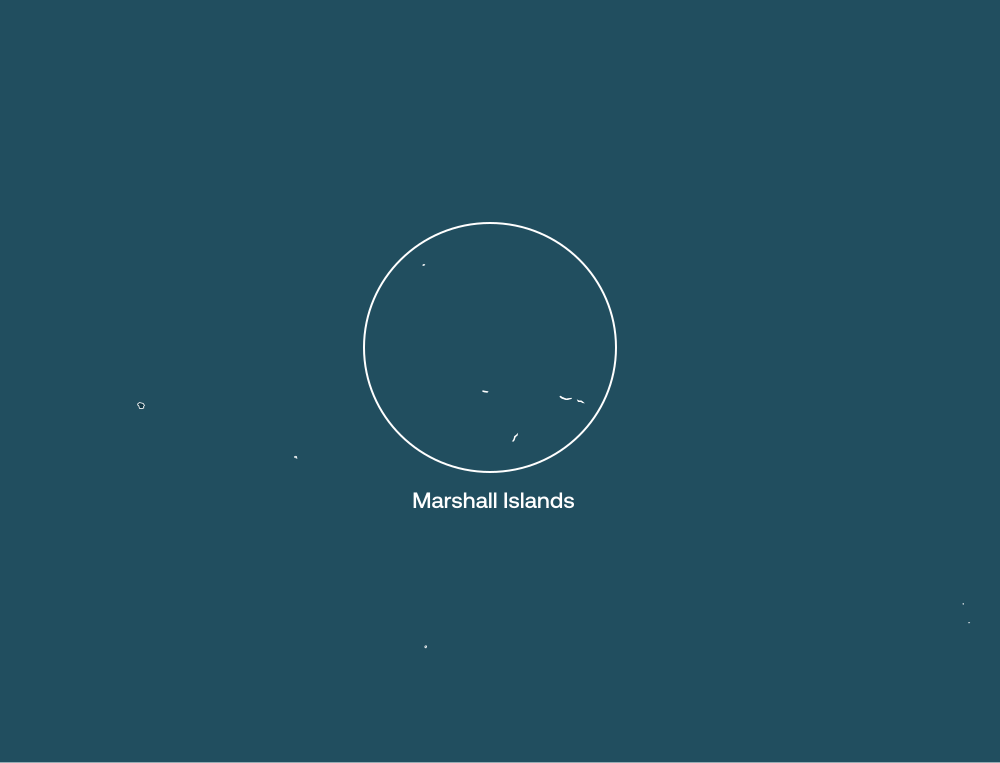
The Marshall Islands emerged from ancient seafaring communities organized across the Ratak and Ralik Chains, later passing through Spanish, German, Japanese, and United States administration. Its modern history remains closely associated with the Trust Territory of the Pacific Islands, the 67 nuclear tests conducted between 1946 and 1958, and the continuing emptiness of parts of Bikini and Rongelap Atolls. Constitutional self-government followed in 1979 under Amata KABUA, with later milestones including Kessai NOTE’s election as the first commoner president and Hilda HEINE’s election as the first woman president.
The country’s regional setting places it near Kiribati, Nauru, the Federated States of Micronesia, and contested Wake Island, where strategic competition and political pressures vary considerably. Kiribati’s diplomatic realignment and ship-registry screening, alongside the FSM’s US-China balancing and developing Financial Intelligence Unit, point to wider concerns involving governance, financial crime, sanctions, and maritime oversight. Although no neighbouring state is described as facing an active war, climate pressures, limited security capacity, and the contested status of Wake Island add complexity to the surrounding environment.
AML & Terrorist Financing
The Marshall Islands is not listed by FATF as having strategic AML deficiencies, yet its 2024 assessment points to moderate effectiveness and unresolved vulnerabilities involving offshore NRDEs, emerging DAO structures, beneficial ownership information, and virtual-asset activity. The Financial Intelligence Unit is developing capacity, while the Attorney-General’s Office, Banking Commission, and Trust Company of the Marshall Islands face resource, coordination, supervision, and enforcement challenges that limit financial investigations, asset recovery, and oversight beyond the banking sector. Terrorist-financing risks are considered low and the legal framework for targeted financial sanctions is broadly established, but limited investigative capability, incomplete screening data, and the absence of effective monitoring for higher-risk NPO DAOs leave important questions around implementation and sanctions-evasion risks.
Sanctions
As a United Nations member, the Marshall Islands supports applicable Security Council measures, including targeted restrictions administered through the UN Consolidated List, although no country-specific sanctions imposed by the Marshall Islands are identified. As of mid-2026, it is not subject to sanctions from the UN, European Union, United States, or United Kingdom. Its maritime registry nevertheless features prominently in sanctions-evasion concerns involving Russian and Iranian oil networks, with references to entities such as Journey Investment Company and Vishnu Inc., vessels including Ladoga and MS ENOLA, and practices such as AIS spoofing, reflagging, and ship-to-ship transfers.
Criminality
Credible allegations and periodic prosecutions point to misuse of government funds and abuse of public office, with procurement, donor-funded activities, personal relationships, and conflicts of interest identified as particular concerns; corruption is also cited by businesses and NGOs as a significant obstacle. Criminal activity is otherwise concentrated in areas such as sex trafficking, illegal fishing, limited illicit trade and drug activity, financial crime, and emerging cyber threats, with the Office of the Attorney General serving as a channel for corruption reports.
Reports
Marshall Islands advanced to Tier 2 after increasing trafficking investigations, pursuing alleged traffickers for the first time in five years, identifying more victims, adopting a new anti-trafficking National Action Plan, and expanding funding, though victim referrals and convictions remain absent. Vulnerabilities span outer-island communities and foreign workers, with exploitation reported across construction, fishing, hospitality, and commercial sex, including activity linked to Majuro-based vessels, recruitment fees, and traditional practices involving impoverished families.
Industry/Product Sector Risk
Marshall Islands’ financial landscape is shaped by a small, cash-based domestic economy alongside a far-reaching offshore shipping and corporate infrastructure, creating contrasting risk profiles across banking, remittances, public procurement, fisheries, and related sectors. Particular attention surrounds the country’s reliance on a single U.S. correspondent relationship, the NRDE registry operated by TCMI, and emerging DAO and virtual-asset activity associated with MIDAO, where beneficial ownership, sanctions, and supervisory concerns intersect. The capacity of the Banking Commission, FIU, Registrar, and other oversight bodies remains central to how the jurisdiction manages exposures ranging from corruption and procurement fraud to cross-border tax offenses, sanctions evasion, and proliferation-financing risks.
Economy & Investment Climate
Marshall Islands’ dollarized, politically stable economy is supported by the amended Compact of Free Association, remittances, fisheries, and a services sector that accounts for roughly 70 percent of GDP, while recovery from pandemic-related contraction is projected at about 2–3 percent. Investment prospects are emerging in marine services, sustainable tourism, aquaculture, renewable energy, and digital infrastructure—including the East Micronesia Cable—but customary land tenure, high logistics costs, limited banking capacity, state-owned enterprise dominance, and labor shortages remain significant considerations highlighted by OCIT, the Ministry of Finance, and MIMRA.
Cryptocurrency Regulations
The Marshall Islands has embraced digital assets through the Sovereign Currency Act of 2018 and the Decentralized Autonomous Organization Acts of 2022 and 2023, while the U.S. dollar remains dominant and the practical reach of the SOV continues to develop. Oversight involving the Banking Commission, APG and FATF expectations, cryptocurrency exchanges, VASPs, and transaction taxation remains an evolving area marked by notable regulatory uncertainties.
Get full access
The information on this page is a brief summary. Get access to EDD country reports, all risk category scores and customisable weightings for 245 jurisdictions.