
Risk Indicators
- FATF/EU Blacklist/Greylist (Lower Concern)
- Terrorism Financing (Lower Concern)
- US Dept of State INCSR
- Proliferation Financing
- Corruption
- Criminality
- Resilience & Governance
- Financial Transparency
- Offshore Finance Centres
- Sanctions
Background
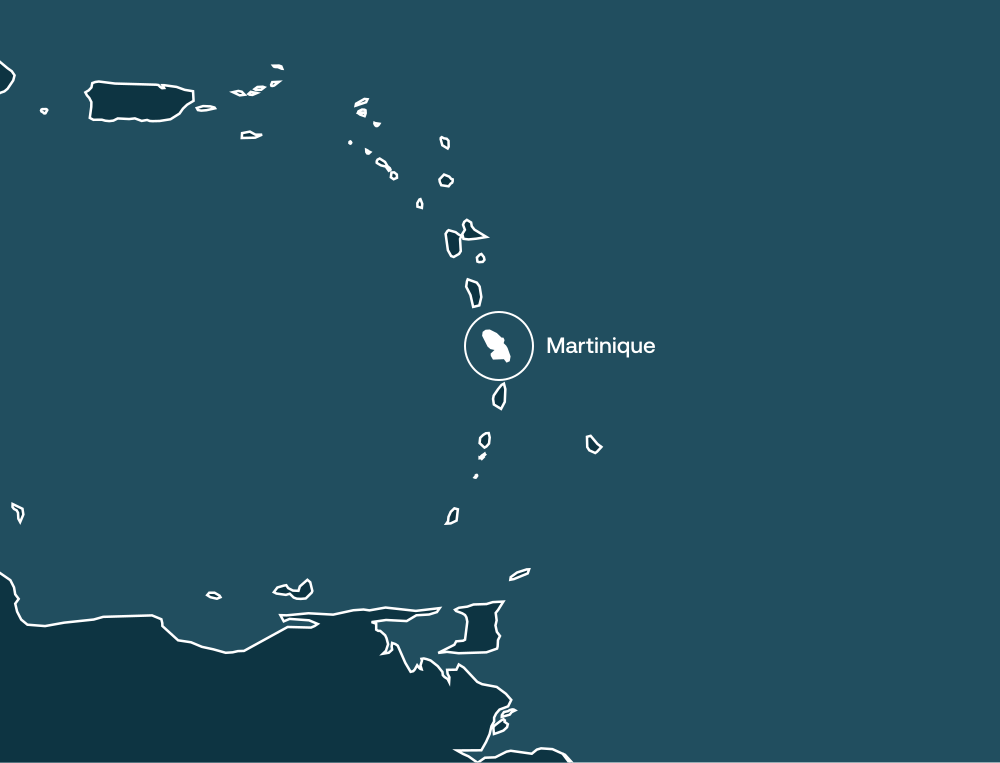
Martinique is a French overseas department in the Eastern Caribbean, positioned near Dominica, Saint Lucia, and Saint Vincent and the Grenadines, within a wider regional network that includes Barbados and the Dominican Republic. Its surroundings feature varying combinations of violent crime, drug-trafficking routes, organized-crime exposure, governance concerns, and pressure on law-enforcement institutions such as the Royal Saint Lucia Police Force. These dynamics are particularly relevant to the Martinique–Saint Lucia–Saint Vincent corridor, where regional security conditions intersect with broader Caribbean trafficking patterns.
As part of France, Martinique is connected to a state with a hybrid presidential-parliamentary system and a prominent role in the United Nations Security Council, NATO, the G-7, the G-20, and the European Union. France’s relationship with Germany and its participation in European integration, including the euro, provide an important wider context for understanding the island’s institutional setting. Across nearby jurisdictions, sanctions frameworks generally center on United Nations measures, while the Dominican Republic has additionally drawn United States sanctions linked to corruption and narcotics.
AML & Terrorist Financing
Martinique, as an overseas department of France, falls within a generally strong AML/CFT framework that is not subject to FATF strategic-deficiency listing, although certain overseas and non-financial sectors present more uneven levels of risk awareness and supervision. France’s 2022 evaluations point to effective use of TRACFIN intelligence, strong terrorist-financing investigations involving the DGSI and PNAT, and notable asset-recovery work by AGRASC, while also highlighting challenges involving complex money-laundering cases, beneficial-owner identification, reporting delays, and oversight of real estate, notaries, lawyers, and other DNFBPs. Cross-border illicit flows, fraud, drug trafficking, corruption, human trafficking, virtual assets, and micro-financing channels remain areas of interest, with the AMF, ACPR, PNF, OCRGDF, and the Beneficial Owner Register forming part of the wider response.
Sanctions
As an overseas department of France, Martinique applies UN-transposed, EU, and autonomous French restrictive measures, including asset freezes, travel bans, sectoral restrictions, and arms controls aimed at specific governments, entities, and individuals. Enforcement activity involving the French Customs Office, financial regulators, raids, asset freezes, and the REPO Task Force has focused particularly on evasion networks connected with Russia, Belarus, and Iran, including transit through neighboring states and third-country intermediaries. No international sanctions are currently in force against Martinique, while France’s proposed Customs Code changes following EU Directive 2024/1226 indicate further development of penalties for sanctions violations.
Criminality
Martinique’s status as an overseas department of France places it within a national framework featuring the Loi Sapin II, the High Authority for Transparency in Public Life, and the Agence Française Anticorruption, although concerns remain over political trust and appointments involving individuals facing corruption cases. Assessments by the OECD Working Group on Bribery have also identified uneven enforcement, limited convictions, unresolved legal obstacles, and questions about prosecutorial independence and resources, with the National Financial Prosecutor and OCLCIFF handling major financial and bribery investigations.
Reports
As a French overseas department, Martinique falls within a national framework that meets minimum anti-trafficking standards, while persistent concerns include declining prosecutions, inconsistent victim referral, and vulnerabilities affecting foreign nationals, children, and people in precarious work. France’s “Emergency Attack” posture, Operation Sentinelle, and the disruption of nine planned terrorist attacks in 2024 reflect a security environment shaped by lone actors, extremist networks, geopolitical tensions, and ongoing border challenges.
Economy & Investment Climate
Martinique’s €8.4 billion economy in 2014 reflects a transition from traditional sugar and banana production toward tourism, while banana cultivation now contributes only a modest 1.6% of GDP and the island continues to depend heavily on imports and support from mainland France. Its status as a French overseas department provides legal stability and EU market access, but high import costs and tourism dependence make diversification through renewable energy, technology, and infrastructure especially significant.
Cryptocurrency Regulations
Martinique follows France and the European Union’s cryptocurrency framework, with the euro remaining the official currency while digital assets and exchanges operate under oversight associated with the AMF, ACPR, PACTE law, and AML/CFT requirements. Tax treatment, registration expectations, transaction monitoring, and potential ICO activity point to a structured but evolving environment, including DGFiP reporting obligations and a stated 30% flat tax on qualifying crypto gains.
Get full access
The information on this page is a brief summary. Get access to EDD country reports, all risk category scores and customisable weightings for 245 jurisdictions.