
Risk Indicators
- FATF/EU Blacklist/Greylist (Lower Concern)
- Terrorism Financing (Lower Concern)
- US Dept of State INCSR
- Proliferation Financing
- Corruption
- Criminality
- Resilience & Governance
- Financial Transparency
- Offshore Finance Centres
- Sanctions
Background
Mexico’s long history encompasses major Amerindian civilizations, three centuries as the Viceroyalty of New Spain, and independence followed by shifting political dominance among the PAN, PRI, and MORENA. The 2000 election marked a major break in modern political history, while the presidencies of Vicente FOX, Felipe CALDERON, Enrique PEÑA NIETO, and Andrés Manuel LÓPEZ OBRADOR reflect successive transformations. Today, the USMCA—known domestically as T-MEC—coexists with persistent concerns over wages, underemployment, inequality, and limited opportunities for indigenous communities in the south.
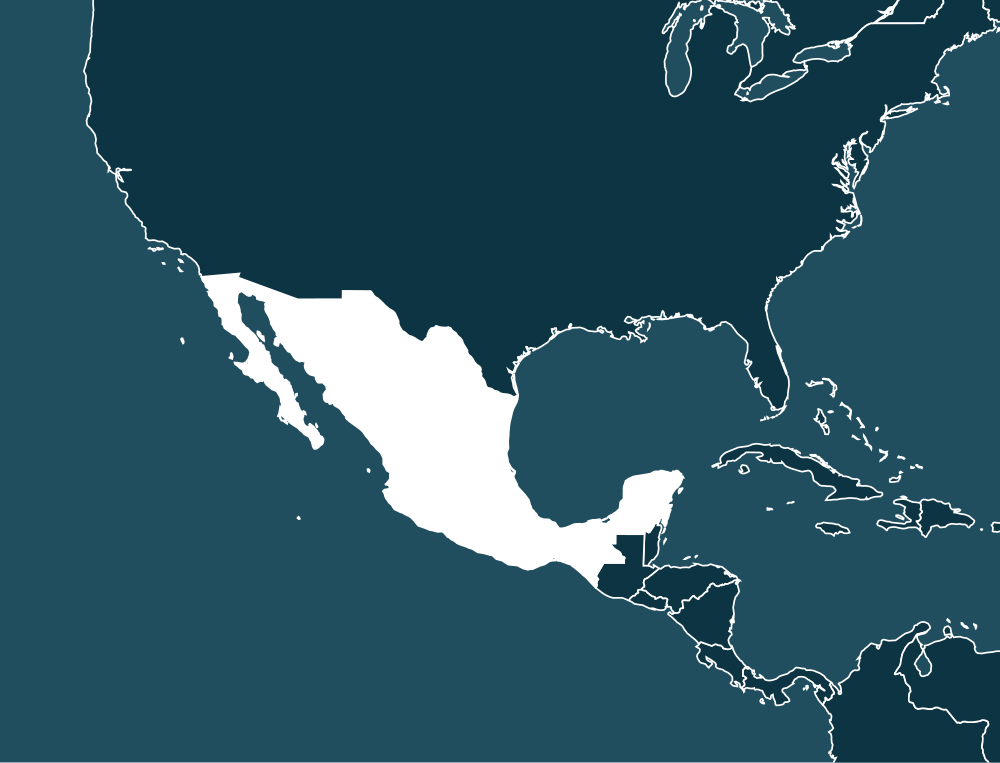
Mexico’s strategic position between the United States, Guatemala, and Belize places it at the center of overlapping trade, migration, trafficking, and security pressures. Relations with Washington have become especially sensitive amid tariffs, fentanyl flows, strained cooperation, and questions surrounding the role of military forces, while the U.S. Treasury and OFAC have targeted networks associated with the Sinaloa Cartel and CJNG. Border areas near Guatemala face cartel competition and trafficking risks, and complex financial channels involving Mexico-based companies and China add further layers to the sanctions and enforcement landscape.
AML & Terrorist Financing
Mexico has a mature AML/CFT framework and is not on the FATF list of jurisdictions with strategic deficiencies, yet significant exposure remains to laundering linked to drug trafficking, corruption, tax evasion, bulk cash smuggling, trade-based schemes, and real estate. The UIF generates useful financial intelligence, but limited dissemination, uneven beneficial-ownership identification, under-resourced DNFBP supervision, and coordination challenges constrain investigations and prosecutions by the FGR, with asset recovery presenting additional obstacles. Terrorist-financing risk is considered relatively low, although the UEITA framework, targeted financial sanctions, non-profit oversight, and proliferation-financing controls reveal areas where implementation, prioritization, and access to timely ownership information remain important.
Sanctions
Mexico supports UN Security Council sanctions regimes, while no international sanctions are currently in force against the country itself. The United States has imposed targeted measures on Mexico-based cartels—including Sinaloa and CJNG—and on certain Mexican entities and individuals linked to alleged Venezuela- and Russia-related sanctions evasion. Specific concerns involve Libre Abordo, Schlager Business Group, PDVSA oil movements, restricted-goods transshipment, and the contrast between Mexico’s Financial Intelligence Unit freezing sanctioned accounts and Pemex facing secondary-sanctions risks.
Criminality
Mexico faces pervasive corruption across public and private sectors, including bribery, diversion of public funds through fictitious companies, procurement abuses, fraud, and conflicts of interest, while the National Anti-Corruption System has produced few widely recognized successes and state-level implementation remains uneven. Criminal markets are broad and sophisticated, spanning drug trafficking, extortion, human trafficking, arms, counterfeit goods, environmental crimes, financial offenses, and cybercrime, with territorial control by Mexican criminal organizations and alleged state-linked corruption complicating efforts by institutions such as the Secretariat of Anticorruption and Good Government and civil society groups including Mexicanos Contra la Corrupción y la Impunidad.
Reports
Mexico remains a pivotal hub for synthetic drug production, trafficking, and cross-border security concerns, with the Sinaloa and Jalisco New Generation cartels, precursor chemical networks, and the Secretariat of the Navy, Defensa, National Guard, and Attorney General’s Office featuring prominently in enforcement efforts. Trafficking vulnerabilities extend from agricultural labor and migration routes to online recruitment and forced criminality, while cooperation through the Bicentennial Framework, Trilateral Fentanyl Committee, and U.S.-Mexico counterterrorism channels continues alongside persistent challenges involving corruption, impunity, victim services, and cartel use of armed drones and IEDs.
Industry/Product Sector Risk
Mexico’s industry landscape presents pronounced exposure to money laundering through banks, correspondent channels, remitters, currency exchange businesses, real estate, casinos, trade finance, and cash-intensive enterprises, while virtual currencies and several investment-related sectors appear less prominent by comparison. Supervisory roles involving SEGOB, SAT, CNBV, CNSF, and the FIU reveal a varied regulatory picture, with recurring concerns around beneficial ownership, shell and front companies, cross-border flows, informal activity, and uneven reporting or inspection coverage. The underlying threats span drug trafficking, organised crime, corruption, tax evasion, extortion, kidnapping, human trafficking, and fuel theft, creating important connections between financial services, professional gatekeepers, public contracting, hospitality, transportation, and property markets.
Economy & Investment Climate
Mexico combines deep North American integration, a large consumer base, and strong potential in sectors such as automotive, aerospace, electronics, and nearshoring, with 2024 trade and investment activity underscoring its importance to international business. At the same time, Banxico’s inflation challenge, evolving energy and judicial reforms, SAT compliance practices, security concerns, and intellectual-property issues highlighted by USTR create a complex operating environment for investors.
Cryptocurrency Regulations
Mexico treats cryptocurrency as a regulated virtual asset rather than legal tender, with the Fintech Law, LFPIORPI, Banco de México, CNBV, SAT, and UIF shaping requirements for exchanges, VASPs, taxation, and transaction monitoring. While the framework emphasizes KYC, AML reporting, and future alignment with FATF and CARF standards, evolving rules around the Travel Rule, token offerings, real-world asset tokenization, and events such as airdrops leave important areas open to interpretation.
Get full access
The information on this page is a brief summary. Get access to EDD country reports, all risk category scores and customisable weightings for 245 jurisdictions.