
Risk Indicators
- FATF/EU Blacklist/Greylist (Medium Concern)
- Terrorism Financing (Medium Concern)
- US Dept of State INCSR
- Proliferation Financing
- Corruption
- Criminality
- Resilience & Governance
- Financial Transparency
- Offshore Finance Centres
- Sanctions
Background
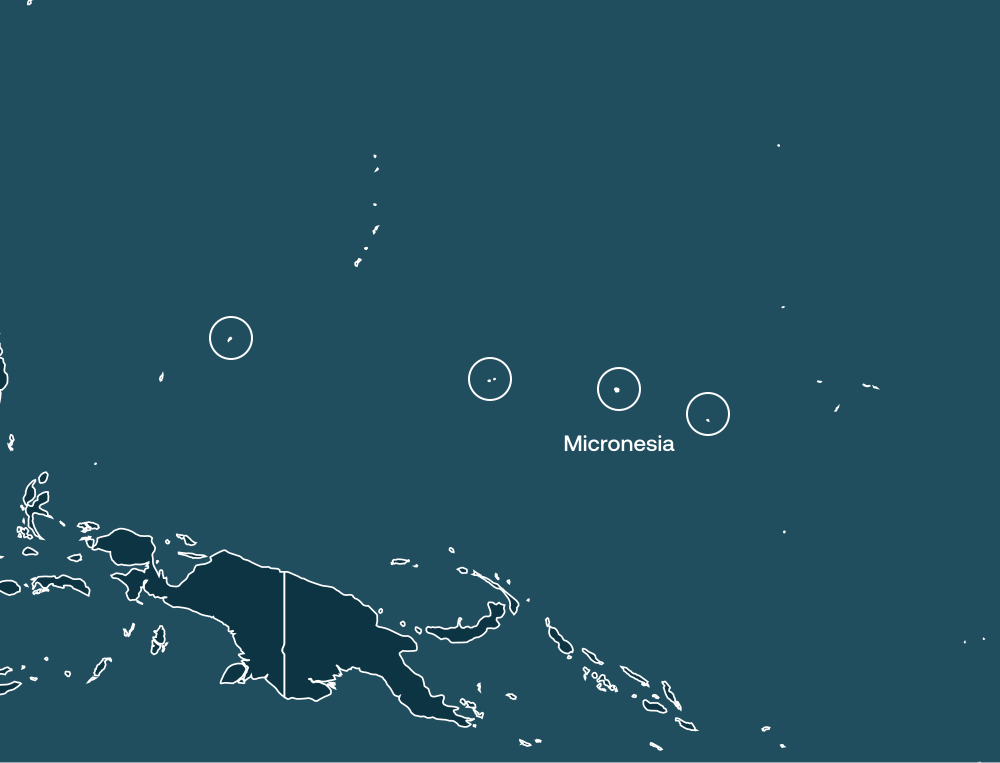
The Federated States of Micronesia brings together Chuuk, Kosrae, Pohnpei, and Yap, each shaped by distinct traditions, political histories, and relationships among island communities. Ancient centers such as Nan Madol and Leluh, along with Yap’s far-reaching chiefly networks and Chuuk’s historical rivalries, reflect a region of considerable cultural complexity. European, German, Japanese, and American involvement later transformed these societies, culminating in the constitutional formation of the FSM in 1979.
The country’s western Pacific setting places it alongside the Marshall Islands, Palau, Papua New Guinea, and Guam, linking its regional context to maritime security, governance, and strategic competition. Nearby concerns range from the Marshall Islands’ corruption allegations, trafficking risks, and nuclear legacy to Palau’s traditional-versus-modern political tensions and the Papua New Guinea Defence Force’s struggles with internal violence. Ship registries, sanctions, and alleged evasion networks involving Russian and Iranian-linked petroleum or LNG activity add a further layer of significance, while Guam remains a major U.S. strategic presence.
AML & Terrorist Financing
Micronesia is not identified by FATF as having strategic AML deficiencies, yet it has not completed a mutual evaluation and was classified as a “Monitored” jurisdiction in the 2016 U.S. INCSR, reflecting a generally low-risk environment with potential exposure through dollar flows, limited oversight capacity, and public-sector corruption. AML responsibilities center on the Department of Justice, its National Police and FIU, with support from the Department of Finance & Administration, but the FIU has historically operated with a single officer and the country remains dependent on U.S. assistance for complex matters. A 2015 money laundering case linked to human trafficking produced one prosecution and conviction, while gaps remain around terrorist-financing offences, asset confiscation, international information exchange, APG participation, and the absence of a publicly accessible beneficial ownership register.
Sanctions
Micronesia supports United Nations Security Council sanctions, including measures reflected on the Consolidated List and administered through sanctions committees. These obligations may involve targeted tools such as arms embargoes, travel bans, and financial or commodity restrictions across the 15 regimes ongoing as of mid-2026. No international sanctions are currently in force against Micronesia.
Criminality
Micronesia faces persistent corruption concerns, including procurement fraud, conflicts of interest, suspected bribery, and money-laundering risks linked to fishing and access licenses, with Pohnpei and Yap pursuing notable cases. Criminal activity also includes human trafficking, IUU fishing, cannabis distribution, emerging methamphetamine activity, counterfeit and excise-goods trading, and occasional cyber and financial crimes, while the National Office of the Public Auditor and state prosecutors remain central to enforcement.
Reports
The Federated States of Micronesia remains on Tier 2, with renewed anti-trafficking activity including investigative work, victim identification procedures, official training, committee efforts, and outreach to diaspora communities, while prosecutions and victim assistance remain notably absent. Trafficking risks span informal employment, migration and recruitment channels, fishing vessels, online platforms, and commercial sex, with climate-related displacement and limited opportunities on outer islands adding to the vulnerability of Micronesian and foreign nationals.
Economy & Investment Climate
Micronesia’s lower-middle-income economy remains shaped by Compact of Free Association transfers, commercial fishing, government employment, and a largely subsistence-based livelihood, with services providing the largest share of GDP. While long-term support funds, tourism, aquaculture, agriculture, and renewable energy offer potential, investment is constrained by state-level regulations, land ownership disputes, unreliable infrastructure, limited finance, and shortages of skilled workers.
Cryptocurrency Regulations
In the Federated States of Micronesia, cryptocurrency exists in a largely undefined space: it is not legal tender—the U.S. dollar remains official—and there is no dedicated framework for VASPs, exchanges, token offerings, or digital-asset taxation. The absence of a FATF Mutual Evaluation, Travel Rule implementation, CARF commitment, and clear supervisory authority leaves compliance, transaction tracking, and consumer protections largely uncertain, creating a landscape whose future may depend on more formal regulation.
Get full access
The information on this page is a brief summary. Get access to EDD country reports, all risk category scores and customisable weightings for 245 jurisdictions.