
Risk Indicators
- FATF/EU Blacklist/Greylist (Lower Concern)
- Terrorism Financing (Lower Concern)
- US Dept of State INCSR
- Proliferation Financing
- Corruption
- Criminality
- Resilience & Governance
- Financial Transparency
- Offshore Finance Centres
- Sanctions
Background
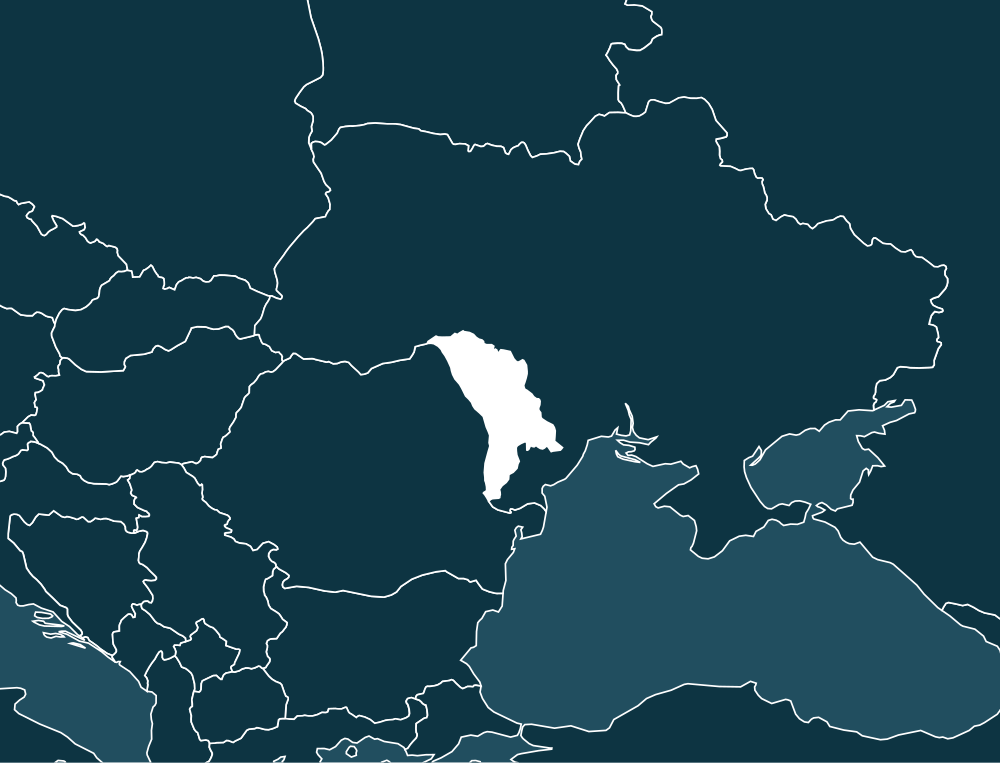
Moldova’s modern trajectory reflects successive shifts between Russian, Romanian, Soviet, and independent statehood, with Russian forces still present east of the Nistru River. Following the upheaval surrounding the 2009 elections, power moved among pro-European and pro-Russian forces before Maia SANDU’s reformist victory and the subsequent rise of the Party of Action and Solidarity. Prime Minister Dorin RECEAN’s cabinet, confirmed in 2023, largely continued the governing approach established under Natalia GAVRILITA.
Moldova’s security environment is shaped by the war in Ukraine, the unresolved status of Transnistria, and competing pressures over energy, borders, and political alignment. Russian troops and pro-Russian networks in Transnistria remain a central concern, while EU and Moldovan sanctions address alleged interference, disinformation, and destabilization linked to figures such as Ilan Shor. Romania provides support for European integration and energy diversification, even as Moldova manages refugee pressures, economic disruption, and the risks identified in its national security strategy.
AML & Terrorist Financing
Moldova has strengthened its AML/CFT framework and is not on the FATF list of jurisdictions with strategic deficiencies, yet MONEYVAL continues to keep it under enhanced follow-up after identifying uneven effectiveness across supervision, beneficial ownership controls, virtual assets, and financial sanctions. Money laundering risks remain linked to corruption, tax evasion, smuggling, cash-intensive activity, shell companies, and opaque ownership structures, while the SPCML’s very high volume of suspicious transaction reports and the limited recovery of criminal assets raise questions about how effectively financial intelligence is converted into prosecutions and confiscations. Terrorist-financing risk is assessed as relatively low, with SIS and PCCOCS demonstrating investigative capacity, but gaps remain in sanctions implementation outside banking, monitoring vulnerable non-profit organisations, and awareness of proliferation-financing obligations—issues that continue to shape Moldova’s AML priorities alongside the legacies of the “Global Laundromat” and “Bank Fraud.”
Sanctions
Moldova supports UN sanctions and commonly aligns with EU measures, including targeted restrictions on individuals and entities linked to destabilization, corruption, and threats to its sovereignty. No country-specific sanctions, arms embargo, or trade restrictions are in force against the Moldovan state; instead, US, EU, and UK actions—including measures involving Vladimir Plahotniuc, Ilan Shor, Evgenia Gutul, and Evrazia—are intended to protect Moldova’s democratic institutions. At the same time, cooperation with OLAF and EU agencies has focused on curbing routes involving Russia, Transnistria, Kyrgyz banking channels, dual-use goods, and other suspected sanctions-evasion activity.
Criminality
Corruption remains a significant problem in Moldova despite renewed reform efforts, with the National Anticorruption Center, Anticorruption Prosecution Office, and Criminal Assets Recovery Agency pursuing cases involving officials, illicit enrichment, election financing, and money laundering. Progress in major investigations has been uneven, while concerns about limited resources, political interference, procurement vulnerabilities, and the slow recovery of assets linked to the “billion-dollar theft” continue to shape the country’s crime and corruption landscape.
Reports
Moldova remains on Tier 2 as authorities expand trafficking investigations, prosecutions, victim-identification tools, and coordination through the Ministry of Labor and Social Protection and Drochia’s specialized group, including a notable conviction of a former police officer. Persistent gaps in staffing, funding, victim services, and oversight—particularly amid risks affecting children, refugees, rural and disabled populations, informal workers, and residents of Transnistria—highlight the complexity of trafficking within Moldova and beyond its borders.
Industry/Product Sector Risk
Moldova’s highest-exposure areas sit at the intersection of cash-intensive activity, cross-border finance and politically connected wealth, with banks and correspondent relationships linked to the legacy of the Banking Fraud and Global Laundromat. The National Bank of Moldova and National Commission for Financial Markets oversee sectors ranging from remittances and currency exchange to investment services and microfinance, where supervisory maturity, beneficial ownership and transaction-monitoring concerns vary considerably. Real estate, trade finance, professional intermediaries and selected non-profit activity add further layers of potential exposure involving corruption, tax evasion, smuggling, fraud and organised crime proceeds.
Economy & Investment Climate
Moldova’s economy is gradually pivoting toward the European Union, supported by accession negotiations, the DCFTA, IMF financing, and initiatives such as “European Moldova 2030,” yet recovery remains constrained by weak growth, energy and supply-chain shocks, low productivity, labor outmigration, and reliance on remittances. Investment opportunities exist across ICT, agriculture, manufacturing, automotive, and energy, with support from the Investment Agency and ODA, although uneven regulatory enforcement, corruption concerns, limited credit access, state-owned enterprise influence, and ongoing justice-sector reforms continue to shape the business environment.
Cryptocurrency Regulations
Moldova’s digital-asset landscape is defined by a restrictive stance following Law No. 66 of March 30, 2023, which prohibits cryptocurrency transactions while still leaving certain holdings and related income subject to scrutiny. The National Bank of Moldova, National Commission for Financial Markets, and 2024 National Risk Assessment point to an AML-focused framework, but exchanges, VASPs, ICOs, and tokenization activities remain largely without a practical legal pathway.
Get full access
The information on this page is a brief summary. Get access to EDD country reports, all risk category scores and customisable weightings for 245 jurisdictions.