
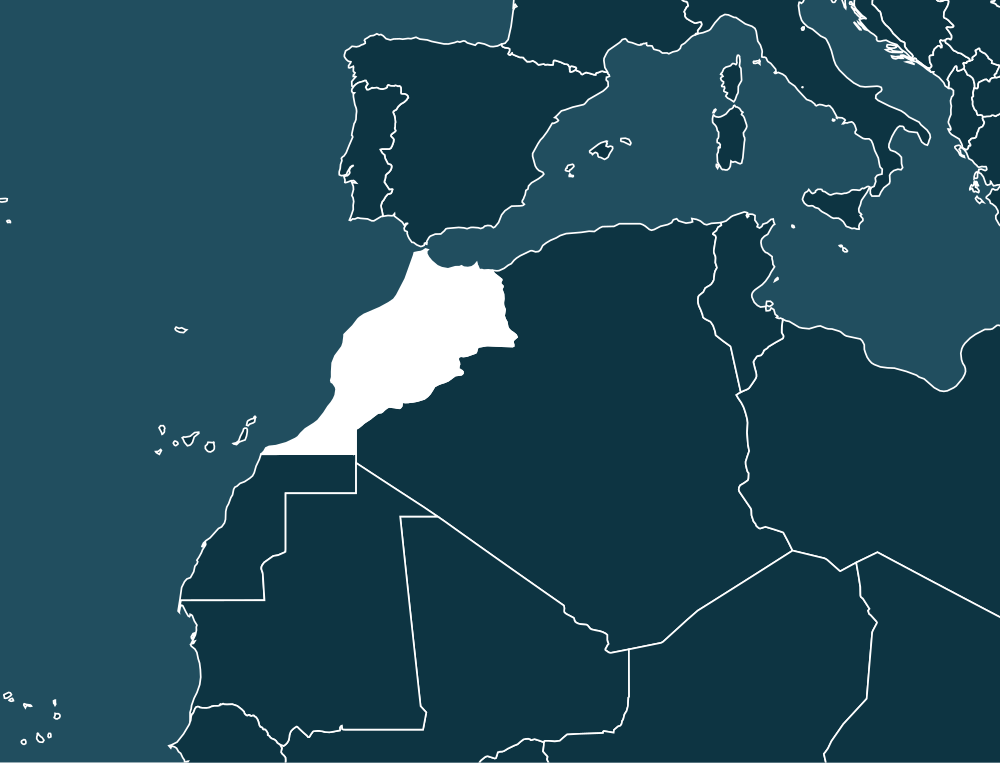
Risk Indicators
- FATF/EU Blacklist/Greylist (Lower Concern)
- Terrorism Financing (Lower Concern)
- US Dept of State INCSR
- Proliferation Financing
- Corruption
- Criminality
- Resilience & Governance
- Financial Transparency
- Offshore Finance Centres
- Sanctions
Background
Morocco’s modern identity reflects centuries of Muslim dynastic rule, the legacy of the Alaouite Dynasty, European intervention, and independence achieved in 1956. Under King Mohammed VI, reforms following the 2011 regional protests expanded the formal role of parliament and the prime minister, while ultimate authority remained with the monarchy and electoral politics shifted from the PJD to the RNI. Its regional position is shaped by the unresolved Western Sahara question, where Morocco exercises extensive de facto control, the Polisario Front contests sovereignty, and MINURSO continues to face operational challenges.
Morocco’s strategic environment is further complicated by its diplomatic rupture with Algeria, Mauritania’s careful “positive neutrality,” and recurring friction with Spain over Western Sahara, migration, and maritime issues. Algeria’s support for the Polisario Front has contributed to military and political tensions, while Mauritania’s role as Morocco’s only land route to Sub-Saharan Africa links its stability to wider Maghreb and Sahel dynamics. Sanctions-related developments nearby—including French measures involving Algerian officials and Mauritania’s cancellation of a Poly Technologies contract following U.S. pressure—illustrate the broader compliance and geopolitical sensitivities surrounding Morocco.
AML & Terrorist Financing
Morocco has made notable progress in strengthening its AML/CFT framework and is no longer subject to FATF increased monitoring, though it remains in MENAFATF enhanced follow-up with effectiveness and technical-compliance issues still requiring attention. Risks are associated with cash-intensive activity, remittances, drug trafficking, cross-border flows, and the use of real estate and other sectors, while the UTRF, Bank Al-Maghrib, AMMC, and ACAPS operate within a developing supervisory structure. Particular areas of continued interest include the practical use of financial intelligence, complex money-laundering investigations and confiscation, timely beneficial-ownership access, oversight of DNFBPs and NPOs, and the implementation of targeted financial sanctions for terrorism and proliferation financing.
Sanctions
Morocco currently faces no international sanctions and maintains no autonomous sanctions list, while implementing binding UN Security Council measures as a UN member. Although Morocco is part of the Arab League, its former Syria-related measures are no longer in force, and the bloc’s Israel boycott is not applied in practice following Morocco’s 2020 normalization and continuing ties with Israel. At the same time, Moroccan ports such as Casablanca and Tangier have been identified in connection with alleged sanctions-evasion routes benefiting Russia, involving Western technology, transshipment, shell companies, and intermediary networks despite compliance efforts including the 2023 Morocco-UAE MOU.
Criminality
Morocco faces persistent corruption concerns alongside organized criminal activity involving drug trafficking, human smuggling, trafficking in persons, counterfeiting, financial fraud, and cybercrime, with some networks reportedly connected to political and administrative circles. The Public Prosecutor’s Office investigated hundreds of corruption cases in the first half of 2024, while the INPLCC, anti-corruption hotline, and Transparency Maroc provide avenues for reporting amid continuing concerns about official accountability, illicit trade, and public-sector integrity.
Reports
Morocco is confronting evolving narcotics and security threats, including synthetic drugs and cocaine moving through northern and southern routes, increased hashish seizures, and sporadic ISIS-inspired activity addressed by the Central Bureau of Judicial Investigation and international partners. At the same time, trafficking vulnerabilities affect Moroccan children, migrants, domestic workers, and people seeking opportunities abroad, while government efforts—including expanded investigations, victim services, border controls, and prevention programs—continue to face implementation and resource challenges.
Industry/Product Sector Risk
Morocco’s financial and commercial landscape spans a dominant banking sector, substantial remittance and cash-based activity, regional trade links, and a broad DNFBP community, with oversight involving BAM, ACAPS, AMMC, UTRF, the Ministry of Interior, and the Ministry of Justice. Heightened exposure is associated with casinos, MVTS, cash-intensive businesses, real estate, transportation, and construction, where vulnerabilities include cross-border flows, limited beneficial-ownership transparency, informal activity, and proceeds linked to narcotics, corruption, fraud, smuggling, and migrant trafficking. By contrast, investment funds, securities dealers, and correspondent banking appear more contained, although uneven risk understanding, limited DNFBP inspections, and the evolving treatment of politically exposed persons leave important areas for closer examination.
Economy & Investment Climate
Morocco is positioning itself as a politically stable gateway between Europe, Africa, and the Middle East, combining expanding infrastructure, trade access, and incentives under Framework Law 03-22 to attract investment into manufacturing, automotive, aerospace, renewable energy, digital services, and agro-industry. Strong institutions such as AMDIE, Bank Al-Maghrib, and the regional investment centers support this ambition, although bureaucracy, regulatory delays, workforce challenges, informality, and uneven investment flows remain important considerations.
Cryptocurrency Regulations
Morocco is moving from its 2017 cryptocurrency ban toward a Bank Al-Maghrib-led framework shaped by FATF principles and developed with input from institutions such as the World Bank and IMF. While exchanges, VASPs, ICOs, and transaction-monitoring obligations remain in formation, the DGI’s treatment of crypto as intangible assets—with a 20% capital-gains rate and recordkeeping expectations—already signals a more structured compliance direction.
Get full access
The information on this page is a brief summary. Get access to EDD country reports, all risk category scores and customisable weightings for 245 jurisdictions.