
Risk Indicators
- FATF/EU Blacklist/Greylist (Lower Concern)
- Terrorism Financing (Higher Concern)
- US Dept of State INCSR
- Proliferation Financing
- Corruption
- Criminality
- Resilience & Governance
- Financial Transparency
- Offshore Finance Centres
- Sanctions
Background
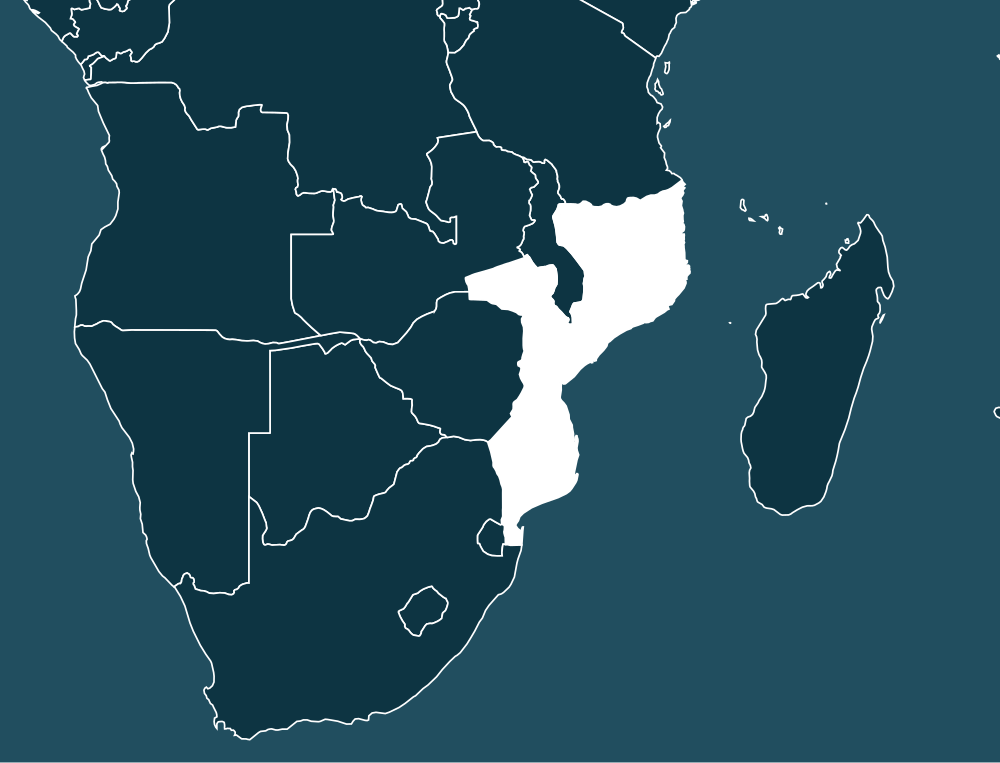
Mozambique’s history reflects centuries of Indian Ocean commerce, Portuguese colonial rule, and a difficult post-independence period shaped by economic dependence, drought, and civil war. The transition from FRELIMO’s Marxist orientation to multiparty politics, followed by the 1992 peace agreement with RENAMO, marked an important but fragile political transformation. Leadership changes from Joaquim CHISSANO to Armando GUEBUZA and then Filipe NYUSI accompanied continuing efforts to consolidate peace and governance.
Since 2017, northern Cabo Delgado has faced a violent insurgency associated with the Islamic State, producing extensive displacement, humanitarian pressures, and threats to gas, mining, and transport interests. Regional responses have included deployments by Rwanda and the Southern African Development Community, whose SAMIM mission ended in July 2024, while instability has affected routes and ports serving neighbours such as Zambia and South Africa. Mozambique’s placement on the FATF list for AML/CFT deficiencies, concerns surrounding tax treaties and illicit financial flows, and sanctions targeting Islamic State-linked actors add further complexity to its security and economic environment.
AML & Terrorist Financing
Mozambique has made significant AML/CFT progress and is no longer subject to FATF strategic-deficiency listing, with reforms involving the Banco de Moçambique, GIFiM/UIF, beneficial ownership registration, and enhanced cooperation with ESAAMLG. Nevertheless, exposure to corruption, narcotics and wildlife trafficking, illicit cross-border flows, cash-based activity, and terrorist financing risks linked to Cabo Delgado continues to test the effectiveness of the country’s framework. Persistent concerns include uneven supervision of DNFBPs, limited use of financial intelligence by SERNIC and prosecutorial authorities, weaknesses in targeted financial sanctions and proliferation-financing controls, and the still-developing ability to investigate, prosecute, and confiscate proceeds of crime.
Sanctions
Mozambique implements United Nations Security Council sanctions measures, including those reflected on the Consolidated List, but the available material does not identify an independent Mozambican sanctions regime imposed on other nations. No international sanctions are currently in force against Mozambique as a country, although the United States has designated ISIS-Mozambique and associated leaders and facilitators under Executive Order 13224. At the same time, UN reporting and references to the Port of Beira, opaque corporate structures, and routes involving Russia and North Korea point to continuing sanctions-evasion concerns, alongside Mozambique’s 2025 electronic cargo-tracking response.
Criminality
Mozambique faces entrenched corruption involving rent-seeking, bribery, politically connected interests, and alleged collusion among judicial, law-enforcement, and trade officials, as illustrated by the unresolved Nampula agricultural export dispute and the hidden-debts prosecutions. Organized criminal activity spans trafficking, kidnapping, narcotics, arms, illicit timber and wildlife, smuggling, and financial crime, while state-embedded actors and networks linked to ports and political figures complicate enforcement despite institutions such as the GCCC and GIFiM.
Reports
Mozambique’s exposure to transnational drug trafficking, synthetic-drug production, human trafficking, and terrorism remains pronounced, with SERNIC and DEA investigations uncovering cocaine shipments and methamphetamine laboratories while displacement and conflict heighten vulnerabilities in Cabo Delgado and beyond. At the same time, ISIS-M violence expanded geographically in 2024, even as Rwandan, Tanzanian, EU, and other partners supported security efforts and the government made uneven progress against trafficking and illicit finance.
Industry/Product Sector Risk
Mozambique’s financial and broader commercial landscape is shaped by substantial exposure to illicit finance, particularly across cash-intensive activities, cross-border trade, mining, transport, real estate, gaming, and public infrastructure. The Central Bank, FIU, Gaming Board and Inspectorate of Games, OCAM, and the Bar Association each have roles in overseeing parts of the system, though informality, limited risk-based supervision, weak beneficial ownership transparency, and porous borders remain recurring concerns. From mobile money and correspondent banking to Cabo Delgado’s extractive activity, NPO operations, and the legacy of the “hidden debt” scandal, the sector-specific dynamics offer important insight into where financial crime risks may concentrate.
Economy & Investment Climate
Mozambique combines substantial opportunity from its coastline, ports, agricultural potential, minerals, and Rovuma Basin gas developments—including renewed momentum for Mozambique LNG and a second FLNG project—with a business environment shaped by political uncertainty, foreign-exchange constraints, infrastructure gaps, and insecurity in Cabo Delgado. Reforms associated with APIEX, the PAE package, and President Daniel Chapo’s anticipated agenda may improve conditions, but state-controlled land, complex approvals, limited financing, corruption concerns, and pressure for local participation remain important considerations for investors.
Cryptocurrency Regulations
Mozambique’s cryptocurrency landscape remains cautious and largely undefined, with the Banco de Moçambique warning that digital assets are not legal tender while broader financial and electronic-transaction laws provide only limited direction. The 2024 AML Act brings virtual-asset businesses into a stricter compliance orbit overseen in part by GIFiM, yet questions around VASP licensing, tax tracking, token offerings, and the Travel Rule leave significant uncertainty for market participants.
Get full access
The information on this page is a brief summary. Get access to EDD country reports, all risk category scores and customisable weightings for 245 jurisdictions.