
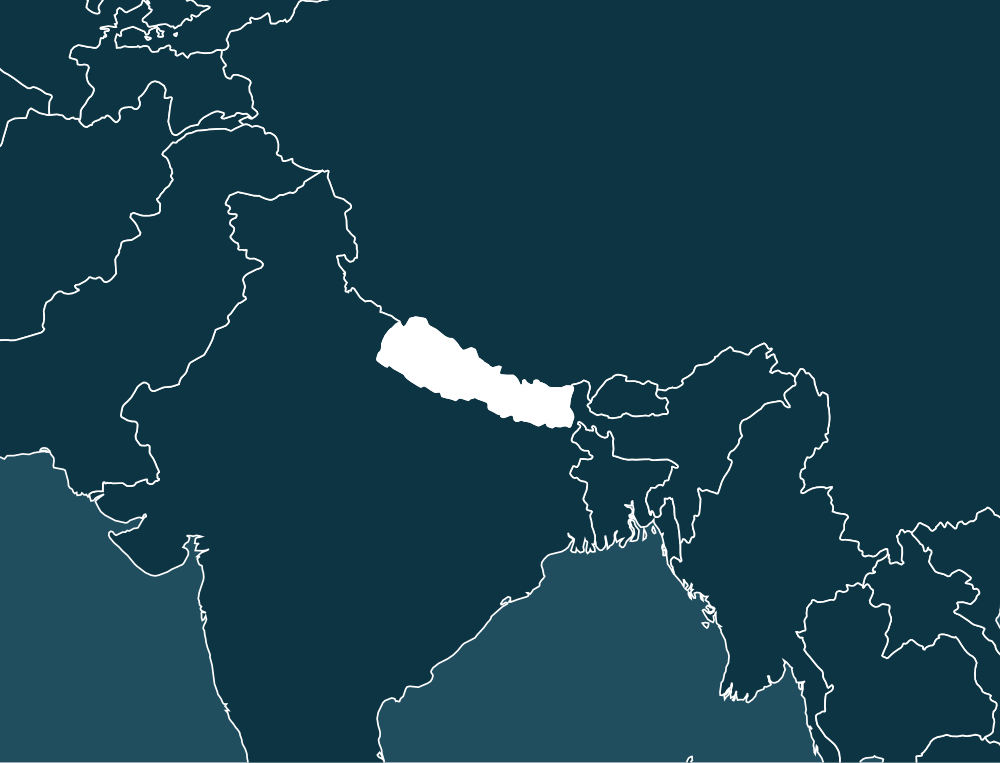
Risk Indicators
- FATF/EU Blacklist/Greylist (Higher Concern)
- Terrorism Financing (Medium Concern)
- US Dept of State INCSR
- Proliferation Financing
- Corruption
- Criminality
- Resilience & Governance
- Financial Transparency
- Offshore Finance Centres
- Sanctions
Background
From the Gorkha-led unification of the sub-Himalayan principalities through the Anglo-Nepalese War and the enduring Gurkha connection with Britain, Nepal developed a distinctive political and diplomatic identity. Its transition from hereditary monarchy to cabinet government, multiparty constitutional monarchy, and ultimately a federal democratic republic was marked by repeated institutional reversals. The 1996–2006 Maoist insurgency, the 2001 royal massacre, the Constituent Assembly process, and the 2015 constitution reshaped the state while leaving coalition politics highly fluid.
Positioned between India and China and linked to Pakistan through wider regional tensions, Nepal faces a demanding balancing act involving open borders, trade dependence, infrastructure competition, and security spillover. Agreements involving China, Tibetan refugees, and mutual legal assistance sit alongside concerns about sovereignty, human rights, and the country’s ability to manage sensitive cross-border matters. Porous borders, uneven enforcement of targeted financial sanctions, limited extradition arrangements with India and China, and moderate counter-terrorist-financing capacity add further complexity to Nepal’s effort to preserve neutrality and control illicit activity.
AML & Terrorist Financing
Nepal remains under enhanced international scrutiny, including FATF strategic-deficiency listing and the European Commission’s high-risk jurisdiction designation, amid uneven progress in strengthening its AML/CFT framework. Key concerns include limited risk understanding, informal hundi channels, porous borders, corruption, weak beneficial-ownership information, and insufficient risk-based supervision beyond major banks, while FIU-Nepal and the Department of Money Laundering Investigation continue building operational effectiveness. Terrorist-financing and proliferation-financing controls remain particularly underdeveloped, reflected in low-effectiveness assessments, limited investigations, shortcomings in targeted financial sanctions, and the absence of demonstrated asset freezes.
Sanctions
Nepal is required to implement United Nations Security Council sanctions, including measures reflected on the Consolidated List and regimes addressing terrorism, non-proliferation, and international conflicts. No international sanctions are currently in force against Nepal, although its 2025 FATF grey-list status highlights vulnerabilities rather than constituting a sanctions regime. Concerns include alleged North Korean-linked procurement and financial activity, informal hundi transfers, and possible diversion through Birgunj, Tribhuvan International Airport, and Indian-connected corridors such as Kolkata and Vishakhapatnam.
Criminality
Corruption is described as widespread and deeply embedded in Nepal’s public processes, particularly licensing, procurement, taxation, and policing, while enforcement of the Prevention of Corruption Act 2002 remains limited and the judiciary is vulnerable to influence. The Commission for the Investigation of Abuse of Authority (CIAA) has increasingly pursued cases involving senior political figures, but Nepal also faces significant trafficking, extortion, illicit trade, financial fraud, environmental crime, and drug- and cyber-related activity involving networks linked to both public and private actors.
Reports
Nepal continues to face significant trafficking risks affecting vulnerable communities, migrant workers, and children, while government efforts include increased prosecutions and cooperation with Indian counterparts but persistent gaps in victim identification, labor protections, recruitment oversight, and legal reform. Counterterrorism conditions remained comparatively stable in 2021, with no reported incidents and a peace agreement involving Biplav, although the Nepal Police Special Bureau, Tribhuvan International Airport, and the open Indian border faced notable resource, screening, and coordination weaknesses.
Industry/Product Sector Risk
Nepal’s industry landscape presents varied exposure to financial crime, with casinos, remittance channels, real estate, virtual assets, cash-intensive businesses, and transport corridors standing out amid a broader network of banks, cooperatives, payment providers, and DNFBPs. Risk is shaped by porous borders, informal hundi activity, cash reliance, precious-metal trade, corruption, and developing oversight, while agencies such as the Social Welfare Council and central-bank and securities authorities operate across sectors with differing levels of risk-based supervision. Further detail reveals important distinctions in licensing, beneficial-ownership controls, market coverage, and emerging digital and cross-border vulnerabilities that are not uniform across Nepal’s economy.
Economy & Investment Climate
Nepal’s economy combines strong long-term potential in hydropower, tourism, ICT, agriculture, and infrastructure with a services-led structure, substantial remittance dependence, and growing regional trade links between India and China. Investment prospects are shaped by initiatives involving Investment Board Nepal, the Department of Industry, and the MCC Compact, but progress remains tempered by regulatory uncertainty, constrained finance, administrative delays, and the implications of Nepal’s 2025 FATF grey listing.
Cryptocurrency Regulations
Nepal maintains a stringent prohibition on cryptocurrency, with the Nepal Rastra Bank’s August 13, 2017 notice placing transactions, trading, mining, exchanges, and token offerings outside the formal financial system under the Foreign Exchange (Regulation) Act, 1962. The resulting landscape has no dedicated VASP registry, licensing path, tax-tracking framework, or Travel Rule application, while AML responsibilities and risk concerns remain connected to the Financial Information Unit of the Nepal Rastra Bank.
Get full access
The information on this page is a brief summary. Get access to EDD country reports, all risk category scores and customisable weightings for 245 jurisdictions.