
Risk Indicators
- FATF/EU Blacklist/Greylist (Lower Concern)
- Terrorism Financing (Higher Concern)
- US Dept of State INCSR
- Proliferation Financing
- Corruption
- Criminality
- Resilience & Governance
- Financial Transparency
- Offshore Finance Centres
- Sanctions
Background
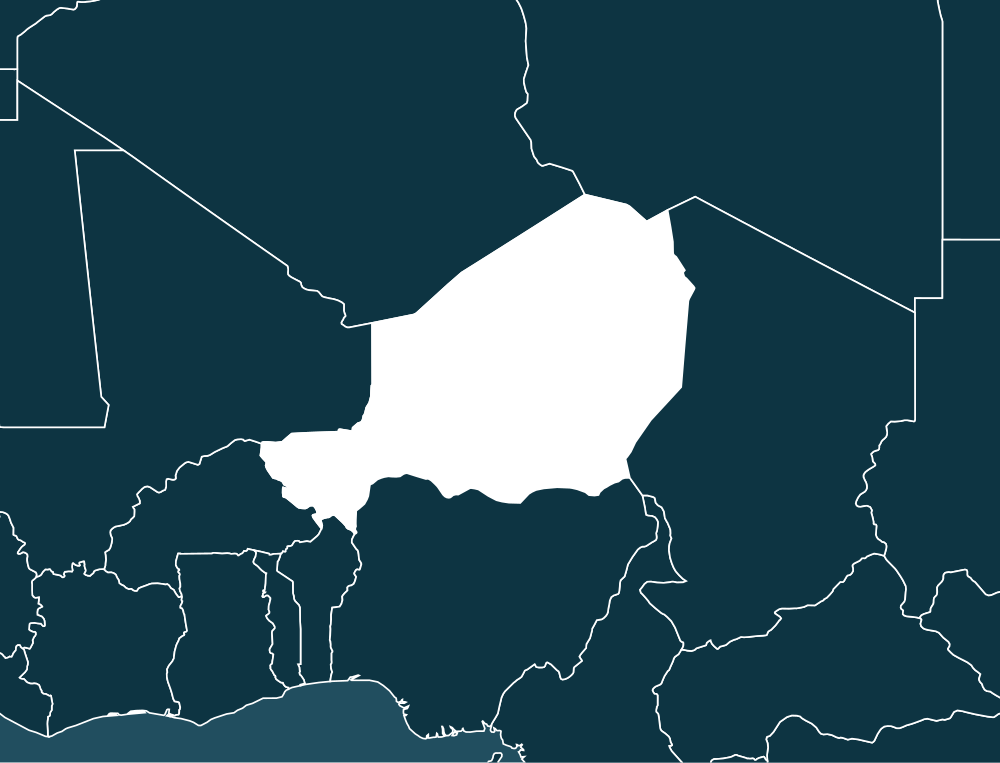
Niger’s history reflects the interaction of Saharan nomadic societies, southern agricultural communities, and regional powers such as the Tuareg kingdom of Takedda, followed by French conquest and colonial administration. Since independence in 1960, the country has moved repeatedly between military and civilian rule, including the democratic transition of 2021 and the seizure of power by General Abdourahamane TIANI’s CNSP in July 2023. These political shifts have unfolded alongside persistent institutional, economic, and developmental constraints.
Among the world’s poorest countries, Niger relies heavily on subsistence agriculture and remains vulnerable to Sahelian droughts, while pursuing greater oil production and mining activity. Its security environment is shaped by porous borders and armed movements linked to instability in Mali, Burkina Faso, Nigeria, and the wider region, including activity associated with JNIM, ISGS, Boko Haram, and IS Sahel. Sanctions imposed after the 2023 coup, followed by regional realignment through the Alliance of Sahel States and Niger’s withdrawal from ECOWAS, have added economic pressure and further complicated cooperation.
AML & Terrorist Financing
Niger is not listed by FATF as having strategic AML deficiencies, yet its 2021 mutual evaluation found limited effectiveness across AML/CFT outcomes, alongside uneven compliance among financial institutions, DNFBPs, and public authorities. High terrorist-financing exposure arises from porous borders, informal cash-based activity, trafficking networks, and vulnerable nonprofit organizations, while weaknesses remain in suspicious transaction reporting, beneficial-ownership transparency, confiscation, targeted financial sanctions, and proliferation-financing controls. CENTIF, the Ministry of Finance, BCEAO, HALCIA, and the Central Agency for the Management of Seized, Confiscated, Frozen and Recovered Assets form part of the response, but enforcement, supervision, institutional capacity, and international cooperation have not consistently matched the risks identified in the NRA and GIABA assessments.
Sanctions
No sanctions enforced by Niger against other nations are identified, while the country has primarily been subject to external political, economic, and security-related restrictions. ECOWAS imposed border closures, asset freezes, and commercial limits after the 2023 coup before lifting them on humanitarian grounds in February 2024, while the African Union suspension remains and most Western governments have relied on aid, visa, or export-control measures rather than comprehensive sanctions. The EU framework under Council Decision (CFSP) 2023/2287 remains active without designations, whereas UN Consolidated List screening, OFAC’s designation of Ousmane Illiassou Djibo, and routes such as the Lomé-Ouagadougou-Niamey corridor illustrate the more targeted compliance and evasion issues surrounding Niger.
Criminality
Niger faces persistent corruption concerns, particularly in defense procurement, government contracting, licensing, concessions, and customs, while asset declarations are reportedly underreported and prosecutions remain limited. The High Authority to Combat Corruption and Related Offenses (HALCIA) has pursued investigations despite resource constraints, as the country also serves as a significant corridor for human smuggling, arms, drugs, and other illicit trade.
Reports
Niger remains a critical crossroads for narcotics, migrants, and other illicit networks, with OCRTIS recording major cocaine seizures while trafficking and exploitation affect children, migrants, and communities vulnerable to hereditary slavery. Counterterrorism capacity is strained by regional instability and limited coordination, as ISIS-GS, JNIM, ISIS-WA, and Boko Haram remained active amid 76 attacks and 773 fatalities, while Niger stayed on the Tier 2 Watch List for trafficking concerns.
Industry/Product Sector Risk
Niger’s financial landscape combines 14 banks, expanding electronic-money services, 78 authorized foreign-exchange dealers, and a small market presence represented by SGI‑Niger, alongside extensive informal activity. The most pronounced vulnerabilities emerge around cash-intensive commerce, casinos, real estate, mining and high-value dealers, money remitters, professional intermediaries, charities, and public procurement, where gaps in beneficial-ownership information, supervision, and customer due diligence may intersect with corruption, smuggling, trafficking, and terrorist financing. From the CIMA-linked insurance framework to the national anti-corruption authority’s concerns over diverted public resources, the country’s risk profile reflects the interaction of cross-border flows, porous informal markets, and rapidly developing payment channels.
Economy & Investment Climate
Niger is pursuing growth through foreign investment, infrastructure, mining, agriculture, energy, and the anticipated CNPC pipeline, with institutions such as the High Council for Investment and ANPIPS supporting a gradually more facilitative business environment. Yet insecurity, limited infrastructure and skilled labor, constrained finance, regulatory and judicial uncertainty, and the 2023 military takeover continue to shape the country’s economic prospects.
Cryptocurrency Regulations
Niger’s cryptocurrency landscape remains largely undefined: while Law No. 2016-33 and the Financial Intelligence Unit’s 2019 National Money Laundering/Terrorist Financing Risk Assessment provide broader AML/CFT foundations aligned with FATF principles, digital assets are neither legal tender nor expressly prohibited. With no documented VASP licensing, crypto-specific tax treatment, compliance registry, or established framework for exchanges, token offerings, or transaction monitoring, users and businesses face substantial regulatory uncertainty.
Get full access
The information on this page is a brief summary. Get access to EDD country reports, all risk category scores and customisable weightings for 245 jurisdictions.