
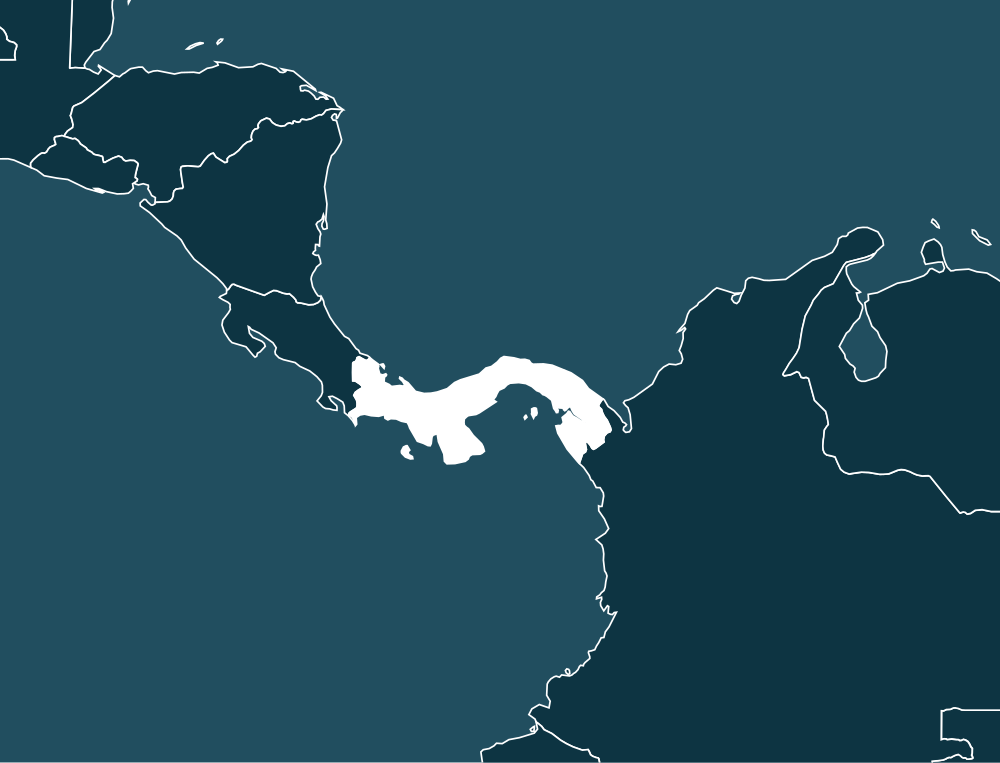
Risk Indicators
- FATF/EU Blacklist/Greylist (Lower Concern)
- Terrorism Financing (Lower Concern)
- US Dept of State INCSR
- Proliferation Financing
- Corruption
- Criminality
- Resilience & Governance
- Financial Transparency
- Offshore Finance Centres
- Sanctions
Background
Panama’s modern identity was shaped by its separation from Colombia in 1903 and the subsequent construction of the Panama Canal by the US Army Corps of Engineers between 1904 and 1914. Control of the Canal and surrounding territory shifted gradually under the 1977 agreement, culminating in the transfer of the Canal, supporting areas, and remaining US military bases by the end of 1999. The country later undertook a major expansion from 2007 to 2016, while its political history also includes the 1989 removal of Manuel NORIEGA with US assistance.
Situated between Costa Rica and Colombia, Panama is bordered by neighbours facing distinct combinations of organized crime, political strain, armed conflict, and humanitarian pressure. Costa Rica’s challenges include rising violence, alleged institutional tensions involving President Rodrigo Chaves, cyberattacks linked to the Conti ransomware group, and reliance on UN sanctions rather than an autonomous sanctions list. Colombia’s continuing crisis involves the ELN, FARC dissidents, criminal groups, and setbacks to the “Total Peace” initiative, alongside paused US sanctions disputes and regional conditions that may create broader illicit-finance or sanction-evasion concerns.
AML & Terrorist Financing
Panama has made substantial AML/CFT progress, including completion of its FATF action plan and the creation of the UAF, SSNF, and private RUBF beneficial-ownership register, but effectiveness remains uneven. Its role as a regional financial and trade hub, including the Colón Free Zone, exposes it to foreign illicit funds linked to narcotics, corruption, tax crimes, smuggling, shell companies, nominee services, and emerging channels such as cryptocurrencies. Ongoing concerns involve access and accuracy of ownership data, uneven supervision of DNFBPs, limited terrorist-financing detection experience, inconsistent enforcement, constrained investigative and judicial resources, and unresolved tax-transparency issues noted by GAFILAT, the U.S. Department of State, the IMF, and the EU.
Sanctions
Panama implements United Nations sanctions regimes and has increasingly used its maritime authorities to deregister vessels and owners linked to UN, U.S., EU, or UK restrictions, particularly involving Iranian and Russian oil networks. Measures including Executive Decree No. 512, the Panama Flag Precheck Process, mandatory ship-to-ship transfer notifications, and cooperation with Liberia and the Marshall Islands reflect a tightening response to sanctions evasion, while OFAC designations have continued to feature Panama-linked ships and companies. Although Panama’s registry remains under scrutiny for historic facilitation of evasion involving Iran, Russia, Syria, and Venezuela-linked shipping, no international sanctions are currently in force against Panama itself.
Criminality
Corruption remains a significant concern in Panama, with alleged kickbacks, opaque procurement, and bribery affecting public contracting, land titling, permitting, and judicial decisions despite measures such as Law 153 and the work of the National Authority of Transparency and Access to Information. Panama also faces extensive illicit activity involving cocaine transit, human trafficking, illegal logging and mining, counterfeit goods, cybercrime, and money laundering, while the Public Ministry, Judicial Branch, and law-enforcement bodies continue to face questions about independence, resources, and enforcement.
Reports
Panama remains a strategically important partner in countering narcotics trafficking, with SENAN, SENAFRONT, the PNP, the Port Task Force, and CROAN supporting substantial maritime, border, and container interdictions despite persistent institutional and corruption-related challenges. Efforts against human trafficking and terrorism financing show mixed progress, including legal reforms and vessel-registration cancellations, while victim protections, trafficking prosecutions, investigative capacity, and the vulnerabilities of migrants, children, and foreign workers remain areas of concern.
Industry/Product Sector Risk
Panama’s financial and commercial landscape presents varied exposure to money laundering risks, with banking, correspondent relationships, remittances, real estate, trade finance, gaming, and wealth-management structures featuring prominently amid substantial cross-border activity. The Intendencia, Superintendence of Banks, Superintendence of the Securities Market, and other sectoral supervisors have identified recurring challenges involving cash-intensive transactions, complex legal entities, beneficial-ownership transparency, and controls over foreign customers and funds. Panama’s free zones, logistics infrastructure, corporate-service ecosystem, and international financial connections create a particularly important context for understanding how proceeds linked to tax offences, corruption, drug trafficking, smuggling, and financial crime may be moved or concealed.
Economy & Investment Climate
Panama remains a services-led, dollarized economy with strategic advantages centered on the Panama Canal, logistics, trade, and its extensive free-trade-zone network, while INEC data and IMF projections point to continued growth ahead of the regional average. At the same time, fiscal pressures, a sub-investment-grade Fitch rating, labor informality, judicial uncertainty, and recurring disputes such as Cobre Panamá create a more complex environment than its strong investment incentives and agencies such as MICI and PROPANAMA might initially suggest.
Cryptocurrency Regulations
Panama permits cryptocurrency activity without recognizing it as legal tender, leaving exchanges, tokens, and VASPs in a shifting legal grey area shaped by Law 23 of 2015, AML/KYC expectations, and the Supreme Court’s treatment of Bill No. 697. Tax obligations overseen by the General Directorate of Revenue may apply to crypto gains and mining, while the absence of dedicated licensing, Travel Rule, ICO, and transaction-reporting guidance creates both flexibility and significant compliance uncertainty.
Get full access
The information on this page is a brief summary. Get access to EDD country reports, all risk category scores and customisable weightings for 245 jurisdictions.