
Risk Indicators
- FATF/EU Blacklist/Greylist (Lower Concern)
- Terrorism Financing (Lower Concern)
- US Dept of State INCSR
- Proliferation Financing
- Corruption
- Criminality
- Resilience & Governance
- Financial Transparency
- Offshore Finance Centres
- Sanctions
Background
Paraguay’s history has been shaped by Guarani communities, independence in 1811, devastating regional wars, and a long period of military rule that ended with Alfredo Stroessner’s fall in 1989. The country later consolidated relatively free presidential elections, while territorial changes following the Chaco War helped define its modern boundaries. Its past continues to inform a national landscape marked by political turbulence, uneven economic development, and institutional pressures.
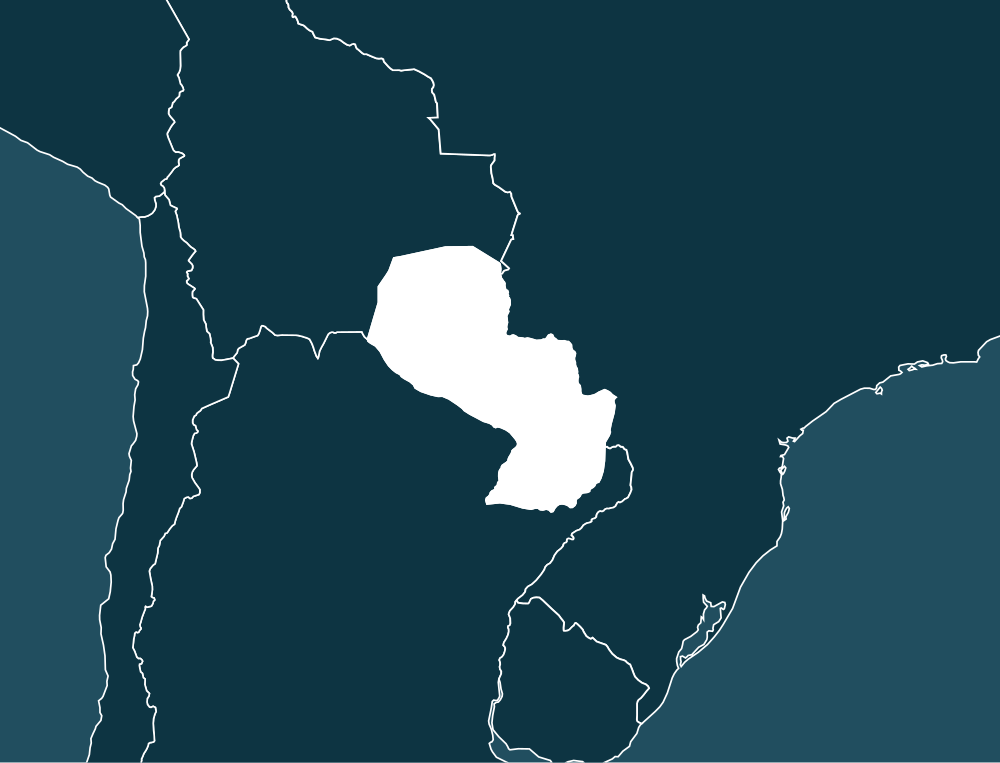
Positioned between Argentina, Brazil, and Bolivia, Paraguay is exposed to cross-border networks involving drugs, arms, money laundering, and sanction-evasion activity, particularly around the tri-border area. Regional actors and groups—including Brazil’s PCC and CV, Hezbollah-linked networks, and trafficking routes associated with Bolivia—intersect with Paraguay’s own challenges involving the EPP, ACA, EML, violence, and corruption. These overlapping pressures give the country a strategic but vulnerable role in South American security dynamics.
AML & Terrorist Financing
Paraguay has strengthened its AML/CFT framework and is no longer subject to FATF monitoring, yet significant exposure remains from porous borders, the Tri-Border Area, informal commerce, drug and arms trafficking, corruption, and trade-based laundering. FIU-SEPRELAD, the Attorney General’s Office, and the Central Bank of Paraguay have expanded coordination, beneficial-ownership measures, and risk-based supervision, but investigations, convictions, sanctions, and the use of financial intelligence remain limited, particularly outside mature financial sectors and in relation to virtual assets. Terrorist-financing and proliferation-financing controls are supported by targeted financial-sanctions mechanisms, although medium effectiveness, limited TF convictions and asset seizures, uneven list-screening by DNFBPs and VASPs, and coordination challenges among authorities such as SEPRINTE leave important implementation questions.
Sanctions
Paraguay implements applicable United Nations Security Council sanctions, while no international sanctions are currently in force against the Paraguayan state itself. U.S. designations remain in place against figures and entities connected to Paraguay, including Hugo Adalberto Velazquez Moreno, Casa Hamze, Galeria Page, and individuals linked to corruption and contraband networks in Ciudad del Este. At the same time, Paraguay’s Tri-Border Area and regional trade corridors have been identified as vulnerable to sanctions-evasion activity involving Hizballah-linked networks, Venezuela’s PdVSA, and the Iran-related Emtrasur/Mahan Air case.
Criminality
Paraguay faces persistent corruption across public institutions, with impunity, politicization of the judiciary, weak oversight, and opaque procurement—areas addressed by the Comptroller General’s Office, DNCP, and the National Regime of Integrity, Transparency, and Prevention of Corruption established under Law 7389. Criminal markets remain broad, encompassing human trafficking, arms and goods smuggling, illicit tobacco, drug production and transit, environmental crime, cybercrime, and financial offenses, with state-linked officials, foreign gangs, and private-sector actors implicated in different activities.
Reports
Paraguay recorded major gains through the National Anti-Drug Secretariat (SENAD), including a historic cocaine seizure and more drug-trafficking convictions, while porous borders, corruption, and regional criminal networks continued to pose challenges. Human trafficking risks remain pronounced, particularly through criadazgo, the Tri-Border Area, and online recruitment, even as authorities pursued stronger protections and convicted EPP member Laura Villalba amid continued efforts to reinforce national security controls.
Industry/Product Sector Risk
Paraguay’s industry risk landscape is shaped by informality, extensive cash usage, cross-border trade, and exposure to proceeds linked to corruption, smuggling, drug trafficking, and tax offences. Higher-risk activity is evident across banking, casinos, currency exchange, money remittance, real estate, trade finance, virtual assets, transportation, and construction, with oversight involving institutions such as SEPRELAD, the Superintendency of Banks, CONAJZAR, and the CNV. Emerging payment channels, beneficial-ownership complexities, porous borders, and uneven implementation of AML/CFT controls create a detailed risk picture spanning both regulated entities and less formal commercial activity.
Economy & Investment Climate
Paraguay is a small, open economy with a steady growth record, driven by agriculture, energy, retail, construction, and export-oriented maquila activity, while investment frameworks such as Law 60/90 and support from MIC’s REDIEX offer notable incentives. Macroeconomic credibility has strengthened alongside reforms led by institutions including the MEF, DNIT, and BCP, but infrastructure gaps, costly credit, informality, corruption, judicial uncertainty, and persistent property and intellectual-property concerns continue to shape the business environment.
Cryptocurrency Regulations
Paraguay treats cryptocurrency as a regulated commodity rather than legal tender, with the Ministry of Industry and Commerce, the National Securities Commission, and SEPRELAD shaping an evolving framework for businesses, trading, and AML compliance. Registration, customer due diligence, transaction monitoring, and emerging tax obligations form the core of oversight, while questions surrounding Travel Rule adoption, token offerings, enforcement, and asset tokenization remain areas of developing guidance.
Get full access
The information on this page is a brief summary. Get access to EDD country reports, all risk category scores and customisable weightings for 245 jurisdictions.