
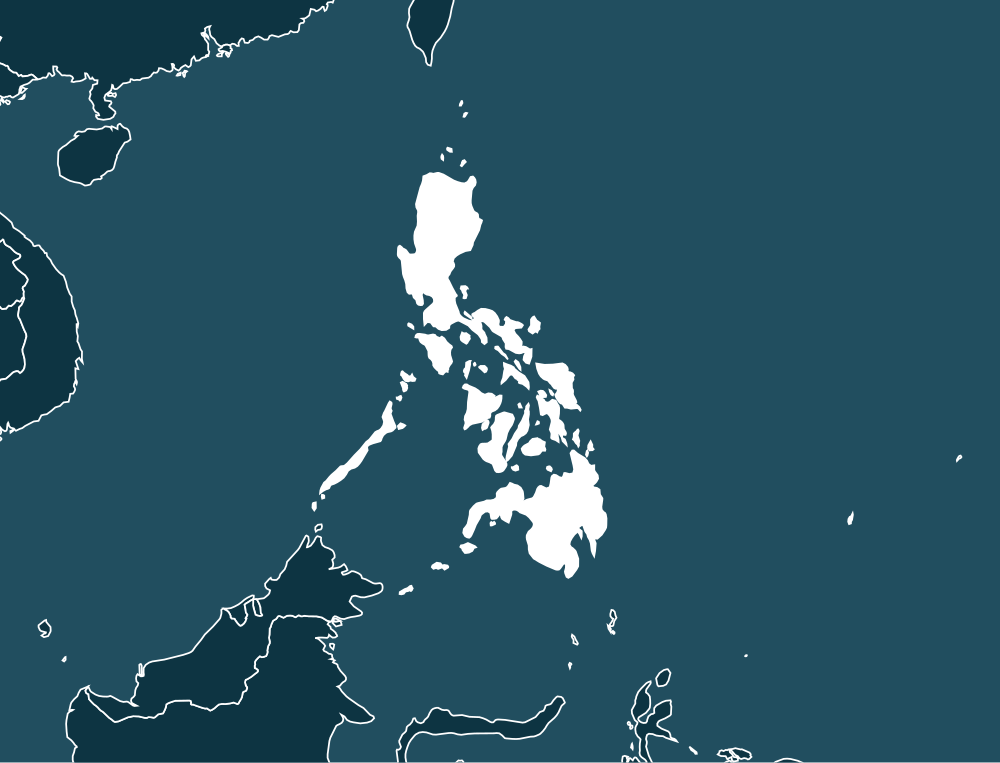
Risk Indicators
- FATF/EU Blacklist/Greylist (Lower Concern)
- Terrorism Financing (Medium Concern)
- US Dept of State INCSR
- Proliferation Financing
- Corruption
- Criminality
- Resilience & Governance
- Financial Transparency
- Offshore Finance Centres
- Sanctions
Background
The Philippines’ modern trajectory reflects successive periods of colonial rule, wartime occupation, democratic transition, and prolonged political turbulence, including the 1986 and 2001 “people power” movements. Leadership passed through figures including Emilio Aguinaldo, Manuel Quezon, Corazon Aquino, Ferdinand Marcos, and Ferdinand Marcos Jr., while economic and institutional progress varied across administrations. Armed separatists, communist rebels, and Islamic terrorist groups have remained persistent challenges, particularly in Mindanao, the southern islands, and remote areas of Luzon.
Its security environment is shaped most sharply by South China Sea confrontations with China around Scarborough Shoal, Second Thomas Shoal, and Sabina Shoal, alongside more limited tensions involving Taiwan and overlapping claims with Vietnam and Brunei. Relations with Malaysia and Indonesia combine unresolved maritime or territorial concerns with cooperation involving counterterrorism, maritime security, and anti-piracy operations. Trade restrictions, worker-visa measures, maritime transshipment risks, cyber-enabled illicit finance, and regional instability add less visible dimensions to the landscape monitored by institutions such as the Philippine Coast Guard.
AML & Terrorist Financing
The Philippines has made significant AML/CFT progress and is no longer subject to FATF strategic-deficiency listing, with the Anti-Money Laundering Council (AMLC) and other agencies advancing risk-based supervision, beneficial ownership access, and enforcement. Nevertheless, substantial exposure remains across cash, remittance, gaming, digital-payment, virtual-asset, free-zone, and clandestine POGO-related activity, while proceeds linked to fraud, drugs, corruption, cybercrime, and trafficking continue to present complex challenges. Terrorist financing and proliferation-financing controls remain areas of particular interest, involving issues such as limited designations and asset freezes, uneven NPO oversight, bank-secrecy constraints, and the continuing need for stronger coordination among the AMLC, BSP, SEC, PAGCOR, law enforcement, and regional task groups.
Sanctions
The Philippines implements United Nations Security Council sanctions, including measures covering arms, travel, financial and commodity restrictions, and notably impounded the North Korean vessel Jin Teng in 2016 under the Pyongyang-related regime. While no international sanctions are currently in force against the Philippines as a country, Philippine-based persons and entities have been individually designated under United States, European Union, and United Kingdom regimes. Its maritime and financial networks—including Subic Bay, Manila ports, remittance channels, and cryptocurrency services—have also featured in concerns involving North Korea and other sanctioned jurisdictions, with the May 2025 OFAC designation of Funnull Technology Inc. illustrating the specificity of these exposures.
Criminality
Corruption remains a pervasive, long-standing concern across the public and private sectors, with the Bureau of Customs frequently identified among the country’s most problematic agencies and political, criminal, and state-linked networks shaping illicit activity. The Philippines also faces significant challenges involving trafficking, counterfeit and excisable goods, illegal environmental activity, synthetic drugs, cybercrime, and financial scams, while citizens can turn to the Office of the Ombudsman, the 8888 Citizens’ Complaint Hotline, and Contact Center ng Bayan to report misconduct.
Reports
The Philippines is pursuing a broader, health-centered response to narcotics while PDEA and the PNP continue targeting trafficking networks amid persistent concerns involving shabu, maritime smuggling, corruption, and human rights. Authorities also face complex trafficking and security threats, from online scam operations and child exploitation to foreign-worker abuses and militant violence, even as agencies such as the DDB, DOH, and anti-terrorism units expand prevention, prosecutions, and international cooperation.
Industry/Product Sector Risk
The Philippine industry landscape presents a varied exposure to money laundering and terrorist financing, with casinos, money remitters, retail banking, real estate, trade finance, cash-intensive businesses, politics, public works, and transportation standing out amid a rapidly evolving digital and payment environment. Supervisory and regulatory responses involving the BSP, AMLC, PAGCOR, SEC, and Insurance Commission show differing levels of maturity, while gaps around beneficial ownership, informal operators, bank secrecy, cross-border flows, and DNFBP coverage remain significant. Underlying threats range from corruption, drug trafficking, fraud and cybercrime to smuggling, environmental offences, human trafficking, and terrorism-linked activity, creating interconnected risks across financial, commercial, maritime, and professional sectors.
Economy & Investment Climate
The Philippines combines resilient, investment-grade fundamentals with a predominantly services-based economy, while growth and investment remain influenced by inflation, global demand, infrastructure constraints, and extreme weather. Recent measures such as the CREATE MORE Act, the PPP Code, and expanded roles for the BOI and PEZA signal a stronger effort to attract capital, even as foreign ownership limits, regulatory complexity, judicial delays, and logistics costs continue to shape the business environment.
Cryptocurrency Regulations
In the Philippines, cryptocurrency operates within an evolving framework shaped by the Bangko Sentral ng Pilipinas, the Securities and Exchange Commission, and the Bureau of Internal Revenue, with licensed VASPs subject to registration, KYC, AML, reporting, and emerging Travel Rule obligations despite digital assets not being legal tender. The treatment of crypto gains, proposed CASP rules, ICO disclosures, tokenized instruments, and the BSP’s expanding oversight—including 14 licensed VASPs as of October 2024—reveals a market balancing innovation with investor protection, financial integrity, and still-developing tax enforcement.
Get full access
The information on this page is a brief summary. Get access to EDD country reports, all risk category scores and customisable weightings for 245 jurisdictions.