
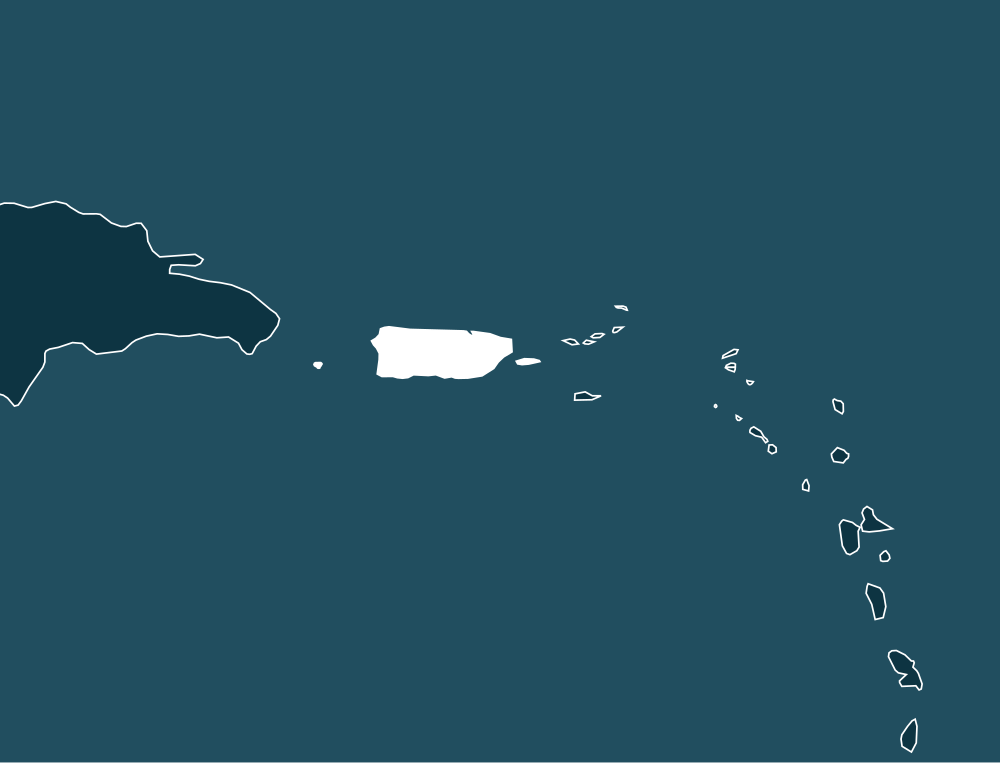
Risk Indicators
- FATF/EU Blacklist/Greylist (Lower Concern)
- Terrorism Financing (Lower Concern)
- US Dept of State INCSR
- Proliferation Financing
- Corruption
- Criminality
- Resilience & Governance
- Financial Transparency
- Offshore Finance Centres
- Sanctions
Background
Puerto Rico’s history stretches from centuries of Indigenous settlement to Spanish rule beginning with the Spanish Crown’s claim in 1493, followed by its cession to the United States in 1898. US citizenship was extended to Puerto Ricans in 1917, popularly elected governors began serving in 1948, and a 1952 constitution established internal self-government. A series of status votes—including those in 1967, 1993, 1998, 2012, and late 2020—reflects an unresolved relationship with the United States and a recurring debate over statehood.
More recently, economic recession and sustained migration to the US mainland have contributed to net population loss since about 2005. Hurricane Maria struck in 2017 as the island’s most destructive storm in eight decades, with damage reaching tens of billions of dollars. Puerto Rico’s circumstances unfold within the broader history of a United States shaped by territorial expansion, civil conflict, economic upheaval, global wars, and technological growth.
AML & Terrorist Financing
Puerto Rico, as a U.S. territory, operates within a sophisticated federal AML/CFT framework led by agencies such as FinCEN, OFAC, the DOJ and MLARS, while its designation covering all areas of Puerto Rico and the U.S. Virgin Islands under the HIFCA program signals heightened financial-crime attention. The broader U.S. system demonstrates strong capabilities in financial intelligence, investigations, confiscation, terrorist-financing disruption and targeted sanctions, supported by national risk assessments and coordinated task-force activity. At the same time, vulnerabilities involving beneficial-ownership transparency, cash and cross-border flows, digital assets, drug trafficking and uneven coverage or supervision of certain professional and non-financial sectors leave important questions for closer examination.
Sanctions
As a U.S. territory, Puerto Rico operates within the United States’ sanctions framework, administered by the Treasury Department’s Office of Foreign Assets Control (OFAC) through country-wide and targeted measures, asset blocking, trade restrictions, and potential secondary sanctions. No international sanctions are currently in force against Puerto Rico, while U.S. enforcement addresses sanctioned networks connected to Russia, Iran, North Korea, and Venezuela. Enforcement priorities include financial intermediaries, transshipment hubs, dual-use technology, and gatekeepers, with routes involving places such as Türkiye, the UAE, China, Oman, and Singapore and coordination among OFAC, the Department of Justice, and the Commerce Department.
Criminality
Puerto Rico falls within a broader U.S. criminal environment marked by drug trafficking, firearms markets, human trafficking, cybercrime, fraud, and the continued activity of gangs and other organized networks. Corruption concerns are less clearly localized but include risks involving public officials, money laundering, politicization of justice, and weakened public trust linked to law-enforcement misconduct.
Reports
As a U.S. territory, Puerto Rico falls within U.S. assessments indicating continued adherence to major arms control, nonproliferation, and disarmament commitments, including verified completion of chemical weapons stockpile destruction in cooperation with the OPCW. The U.S. State Department’s 2025 trafficking findings also place the United States on Tier 1 while noting persistent concerns involving victim protections, housing and services, prosecutions, convictions, and screening in immigration custody.
Economy & Investment Climate
Puerto Rico combines a highly industrialized economy—led by pharmaceuticals, electronics, petrochemicals, and related exports—with a substantial services base that includes tourism, while agriculture remains comparatively small. Its access to U.S. markets and federal support is balanced by heavy import dependence, prolonged fiscal strain reflected in Standard & Poor’s D rating, infrastructure and environmental pressures, and investment risks that authorities are addressing through incentives and development initiatives.
Cryptocurrency Regulations
Puerto Rico treats cryptocurrency as a regulated financial activity rather than legal tender, with the U.S. dollar remaining official and businesses often subject to FinCEN registration, OCIF licensing under Act 136-2010, and AML/KYC obligations. Tax treatment, Act 60 incentives, securities considerations for token offerings, and the uncertain visibility of licensed VASPs—including enforcement such as the Athena Bitcoin cease-and-desist order—create a framework whose details merit closer examination.
Get full access
The information on this page is a brief summary. Get access to EDD country reports, all risk category scores and customisable weightings for 245 jurisdictions.