
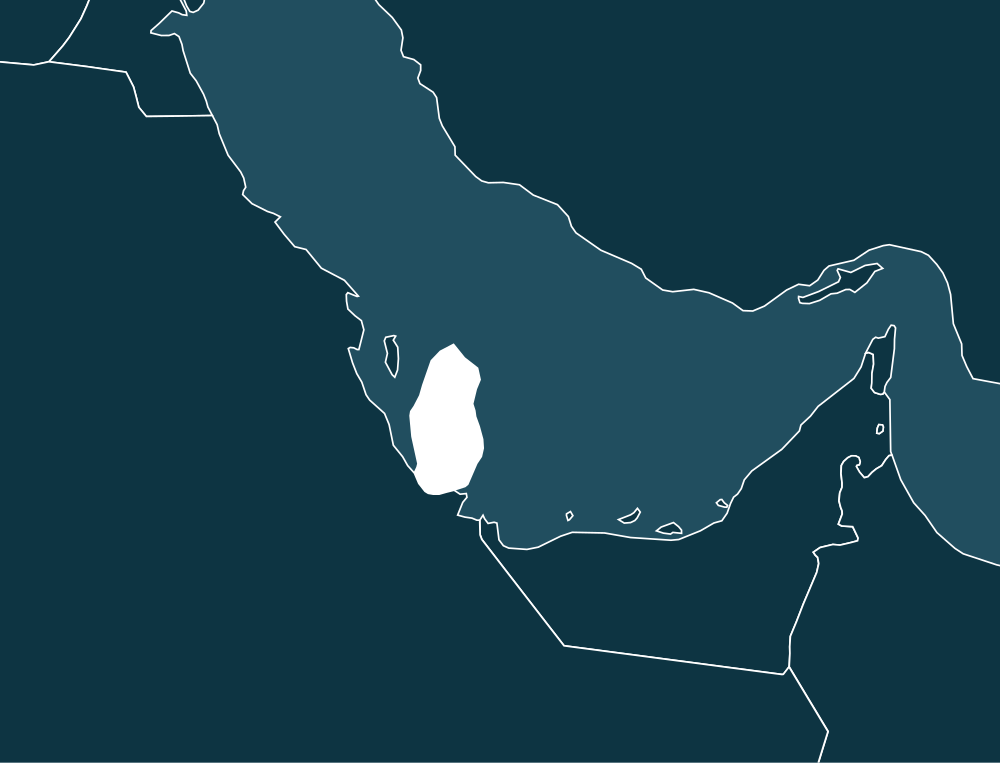
Risk Indicators
- FATF/EU Blacklist/Greylist (Lower Concern)
- Terrorism Financing (Lower Concern)
- US Dept of State INCSR
- Proliferation Financing
- Corruption
- Criminality
- Resilience & Governance
- Financial Transparency
- Offshore Finance Centres
- Sanctions
Background
Qatar’s transformation under the Al Thani family has taken it from a pearling-based British protectorate to an independent, hydrocarbon-rich state with an outsized regional profile. The era of former Amir HAMAD bin Khalifa Al Thani brought political and media changes, major investment, mediation efforts, and the creation of Al-Jazeera, followed by a peaceful succession to Amir TAMIM bin Hamad in 2013. Healthcare, education, infrastructure, and the hosting of the 2022 FIFA Men’s World Cup have become prominent features of the country’s modern development.
Qatar’s position in the Gulf places it alongside neighbours managing conflict, political repression, cyber threats, and shifting alliances, even as Doha itself is not engaged in direct conflict with them. Relations with Saudi Arabia, the UAE, and Bahrain have been shaped by the 2017–2021 blockade, while Iran’s proximity, extensive international sanctions, and suspected evasion networks create a more complex security and compliance environment. Across the GCC, governments must balance neutrality, ties with the United States and Israel, uninterrupted trade, and the risks highlighted by U.S. measures such as Executive Order 13818.
AML & Terrorist Financing
Qatar is not subject to FATF enhanced monitoring and its 2023 assessment found broad technical compliance, supported by institutions including NAMLC, the QFIU, QCB, QFCRA and QFMA, yet important effectiveness gaps remain. The country faces medium-high money-laundering and terrorist-financing risks involving cash, remittances, banks, exchange houses, real estate, precious metals, charities and cross-border activity, while financial intelligence is not consistently converted into complex ML or TF cases and DNFBP supervision and beneficial-ownership accuracy remain areas of concern. Its framework for targeted financial sanctions is comparatively strong, including substantial TF-related asset freezes and RACA oversight of charities, but low TF prosecution outcomes, limited PF enforcement, untested cross-border controls and exposure arising from trade links with Iran leave significant questions for closer examination.
Sanctions
Qatar implements United Nations Security Council sanctions, including measures administered through the Consolidated List, while Qatar-based individuals or entities may also face designations such as the U.S. Specially Designated Nationals listing. Qatar has not itself been subject to country-level sanctions, although Saudi Arabia, the UAE, Bahrain, and Egypt imposed a land, sea, and air blockade from 2017 until its lifting under the January 2021 Al-Ula Declaration. The country’s financial and logistical links with Iran—including frozen Iranian assets, humanitarian transactions, Qatari ports, and air routes—have nevertheless drawn scrutiny over possible sanctions-evasion risks.
Criminality
Qatar maintains extensive anti-corruption laws and institutions, including the Administrative Control and Transparency Authority, State Audit Bureau, and Public Prosecutor, yet concerns remain about procurement and customs transparency, personal connections, and accountability involving senior officials. Crime risks include migrant-worker exploitation and trafficking, illicit drugs and wildlife, counterfeit goods, cyber-enabled scams, and financial crimes, with loosely connected transnational networks and some private- and state-embedded actors implicated.
Reports
Qatar remains on Tier 2 for human trafficking, with increased prosecutions, victim referrals, legal reforms, and labor-mobility measures, while migrant workers—including domestic staff and workers tied to “free visas” or Hayya cards—continue to face recruitment deception, wage abuses, passport retention, and restricted access to justice. The National Committee to Combat Human Trafficking remains central to victim referrals, even as Qatar expands cooperation with U.S. agencies on screening and border security, supports regional counterterrorism efforts, and reports no terrorist incidents during the period covered.
Industry/Product Sector Risk
Qatar’s principal exposure is concentrated in globally connected banks, correspondent relationships, exchange houses, remittance channels and trade finance, with cross-border flows, cash reliance and foreign predicate crime shaping the risk landscape. Higher-risk areas include precious metals and stones, charities and NPOs, construction, transportation, cash-intensive businesses and TCSPs, where complex ownership, public procurement, informal transfers and overseas activity create distinctive vulnerabilities. Oversight spans institutions such as the Qatar Central Bank, QFC, QFCRA, QFMA and Ministry of Justice, while restrictions on casinos and virtual assets and comparatively lower-risk profiles in insurance, real estate and securities provide important contrasts.
Economy & Investment Climate
Qatar’s high-income economy remains anchored by LNG and other hydrocarbons, with QatarEnergy’s planned production expansion expected to support growth while National Vision 2030 and the 2024–2030 National Development Strategy seek broader private-sector and foreign investment. Agencies such as Invest Qatar, the Qatar Financial Centre, and the Qatar Free Zones Authority offer notable entry opportunities, although state dominance, sector-specific ownership limits, Qatarization requirements, and administrative frictions remain important considerations.
Cryptocurrency Regulations
Qatar maintains a notably restrictive position on ordinary cryptocurrencies, with the Qatar Central Bank and Qatar Financial Centre Regulatory Authority prohibiting or excluding activities involving cryptocurrencies, stablecoins, and similar assets while permitting a narrower framework for property-backed tokens under the QFC’s 2024 regulations. Law No. 20 of 2019 and the Qatar Financial Information Unit’s suspicious-transaction processes remain relevant to potential exposure, but licensing, taxation, and transaction-reporting treatment for crypto activity remain limited or unsettled.
Get full access
The information on this page is a brief summary. Get access to EDD country reports, all risk category scores and customisable weightings for 245 jurisdictions.