
Risk Indicators
- FATF/EU Blacklist/Greylist (Lower Concern)
- Terrorism Financing (Lower Concern)
- US Dept of State INCSR
- Proliferation Financing
- Corruption
- Criminality
- Resilience & Governance
- Financial Transparency
- Offshore Finance Centres
- Sanctions
Background
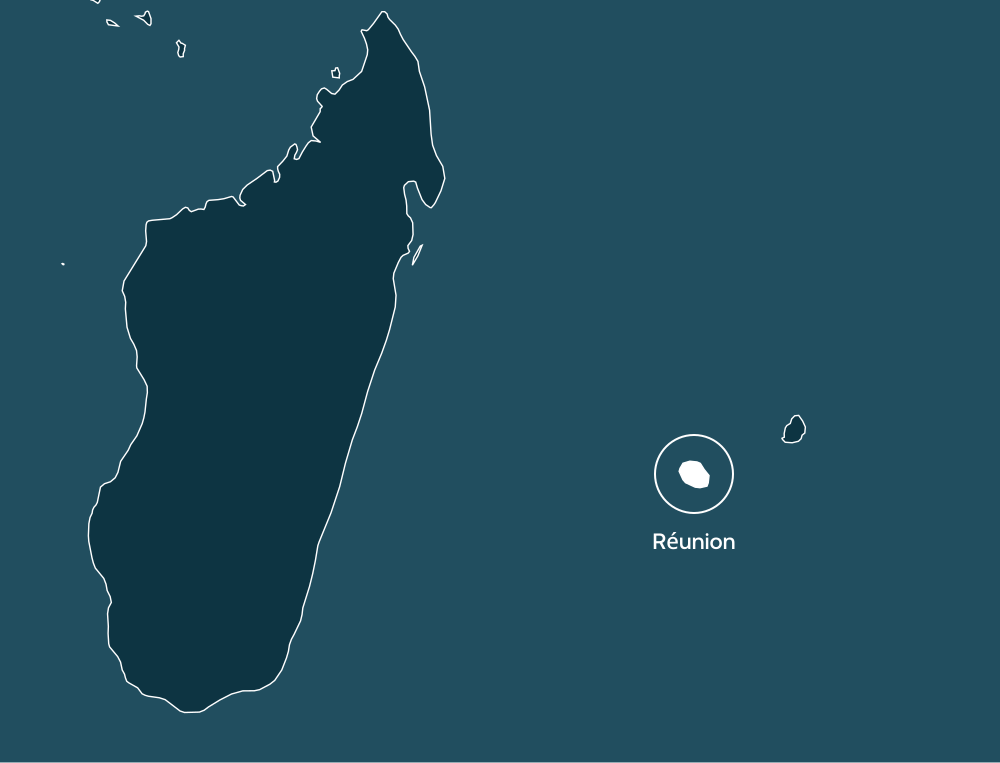
Réunion is one of five French overseas entities that became regions and part of France proper in the early 21st century. Its status places it within the framework of the modern French state, whose hybrid presidential-parliamentary system dates to 1958. This development connects Réunion to a country with a significant role in European integration and global institutions.
France’s wider position includes participation in the European Union, NATO, the G-7, the G-20, and the United Nations Security Council. The country’s cooperation with Germany and adoption of the euro in January 1999 helped shape the European setting in which Réunion is situated. Further details on Réunion’s place within France’s overseas structure offer a closer look at this distinctive relationship.
AML & Terrorist Financing
Réunion falls within France’s AML/CFT framework, which is not subject to FATF strategic-deficiency listing and has demonstrated strong capabilities in areas such as financial intelligence, confiscation, and terrorist-financing investigations. Nevertheless, exposure to cross-border proceeds, fraud, drug trafficking, corruption, human trafficking, and emerging channels such as virtual assets creates continuing challenges, particularly in beneficial-owner identification, suspicious transaction reporting, and the supervision of real estate and other DNFBP sectors. Agencies including TRACFIN, ACPR, AMF, PNF, and OCRGDF form a coordinated enforcement network, while differing levels of implementation among smaller institutions and non-financial professions leave important details worth examining.
Sanctions
As a French overseas department, Réunion falls under France’s implementation of UN and EU restrictive measures, including asset freezes, travel bans, sectoral controls, and counterterrorism actions affecting individuals, entities, and selected activities linked to places such as Russia, Belarus, and Iran. French Customs, financial regulators, and the REPO Task Force pursue evasion through raids, asset freezes, prosecutions, and investigations into transit routes, intermediary companies, and other networks involving destinations such as Kazakhstan, Armenia, China, and the UAE. No international sanctions are currently in force against Réunion, while a French legislative initiative tied to EU Directive 2024/1226 points toward further harmonisation of penalties for violations.
Criminality
As an overseas department of France, Réunion is covered by a comparatively developed anti-corruption framework, including the Sapin II law, asset and interest disclosures through HATVP, and protections for whistleblowers. Persistent concerns remain over political appointments involving individuals facing corruption cases and uneven enforcement, with agencies such as the Agence Française Anticorruption, OCLCIFF, and the National Financial Prosecutor addressing risks that include foreign bribery, financial crime, and questions about prosecutorial independence.
Reports
Réunion’s security and human-trafficking context follows France’s national framework, which the U.S. State Department’s 2025 assessment places on Tier 1 while noting evolving exploitation risks, uneven victim protections, and particular vulnerabilities in nearby Mayotte. France’s “Emergency Attack” posture, Operation Sentinelle, international counterterrorism cooperation, and the reported disruption of nine planned attacks in 2024 point to a complex threat environment involving lone actors, extremist networks, and geopolitical tensions.
Economy & Investment Climate
Réunion’s economy is increasingly anchored in tourism, while sugarcane agriculture remains important and contributes notably to employment and regional output; GDP reached an estimated €19.5 billion in 2019, and unemployment fell to 19.0% in 2023, its lowest level in decades. As an overseas department of France with access to European Union markets, the island offers institutional stability alongside exposure to tourism and labor-market challenges, while public efforts in renewable energy and infrastructure seek to broaden its investment appeal.
Cryptocurrency Regulations
Réunion follows France’s cryptocurrency framework, where digital assets are permitted but are not legal tender, and providers may face registration, AML/KYC, and disclosure obligations overseen by the AMF and ACPR. Tax reporting through the DGFiP, evolving Travel Rule and CARF requirements, and French rules for exchanges, token offerings, and investor protection create a compliance landscape with important details for users and businesses to explore.
Get full access
The information on this page is a brief summary. Get access to EDD country reports, all risk category scores and customisable weightings for 245 jurisdictions.