
Risk Indicators
- FATF/EU Blacklist/Greylist (Lower Concern)
- Terrorism Financing (Lower Concern)
- US Dept of State INCSR
- Proliferation Financing
- Corruption
- Criminality
- Resilience & Governance
- Financial Transparency
- Offshore Finance Centres
- Sanctions
Background
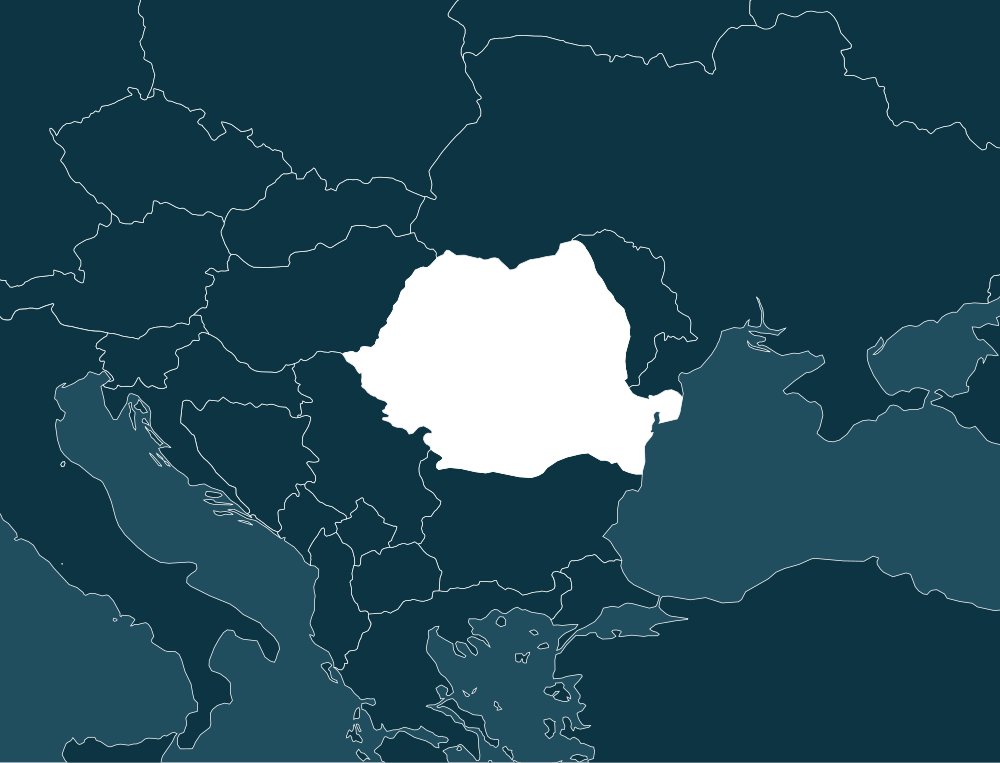
Romania emerged from the union of Wallachia and Moldavia in the nineteenth century and expanded substantially after joining the Allied Powers in World War I, notably through the acquisition of Transylvania. Its subsequent trajectory moved from wartime alignment with the Axis and Soviet occupation to a communist people’s republic, culminating in the increasingly repressive rule of Nicolae CEAUSESCU and the Securitate before his overthrow and execution in 1989. Since then, Romania has pursued deeper Euro-Atlantic integration through NATO membership in 2004, European Union membership in 2007, and Schengen air and sea access in 2024.
Romania’s strategic setting is shaped by an active war in neighbouring Ukraine, Russian hybrid pressure around Moldova, Black Sea security concerns involving Bulgaria, and political tensions with Hungary over minority rights. Risks include drone incursions, conflict spillover, cyberattacks, separatist instability in Transnistria, espionage, and regional sanctions-evasion networks using third countries. Romania’s role includes military support and refugee hosting for Ukraine, energy and defence coordination with Moldova, and cooperation with Bulgaria on mine clearance and NATO initiatives.
AML & Terrorist Financing
Romania is not listed by FATF as having strategic AML deficiencies, but MONEYVAL’s 2026 follow-up indicates that technical progress coexists with uneven effectiveness across key recommendations. Persistent challenges include a cash-heavy economy, significant predicate-crime exposure, limited resources at the ONPCSB-FIU, incomplete use of financial intelligence and beneficial-ownership data, and comparatively limited pursuit of complex or third-party money laundering. Terrorist-financing controls remain less mature, with the RIS and DIICOT focused largely on prevention and disruption, limited reporting outside major financial sectors, weaker understanding among DNFBPs and VASPs, and no risk-based framework for the non-profit sector.
Sanctions
Romania currently faces no international sanctions, although persons and entities located there may be designated under thematic or Russia-related regimes. Through its EU membership, Romania applies UN-transposed and autonomous EU restrictive measures—often involving asset freezes, travel bans, trade controls, financial restrictions, or arms embargoes—particularly concerning Russia, Ukraine, Syria, Iran, Libya, and other designated situations. Enforcement and evasion risks have centered on assets such as TMK ARTROM SA and AEROFLOT, offshore activity linked to GSP Offshore, and transit through Constanța and regional land borders, with the RO e-Transport regime now adding penalties and confiscation powers.
Criminality
Romania has made progress against corruption, but it remains a persistent concern in public administration and business, with the OECD noting widespread practices in certain sectors, difficulties securing convictions, and thousands of cases closed because of statute-of-limitations issues. The National Anticorruption Directorate, National Integrity Agency, and PREVENT system provide important safeguards, yet complaints continue to involve customs, municipal officials, and local financial authorities, alongside organized criminal activity affecting trafficking, illicit trade, illegal logging, drugs, cybercrime, and financial fraud.
Reports
Romania remains on Tier 2, with increased victim identification, stronger criminal penalties, expanded legal and financial support, and a new four-year strategy supported in part by ANABI’s confiscated-assets fund. Significant concerns persist around child exploitation, abuse in state-run institutions, insufficient victim services, official complicity, and the trafficking risks facing Roma communities, migrants, asylum-seekers, and people displaced from Ukraine.
Industry/Product Sector Risk
Romania’s financial and non-financial landscape presents a varied risk profile, with particularly pronounced exposure in cash-intensive activities, real estate and construction, gambling, transportation, forestry, information technology, virtual assets, and politically connected transactions. MONEYVAL observations indicate that the banking system has more mature controls but may be under-rated, while the FSA-supervised sectors and certain professional gatekeepers show uneven risk-based supervision, beneficial-ownership weaknesses, and limited understanding of higher-risk activities. Across the Romanian NRA, recurring patterns involve tax evasion, corruption, cyber-fraud, trafficking, smuggling, and drug proceeds moving through cash, legal persons, cross-border channels, property, and emerging payment technologies.
Economy & Investment Climate
Romania offers an increasingly attractive platform for investment across technology, automotive, energy, manufacturing, and services, supported by EU and NATO membership, a strategic regional position, competitive wages, and substantial EU funding opportunities. Growth has slowed while inflation, skills shortages, administrative bottlenecks, regulatory uncertainty, and energy-policy shifts remain significant considerations, even as institutions such as ARICE, AMEPIP, and the National Bank of Romania support a gradually maturing investment environment.
Cryptocurrency Regulations
Romania permits cryptocurrency activity while treating digital assets as a distinct, non-currency asset class governed largely by Law no. 129/2019, MiCA, and oversight from institutions including the ASF, BNR, and ONPCSB. Exchanges and wallet providers face registration, KYC, Travel Rule, and transaction-reporting obligations, while tax treatment, CARF implementation, and evolving token-offering rules add further layers that participants must navigate.
Get full access
The information on this page is a brief summary. Get access to EDD country reports, all risk category scores and customisable weightings for 245 jurisdictions.