
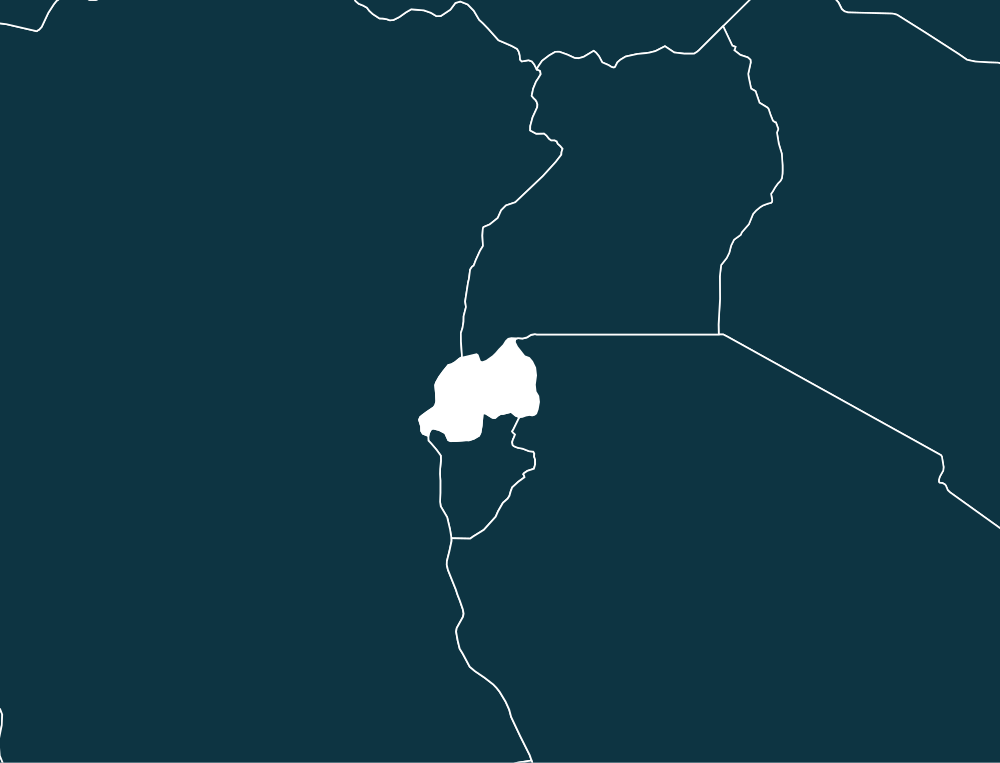
Risk Indicators
- FATF/EU Blacklist/Greylist (Lower Concern)
- Terrorism Financing (Medium Concern)
- US Dept of State INCSR
- Proliferation Financing
- Corruption
- Criminality
- Resilience & Governance
- Financial Transparency
- Offshore Finance Centres
- Sanctions
Background
Rwanda’s history has been shaped by a centralized royal tradition, colonial rule, and changing relationships between Hutu and Tutsi communities that were once more fluid than later political systems suggested. The upheavals surrounding the 1959 revolution, Juvenal Habyarimana’s long rule, and the 1994 genocide transformed the country and paved the way for the Rwandan Patriotic Front and Paul Kagame’s presidency. Its post-genocide political order and distinctive regional role remain closely connected to these earlier developments.
Today, Rwanda’s security and diplomatic posture is strongly influenced by conflicts in the Democratic Republic of the Congo, alongside persistent tensions with Uganda and Burundi. Allegations concerning support for M23, cross-border operations, and the movement of minerals such as coltan have drawn scrutiny from the United States, European Union, and United Kingdom, including sanctions involving figures such as James Kabarebe. These disputes, involving regional forces and competing claims about groups including the FDLR, have given Rwanda an outsized and controversial role in Great Lakes stability.
AML & Terrorist Financing
Rwanda is not identified as having strategic AML deficiencies and has strengthened its legislative and institutional framework, though the 2024 assessments point to limited effectiveness and uneven compliance across sectors. Domestic risks include tax evasion, public and cooperative fund embezzlement, cross-border cash movements, mineral smuggling, and vulnerabilities linked to real estate, informal activity, and legal persons, while understanding of terrorist-financing risks remains comparatively limited. The Financial Intelligence Centre, BNR, CMA, RIB, NPPA, and Rwanda Development Board each have defined roles, but challenges persist in intelligence use, beneficial-ownership oversight, supervisory sanctions, investigations, and the timely implementation of targeted financial sanctions.
Sanctions
Rwanda is required to implement United Nations sanctions measures, including arms, travel, financial, and commodity restrictions, but no distinct Rwandan sanctions regime against another nation is identified. International measures connected to the DRC conflict have instead targeted M23 and individuals or entities linked to Rwanda, with U.S. designations extending to the Rwanda Defence Force, James Kabarebe, and the Gasabo Gold Refinery, while the UK applies transit controls on arms-related goods. Although no international sanctions are currently in force against Rwanda as a country, scrutiny has intensified over alleged support for M23, mineral-trafficking routes through regional corridors, and obstruction of UN investigations into embargo violations.
Criminality
Rwanda maintains a prominent national anti-corruption effort, with investigations and prosecutions involving senior officials, although concerns persist over administrative-level corruption involving customs, tax, and police personnel. Crime concerns include trafficking in persons, illicit goods and mineral flows, arms and wildlife trafficking, growing drug transit, cybercrime, and financial offenses such as tax evasion, embezzlement, and mobile-money fraud, with oversight and reporting channels involving the Ombudsman, Rwanda Revenue Authority, and Office of the Auditor General.
Reports
Rwanda remains on the Tier 2 Watch List amid increased trafficking investigations and international cooperation, but fewer convictions, reduced victim identification, and the absence of referrals to services continue to expose gaps in protection. Trafficking risks span domestic work, mining, agriculture, sex commerce, online recruitment, refugee communities, and alleged child-soldier recruitment linked to M23, with Rwandans also exploited across East Africa, Southern Africa, the Middle East, and Asia.
Industry/Product Sector Risk
Rwanda’s financial and non-financial sectors span a rapidly developing banking, mobile money, mining, real estate, trade, and international financial centre landscape, with risk concentrated in cash-intensive, cross-border, and high-value activities. The most significant vulnerabilities appear around beneficial ownership, politically exposed persons, agent networks, trade documentation, informal intermediaries, and the evolving oversight of professions such as lawyers, notaries, and TCSPs, while smaller securities markets present comparatively lower exposure. Supervision involves institutions including the central bank, the Financial Intelligence Centre, the Rwanda Mines, Petroleum and Gas Board, the Capital Market Authority, the Rwanda Bar Association, and the Institute of Certified Public Accountants of Rwanda, whose developing assessments and compliance efforts offer important signals for deeper analysis.
Economy & Investment Climate
Rwanda combines rapid growth, streamlined business registration through the Rwanda Development Board, and investment incentives linked to the 2021 Investment Code and Kigali International Financial Centre with a relatively small domestic market and significant exposure to currency, climate, and regional trade pressures. Yet investors continue to navigate high financing and logistics costs, complex tax administration under the Rwanda Revenue Authority, uneven contract enforcement, delayed public payments, and competition concerns involving state-linked enterprises.
Cryptocurrency Regulations
Rwanda permits cryptocurrency as a regulated virtual asset rather than legal tender, with Law No. 023/2026 placing licensed virtual asset businesses under the Capital Market Authority while implementation details and the compliance registry continue to develop. The framework brings KYC, AML/CFT, Travel Rule, disclosure, and tokenization requirements, while the Rwanda Revenue Authority treats gains as taxable and the National Bank of Rwanda reserves the Rwandan franc’s role as official currency.
Get full access
The information on this page is a brief summary. Get access to EDD country reports, all risk category scores and customisable weightings for 245 jurisdictions.