
Risk Indicators
- FATF/EU Blacklist/Greylist (Lower Concern)
- Terrorism Financing (Lower Concern)
- US Dept of State INCSR
- Proliferation Financing
- Corruption
- Criminality
- Resilience & Governance
- Financial Transparency
- Offshore Finance Centres
- Sanctions
Background
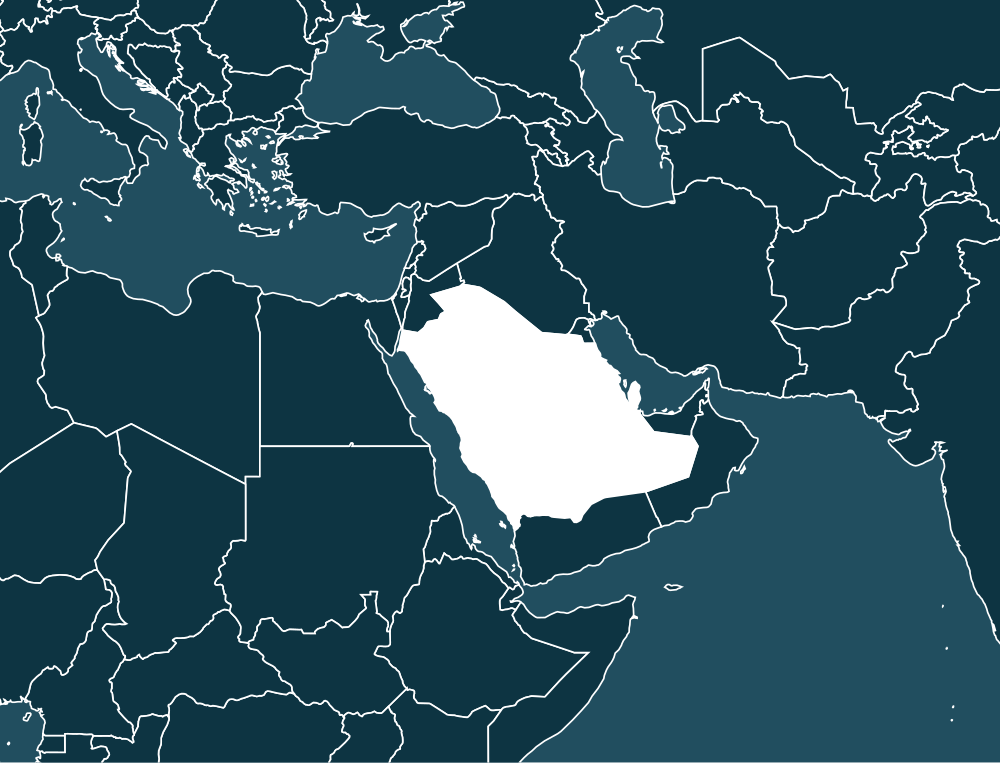
Saudi Arabia, founded in its modern form by ABD AL-AZIZ bin Abd al-Rahman AL SAUD in 1932, remains shaped by its religious significance, hereditary monarchy, and central role in regional affairs. Successive kings have combined cautious political management with social and economic changes, including women’s participation in municipal elections, the lifting of the driving ban, education reforms, and the launch of Vision 2030. Its security posture has also evolved through counter-extremism initiatives such as Etidal, military involvement in Yemen, and renewed cooperation with Western forces following attacks on its oil infrastructure.
As a leading holder of global oil reserves, the Kingdom is balancing energy influence with diversification, foreign investment, and the private-sector objectives associated with WTO membership and Vision 2030. Its strategic environment is complicated by conflict and instability in Yemen, Iraq, and Syria, alongside broader tensions involving Iran and regional proxy networks. Cross-border insecurity, humanitarian pressures, and scrutiny surrounding sanctions evasion, re-exported dual-use goods, and trade with Russia add further layers to Saudi Arabia’s political, economic, and security landscape.
AML & Terrorist Financing
Saudi Arabia is not on the FATF list of jurisdictions with strategic AML deficiencies, and its 2020 follow-up assessment recorded progress on targeted sanctions alongside generally strong financial-sector controls and inter-agency coordination through bodies including SAMA and the Anti-Money Laundering Permanent Committee. Significant vulnerabilities nevertheless remain around complex money-laundering investigations, proceeds confiscation, suspicious transaction reporting, cash and remittance flows, and the effectiveness of the FIU’s financial analysis, particularly where funds move abroad or through informal channels. Terrorist-financing investigations led with Mabaheth have produced substantial results domestically, while proliferation-financing controls, sanctions communication, international pursuit of criminal proceeds, and the practical safeguards surrounding certain financial restrictions continue to present areas of concern, even as the Ministry of Commerce’s 2025 UBO framework adds a newer layer of corporate transparency.
Sanctions
Saudi Arabia is expected to implement United Nations Security Council measures, including targeted restrictions administered through sanctions committees and reflected on the Consolidated List. At the same time, concerns describe Saudi-linked channels involving Russian oil, Iranian fuel swaps, third-country transit hubs, trade-based money laundering, hawala, and cryptocurrency transfers that may facilitate sanctions evasion. No distinct foreign sanctions regime imposed directly against Saudi Arabia is identified, though its financial infrastructure, energy partnerships, and regional trade corridors are portrayed as facing significant international compliance pressure.
Criminality
Saudi Arabia has expanded its formal anti-corruption framework through the Oversight and Anti-Corruption Commission (Nazaha), the 2024 Nazaha Law, financial-crime controls, and the Etimad procurement portal, though businesses continue to identify selective enforcement and limited transparency in procurement, licensing, and concessions. Beyond corruption, the country faces persistent concerns involving trafficking and migrant exploitation, synthetic drugs, counterfeit and illicit goods, ransomware and online fraud, with allegations of state-linked involvement and uneven attention across criminal markets.
Reports
Saudi Arabia has expanded coordination through the NRM, strengthened screening and prevention measures, and introduced protections such as domestic-worker coverage under the Wage Protection System, while significant vulnerabilities remain for migrant and domestic workers amid wage theft, passport confiscation, restricted job mobility, and limited victim services. At the same time, Riyadh maintains an extensive counterterrorism architecture involving biometric screening, counterterrorist-financing efforts, U.S. cooperation, and the Global Coalition to Defeat ISIS, alongside concerns over the use of counterterrorism and cybercrime laws and continuing security pressures linked to the Houthi threat.
Industry/Product Sector Risk
Saudi Arabia’s financial system is anchored by a concentrated, closely supervised banking sector, while SAMA-regulated remittance and currency-exchange channels remain particularly exposed to high-volume cross-border flows. The broader risk landscape extends across trade finance, transportation, construction, charities and cash-intensive businesses, with the Saudi National Risk Assessment highlighting concerns linked to corruption, smuggling, narcotics trafficking, counterfeiting and terrorist financing. Oversight by bodies including SAMA, the Capital Market Authority, the Ministry of Justice and the Ministry of Commerce and Investment provides important safeguards, yet sector-specific vulnerabilities emerge wherever complex ownership, public procurement, digital fundraising or international trade intersect.
Economy & Investment Climate
Saudi Arabia’s economy is undergoing a state-directed transformation under Vision 2030, combining continued oil dependence with large-scale investment in tourism, infrastructure, mining, healthcare, technology, renewable energy, and logistics through vehicles such as the Public Investment Fund and programs supported by MISA. Attractive financing, expanding foreign ownership, special economic zones, and improving commercial rules coexist with fiscal deficits, localization requirements, regulatory uncertainty, labor-market pressures, and security and enforcement risks that merit closer examination.
Cryptocurrency Regulations
Saudi Arabia maintains a cautious and restrictive posture toward cryptocurrency, with the Saudi Central Bank (SAMA) and Capital Market Authority (CMA) relying on existing financial, AML, and market-conduct rules rather than a dedicated licensing regime, leaving users largely dependent on offshore platforms. Tax treatment generally follows corporate tax, zakat, and VAT principles overseen by ZATCA, while initiatives involving digital assets and real-estate tokenization—particularly through the Real Estate General Authority (REGA)—suggest that more defined frameworks may gradually emerge.
Get full access
The information on this page is a brief summary. Get access to EDD country reports, all risk category scores and customisable weightings for 245 jurisdictions.