
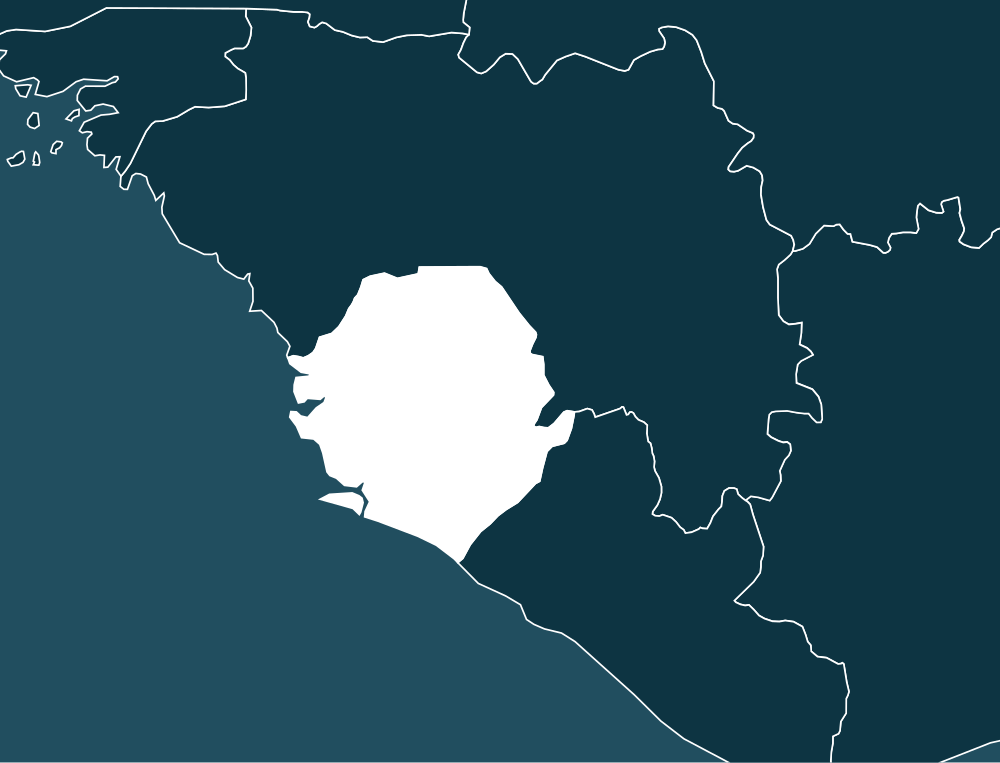
Risk Indicators
- FATF/EU Blacklist/Greylist (Lower Concern)
- Terrorism Financing (Medium Concern)
- US Dept of State INCSR
- Proliferation Financing
- Corruption
- Criminality
- Resilience & Governance
- Financial Transparency
- Offshore Finance Centres
- Sanctions
Background
Sierra Leone’s history reflects centuries of settlement, regional trade, Islamic influence, and British involvement that expanded from commerce in timber and ivory to the trafficking of enslaved people. Freetown later became a destination for Black British loyalists and liberated Africans, while the colony gradually extended inland before gaining independence from the United Kingdom in 1961. Its modern political trajectory has included authoritarian rule under Siaka STEVENS, a devastating civil war, and a prolonged democratic contest between the Sierra Leone People’s Party (SLPP) and the All People’s Congress (APC).
Since the war’s formal conclusion in 2002, elections and political reforms have remained central to Sierra Leone’s development, including Julius Maada BIO’s victories and the 2023 Agreement for National Unity. The country’s surrounding security environment is shaped by Guinea’s military junta under Colonel Mamady Doumbouya, reported cross-border tensions, jihadist spillover risks, and concerns involving Russian-linked security networks. Liberia adds a separate layer of regional uncertainty through fragile postwar stability, porous borders, communal violence, arms-trafficking risks, and a periodically renewed UN/EU arms embargo.
AML & Terrorist Financing
Sierra Leone is not listed by FATF as having strategic AML deficiencies, yet its last mutual evaluation identified significant weaknesses across core recommendations and has not been replaced by a newer assessment. Progress has included strengthening the Financial Intelligence Unit, ratifying the Palermo Convention, introducing measures linked to UNSCRs 1267 and 1373, and bringing some informal currency exchange activity under Bank of Sierra Leone oversight, although supervision and implementation remain uneven. Persistent exposure arises from corruption, smuggling, porous borders, unregulated financial activity, and limited investigative capacity, with institutions such as the FIU, Anti-Corruption Commission, and Transnational Organized Crime Unit facing resource and enforcement challenges.
Sanctions
Sierra Leone supports United Nations sanctions regimes, including measures involving arms, travel, finance, commodities, and the Consolidated List, but no international sanctions are currently in force against the country. Its maritime registry and financial channels have nevertheless been associated with sanctions-evasion concerns involving Iranian energy shipments and North Korean-linked vessels, including the Sierra Leone-flagged Latin Venture. Historical diamond and arms trafficking through Liberia, alongside vulnerabilities in vessel registration, border controls, and AML/CFT oversight, adds further complexity to enforcement.
Criminality
Corruption remains a significant concern in Sierra Leone, especially in procurement, licensing, customs, regulatory enforcement, and dispute resolution, despite investigations, convictions, and recovered funds by the Anti-Corruption Commission. Criminal activity also spans trafficking, smuggling, illegal resource extraction, counterfeit goods, and drug transit, with the 2023 Audit Report, Audit Service Sierra Leone, and National Public Procurement Authority highlighting the importance—and limits—of existing oversight.
Reports
Sierra Leone remains on Tier 2 as the government advances a revised National Action Plan and records renewed convictions, while victim support, investigations, international cooperation, and the national hotline remain areas of concern. Trafficking risks span rural-to-urban movement, mining, domestic work, begging, and commercial sex, with children affected through practices such as menpikin and Sierra Leonean migrants vulnerable across West Africa, the Middle East, and Europe.
Industry/Product Sector Risk
Sierra Leone’s financial and commercial landscape is shaped by a predominantly cash-based informal economy, with commercial banks handling most formal assets and cross-border flows while foreign exchange bureaux, remittance providers, real estate, mining, casinos, and high-value dealers present more acute exposure. Diamonds and other extractive activities, public-sector corruption, smuggling, fraud, and trade-based schemes recur across sectors, with gaps in beneficial ownership transparency, supervision, suspicious transaction reporting, and controls over professional gatekeepers creating additional vulnerabilities. The roles of the Anti-Corruption Commission, the Corporate Affairs Commission, mobile money providers, and authorities overseeing customs, mining, and non-profit organisations point to a complex risk environment whose finer details warrant closer examination.
Economy & Investment Climate
Sierra Leone’s economy combines strong potential in agriculture, mining, fisheries, tourism, and infrastructure with an export base centered on iron ore, titanium ore, diamonds, aluminum ore, and cocoa, while the Medium-Term National Development Plan and Feed Salone initiative signal an emphasis on food security, human capital, and private-sector growth. The National Investment Board and recent reforms such as the Arbitration Act 2022 point to a more investment-oriented framework, although limited infrastructure, costly credit, skills shortages, governance concerns, and unresolved fiscal and debt pressures continue to shape the business environment.
Cryptocurrency Regulations
Sierra Leone places cryptocurrency in a legal grey area: it is not legal tender, yet the 2024 AML/CFT Act brings virtual assets and VASPs under Bank of Sierra Leone licensing and information-reporting requirements. With GIABA noting a sectoral risk assessment but no licensed VASPs as of November 2024, exchange oversight, token offerings, and cryptocurrency taxation remain areas of developing regulation and considerable uncertainty.
Get full access
The information on this page is a brief summary. Get access to EDD country reports, all risk category scores and customisable weightings for 245 jurisdictions.