
Risk Indicators
- FATF/EU Blacklist/Greylist (Lower Concern)
- Terrorism Financing (Lower Concern)
- US Dept of State INCSR
- Proliferation Financing
- Corruption
- Criminality
- Resilience & Governance
- Financial Transparency
- Offshore Finance Centres
- Sanctions
Background
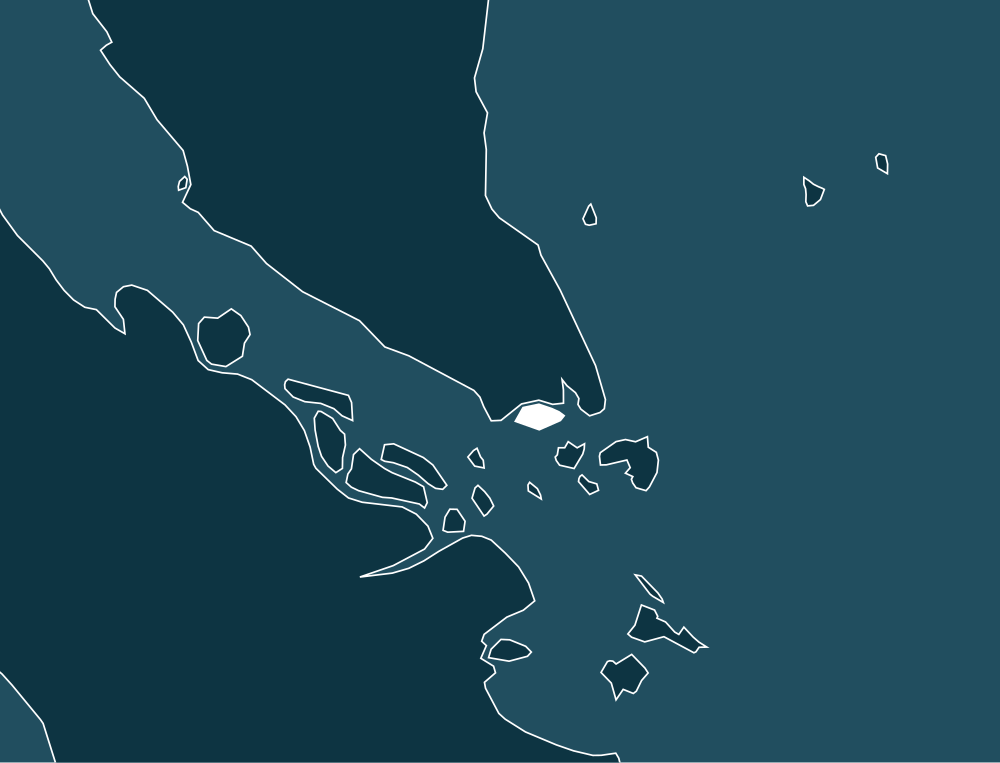
Singapore emerged from the historic trading settlement of Temasek to become a British-founded colony, a self-governing state, and an independent city-state after its brief union with Malaysia. It has since developed into one of the world’s most prosperous economies, supported by extensive international trade and exceptionally high per capita GDP. The People’s Action Party has remained dominant since the colonial era, helped by sustained economic performance, divided opposition, and electoral arrangements favoring the ruling party.
Its surrounding environment is shaped by Malaysia’s sanctions policy and semiconductor exposure, including the US designation of Kuala Lumpur-based Jatronics, alongside Indonesia’s internal conflict and alleged role in sanctions-evasion networks. Violence involving Indonesian security forces and the West Papua National Liberation Army has raised civilian-protection concerns, while intermediaries linked to Mahan Air reportedly facilitated aircraft transfers. Together, these developments point to a tightly connected regional landscape where domestic instability, strategic trade, and global enforcement pressures overlap.
AML & Terrorist Financing
Singapore is not subject to FATF strategic-deficiency listing, and its 2026 assessments reflect a generally strong but uneven AML/CFT framework amid risks arising from its role as a global financial, trade, transport, and digital-asset hub. High-profile enforcement such as the 2023 multibillion-dollar money-laundering case, together with the work of MAS, CAD, and STRO, illustrates substantial institutional capability, while foreign-originated illicit flows, cyber-enabled fraud, environmental crime, and complex corporate structures remain important concerns. Terrorist-financing and proliferation-financing controls show notable strengths but also unresolved issues involving risk-based mitigation, sanctions implementation, supervisory coverage, beneficial-ownership accuracy, enforcement consistency, and the pursuit of funds moving through Singapore.
Sanctions
Singapore implements UN Security Council sanctions, including asset freezes and trade restrictions, through measures overseen by institutions such as the Monetary Authority of Singapore and the Commercial Affairs Department. Although no international sanctions are currently in force against Singapore, its position as a major trade and financial hub has drawn scrutiny over alleged evasion networks linked to Russia, Iran, North Korea, and Myanmar. Cases involving entities such as Asia Trading & Construction, CCIC Singapore, and Kwek Kee Seng point to the use of shell companies, ship-to-ship transfers, falsified documents, and maritime deception across regional routes.
Criminality
Singapore maintains a stringent, actively enforced anti-corruption framework, with the Corrupt Practices Investigation Bureau empowered under the Prevention of Corruption Act to pursue offenses involving officials, political parties, family members, and Singaporeans abroad, while corporate fraud still attracts swift scrutiny. Crime remains more visible in illicit markets and technology-enabled offenses, including trafficking, counterfeit goods, drug distribution, wildlife and timber smuggling, ransomware, scams, money laundering, and other financial crimes linked to Singapore’s role as a major commercial and financial hub.
Reports
Singapore maintains strong systems against trafficking and terrorism, with increased investigations, victim referrals, and support alongside comprehensive security and prevention measures involving agencies such as the Immigration and Checkpoints Authority, Singapore Police Force, and MUIS. Yet vulnerabilities remain among migrant and domestic workers, while youth radicalization, online extremist content, and the reach of preventive security powers continue to shape the country’s evolving approach.
Industry/Product Sector Risk
Singapore’s position as a regional financial, trading and travel hub creates significant exposure across banking, trade finance, private wealth, casinos, remittances and corporate structures, with cross-border flows and foreign-sourced proceeds recurring themes. The NRA highlights heightened risks involving fraud, corruption, tax offences, unlicensed money lending, organised crime and trade-based laundering, while emerging channels such as internet-based payments, virtual currencies and money-mule activity add further complexity. Oversight involving bodies such as the Commissioner of Charities and financial-sector authorities reflects a broad control framework, yet vulnerabilities remain around cash intensity, beneficial ownership, complex transactions and the effective monitoring of international customers and intermediaries.
Economy & Investment Climate
Singapore’s open, trade-dependent economy combines world-class infrastructure, strong institutions, advanced manufacturing and financial services with an ambitious push into digital innovation, cybersecurity, and sustainable energy. Foreign investors benefit from EDB facilitation, MAS-regulated markets, extensive trade agreements, and reliable dispute resolution, while navigating targeted national-security screening, foreign-labor controls, state-linked enterprises, and energy-transition constraints.
Cryptocurrency Regulations
Singapore permits cryptocurrency activity under a structured framework led by the Monetary Authority of Singapore (MAS), with the Payment Services Act, Notice PSN02, licensing requirements, and the Financial Institutions Directory shaping how digital payment token providers operate. The country combines Travel Rule obligations and active supervision with tax treatment overseen by IRAS, while emerging initiatives such as CARF and Project Guardian point to continued development in compliance and tokenization.
Get full access
The information on this page is a brief summary. Get access to EDD country reports, all risk category scores and customisable weightings for 245 jurisdictions.