
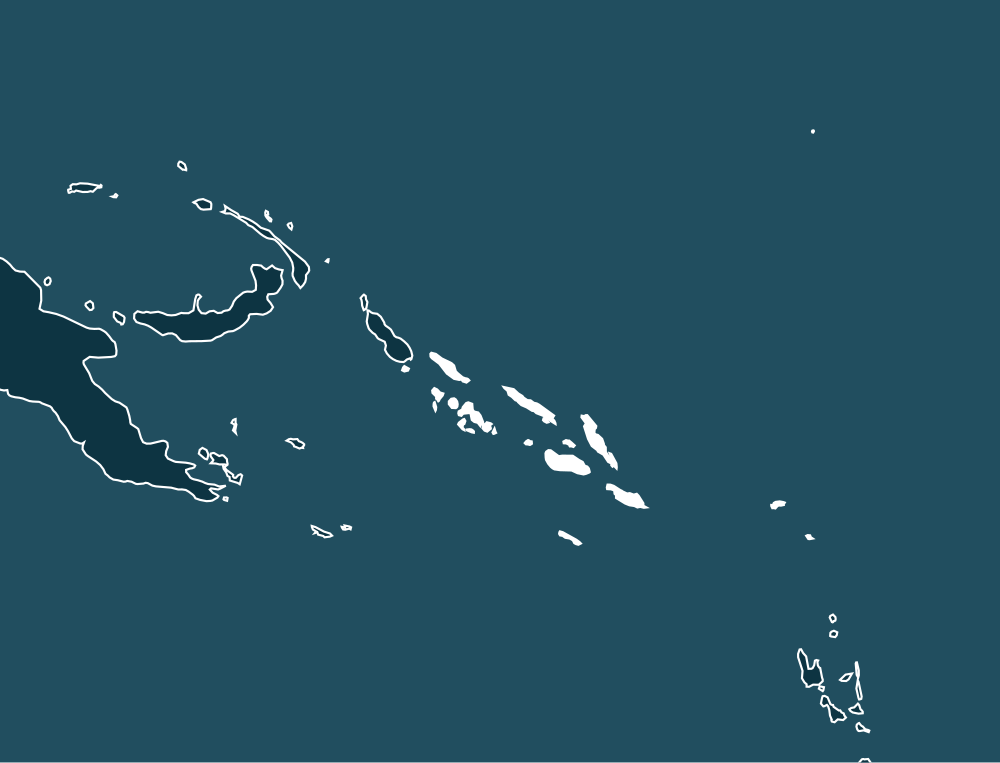
Risk Indicators
- FATF/EU Blacklist/Greylist (Lower Concern)
- Terrorism Financing (Medium Concern)
- US Dept of State INCSR
- Proliferation Financing
- Corruption
- Criminality
- Resilience & Governance
- Financial Transparency
- Offshore Finance Centres
- Sanctions
Background
Solomon Islands emerged from the interweaving of Papuan and Austronesian settlement, followed by centuries of inter-island exchange without a unified political structure. European involvement developed gradually, leading to German and British protectorates before wartime occupation and the devastation of the Guadalcanal Campaign. Self-government arrived in 1976, followed by independence in 1978 under Prime Minister Sir Peter Kenilorea.
More recent history has been shaped by tensions between communities associated with Guadalcanal and Malaita, including civil conflict, displacement, and unrest in Honiara. International intervention through the Australian-led Regional Assistance Mission to the Solomon Islands helped restore security, though political grievances and allegations surrounding China continued to fuel instability. The country’s setting also places it near challenges involving Bougainville, offshore financial crime, sanctions enforcement, and wider strategic competition among Australia, China, and the United States.
AML & Terrorist Financing
Solomon Islands is not on the FATF list of jurisdictions with strategic AML deficiencies, yet its 2019 Mutual Evaluation identified uneven technical compliance and low effectiveness across AML/CFT outcomes, amid risks linked to corruption, fraud, illegal logging, tax evasion, illegal gold exports and illegal fishing. The SIFIU, RSIPF and AMLTEG have established channels for cooperation, but limited supervision, weak customer and beneficial-ownership controls, scarce resources and a focus on predicate offences have contributed to very few money-laundering convictions and low levels of confiscation. Terrorist-financing activity has not been identified, but the framework remains underdeveloped, including gaps in targeted financial sanctions, proliferation-financing controls and oversight of high-risk sectors such as non-profit organisations, while the APG Typologies Report 2022 noted online scams, pyramid schemes and growing digital-token activity.
Sanctions
Solomon Islands supports United Nations Security Council sanctions, including measures reflected on the Consolidated List and spanning areas such as arms, travel, financial, and commodity restrictions. No international sanctions are currently in force against Solomon Islands, although its banking, money-transfer, maritime, logging, fishing, and gold-export sectors present vulnerabilities that could be exploited in evasion schemes associated with jurisdictions such as Russia, Iran, or North Korea. The most relevant concerns involve indirect shipping routes, ship-to-ship transfers, falsified documentation, offshore laundering, and cash movements, rather than any established finding that Solomon Islands is facilitating sanctions evasion.
Criminality
Solomon Islands faces persistent criminal activity linked to human trafficking, illegal logging and fishing, cannabis markets, financial scams, and the suspected diversion of public and natural-resource revenues by corrupt actors. State-linked figures, foreign companies, and networks operating around logging camps, urban areas, and border zones are repeatedly associated with these activities, while the Royal Solomon Islands Police Force confronts cases involving embezzlement, money laundering, and trafficking.
Reports
Solomon Islands remains on the Tier 2 Watch List, with the Ministry of Commerce’s Labor Division, frontline officials, and a crisis center involved in prevention and assistance efforts, while authorities have yet to investigate trafficking crimes or secure convictions. Trafficking risks span logging, fishing, mining, domestic work, tourism, informal adoption, and seasonal worker programs, affecting Solomon Islanders and foreign nationals amid economic instability, migration pressures, and alleged corruption.
Industry/Product Sector Risk
Solomon Islands’ industry landscape is shaped by a predominantly cash-based economy, with banking, money remittance, currency exchange, casinos, fisheries, forestry, mining, construction and political activity presenting varying degrees of exposure to money laundering risks. The National Risk Assessment highlights illegal logging, illegal fishing, illegal gold exports, corruption, fraud and tax evasion as recurring concerns, while limited AML/CFT supervision by SIFIU and CBSI leaves vulnerabilities across both financial institutions and DNFBPs. Against this backdrop, initiatives such as Task Force Janus, alongside the roles of the Solomon Islands Gaming Board and the Institute of Solomon Islands Accountants, point to a complex network of regulatory and sector-specific issues warranting closer examination.
Economy & Investment Climate
Solomon Islands has a resource-based economy anchored by subsistence agriculture, fishing, timber, and mining, with services contributing 47.3% of GDP and exports of wood, fish, gold, and palm oil led by trade with China, Australia, and Italy. Investment potential in tourism and renewable energy is tempered by infrastructure damage, political and land-ownership challenges, environmental pressures affecting coral reefs, and a persistent gap between imports and exports.
Cryptocurrency Regulations
Cryptocurrencies remain legal to hold and trade in the Solomon Islands but are not legal tender, with the Central Bank of Solomon Islands (CBSI) warning that assets such as Bitcoin and Ethereum operate outside its regulatory mandate. The Money Laundering and Proceeds of Crime Act and the Solomon Islands Financial Intelligence Unit provide only indirect AML context, while the absence of VASP licensing, dedicated tax rules, and enacted legislation—despite a proposed Virtual Assets Business Bill in May 2026—leaves exchanges, token offerings, and users navigating substantial uncertainty.
Get full access
The information on this page is a brief summary. Get access to EDD country reports, all risk category scores and customisable weightings for 245 jurisdictions.