
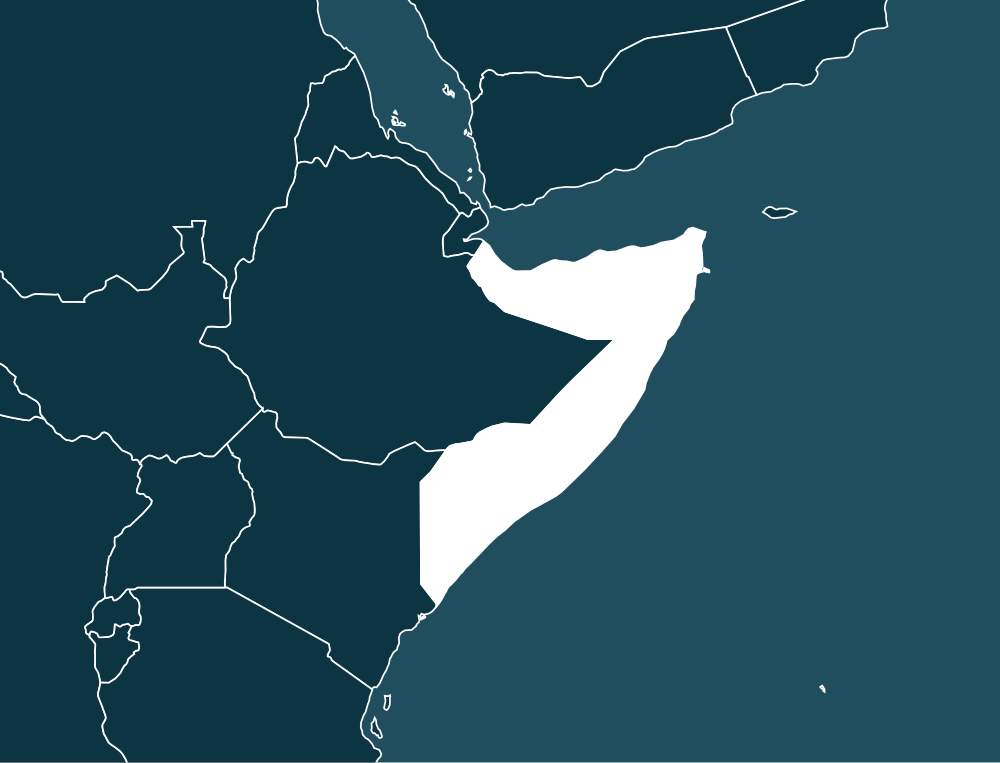
Risk Indicators
- FATF/EU Blacklist/Greylist (Medium Concern)
- Terrorism Financing (Higher Concern)
- US Dept of State INCSR
- Proliferation Financing
- Corruption
- Criminality
- Resilience & Governance
- Financial Transparency
- Offshore Finance Centres
- Sanctions
Background
Somalia’s history reflects centuries of Indian Ocean connections, colonial rule, and a post-1960 political order that fractured after General Mohamed Siad Barre’s coup and subsequent state collapse. Clan-based conflict, famine, international intervention, and the legacy of the 1993 Mogadishu fighting shaped the country’s difficult path toward federal governance. The emergence of Somaliland, Puntland, localized institutions, and sharia courts reveals a political landscape in which authority has often been built from the ground up.
The Islamic Courts Union’s brief expansion, Ethiopia’s 2006 intervention, and the rise of al-Shabaab remain central to understanding Somalia’s continuing security and governance challenges. Although the African Union helped create space for the Somali Federal Government and later presidential elections, al-Shabaab still controls significant territory and sustains pressure on national institutions. Across the region, tensions in Ethiopia, smuggling and corruption concerns in Kenya, and the Front for the Restoration of Unity and Democracy insurgency in Djibouti add further complexity to border security, sanctions enforcement, and illicit arms networks.
AML & Terrorist Financing
Somalia’s AML and terrorist-financing framework is developing amid a largely informal financial system, extensive reliance on hawala and money-transfer businesses, weak supervision, limited border controls, and persistent corruption. Although the country is not currently listed by FATF for strategic deficiencies, it has not completed a mutual evaluation, while risks linked to al-Shabaab financing, illicit charcoal and sugar trade, cash couriers, and remittance channels remain significant. Institutions including the National Anti-Money Laundering Committee (NAMLC), Financial Reporting Center (FRC), and the Attorney General’s Financial and Economic Crimes Unit provide an emerging enforcement structure, but regulatory implementation, investigative capacity, beneficial-ownership transparency, and international information-sharing continue to warrant close attention.
Sanctions
Somalia is not identified as imposing sanctions on other nations, while it remains subject to a multilayered international framework led by the UN and implemented by authorities including OFAC, the European Union, and the UK. Since Resolution 2714 lifted the general arms embargo on the Somali government, remaining measures have focused increasingly on Al-Shabaab and associated networks through targeted arms restrictions, asset freezes, travel bans, charcoal and IED-component prohibitions, and maritime interdiction extended by Resolution 2806. Enforcement is complicated by charcoal trafficking, hawala transfers, front companies, and maritime routes linking Somali ports with the UAE and other regional hubs, with humanitarian and security-sector exemptions preserving support for legitimate Somali institutions.
Criminality
Somalia criminalizes abuse of office, embezzlement, and bribery, yet corruption remains pervasive, particularly in public procurement, where required procedures and a permanent procurement board are absent and the Somalia Independent Anti-Corruption Commission has not been reconstituted. Criminal activity spans trafficking in people, arms, charcoal, and counterfeit goods, alongside extortion, financial crime, and cybercrime involving Al-Shabaab, clan-based networks, state-embedded actors, and foreign participants, while citizens lack a centralized and confidential mechanism for reporting corruption.
Reports
Somalia’s prolonged insecurity, humanitarian pressures, and limited government reach continue to shape concerns involving trafficking, extremist recruitment, and exploitation, with al-Shabaab and ISIS-Somalia remaining prominent threats. Vulnerable groups—including internally displaced people, children, and migrants—face risks along domestic and cross-border routes, while the Federal Government of Somalia, Puntland authorities, and Somaliland institutions have shown varying levels of response amid persistent operational and political challenges.
Economy & Investment Climate
Somalia’s economy is rebuilding amid macroeconomic reforms, with HIPC completion, expanding digital activity, and opportunities in agriculture, livestock, fisheries, energy, ports, and logistics supporting a cautiously positive outlook. Yet insecurity, fragmented regulation, weak infrastructure, limited banking connections, corruption, and unresolved land and contract protections continue to complicate investment, even as SOMINVEST, the Central Bank of Somalia, NAMLC, and the Financial Reporting Center advance institutional reforms.
Cryptocurrency Regulations
In Somalia, cryptocurrency remains outside legal-tender status, with the Central Bank of Somalia’s July 2024 warning underscoring that no financial institution is licensed to provide virtual-asset services. Although the 2016 Anti-Money Laundering and Counter Financing of Terrorism Act offers a broader compliance foundation, the absence of VASP licensing, crypto-specific tax treatment, exchange supervision, and token-offering rules leaves the sector in an uncertain regulatory space.
Get full access
The information on this page is a brief summary. Get access to EDD country reports, all risk category scores and customisable weightings for 245 jurisdictions.