
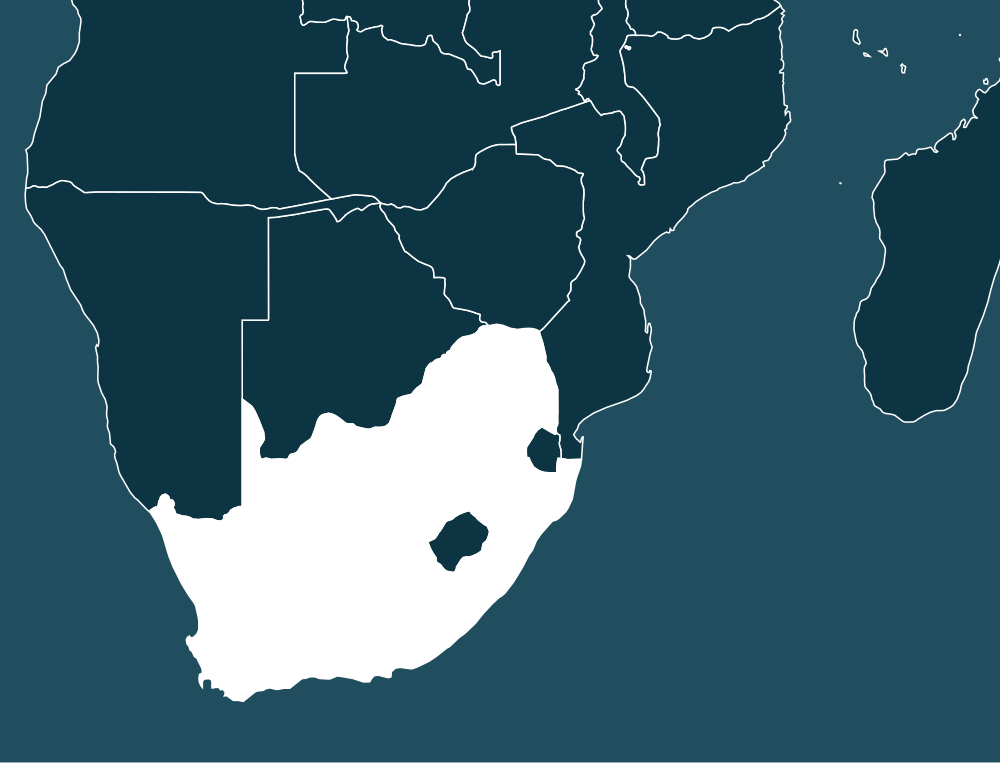
Risk Indicators
- FATF/EU Blacklist/Greylist (Lower Concern)
- Terrorism Financing (Lower Concern)
- US Dept of State INCSR
- Proliferation Financing
- Corruption
- Criminality
- Resilience & Governance
- Financial Transparency
- Offshore Finance Centres
- Sanctions
Background
South Africa’s history reaches back to some of the earliest human remains in the fossil record, followed by successive movements of Bantu-speaking, Khoisan-speaking, Dutch, and British communities. Cape Town emerged from a 1652 Dutch trading station, while the discovery of diamonds and gold drew large-scale immigration and intensified political and territorial conflict. The Union of South Africa, the National Party’s apartheid system, and the African National Congress resistance—including the imprisonment of Nelson MANDELA—preceded the first multiracial elections in 1994.
Since the ANC-led transition to majority rule, successive governments have faced the enduring effects of apartheid on wealth, housing, education, and health care, while Cyril RAMAPHOSA has pursued measures to curb corruption. South Africa’s strategic position links it to instability in Zimbabwe, insurgency in Mozambique, political tensions in Eswatini and Lesotho, and the wider conflict in the Democratic Republic of the Congo, where UN sanctions and illicit mineral networks remain significant. Although not under international sanctions, South Africa faces growing scrutiny from the US and other Western governments over foreign-policy positions, alleged relationships involving Russia and Iran, and claims concerning regional financial and sanction-evasion channels.
AML & Terrorist Financing
South Africa has made significant AML/CFT progress and was removed from the FATF list in October 2025, following improvements involving supervision, international cooperation, financial intelligence, confiscation, and targeted sanctions. Yet substantial exposure remains from corruption and state capture, cash-based and informal activity, cross-border proceeds, precious-mineral crime, and weaknesses in beneficial-ownership transparency, with the FIC and CIPC central to ongoing efforts. Terrorist-financing effectiveness and complex money-laundering prosecutions continue to warrant attention, including the practical impact of the NPA, DPCI, and other authorities in identifying networks, pursuing cases, and disrupting assets.
Sanctions
South Africa supports United Nations sanctions measures, including those administered through Security Council sanctions committees and reflected on the Consolidated List, but is not identified as a major independent sender of sanctions. No international sanctions are currently in force against South Africa, although its ports, financial institutions, shipping companies, and professional services have drawn attention as potential intermediaries in evasion networks linked most notably to Russia after the invasion of Ukraine. These concerns also extend to networks associated with Hizballah, Hamas, ISIS, and sanctioned Russian oligarchs, involving trade rerouting, financial masking, and the movement of commodities, diamonds, art, and luxury goods.
Criminality
South Africa has an extensive anti-corruption framework, yet uneven enforcement, limited public-sector accountability, and risks to whistleblowers remain significant, with the Zondo Commission and other inquiries documenting deeply entrenched networks involving state institutions and private interests. The country also faces broad criminal activity spanning trafficking, extortion, illegal firearms and resource trading, drug transit, cybercrime, and financial fraud, while agencies such as the Directorate for Priority Crime Investigations and the Office of the Public Protector operate against well-organized and sometimes state-linked actors.
Reports
South Africa remains a major regional hub for illicit drugs and cross-border trafficking, with O.R. Tambo International Airport, maritime and land routes, Nigerian-linked networks, and substances such as “nyaope” featuring prominently alongside enforcement efforts by SAPS and Operation Fiela. Human trafficking vulnerabilities span sex trafficking, forced labor, mining, agriculture, migration, and online exploitation, while coordination and victim services remain uneven as ISIS-linked logistical activity, border-security pressures, FATF concerns, and the work of the Border Management Authority shape the wider security picture.
Industry/Product Sector Risk
South Africa’s financial and broader commercial landscape presents varied money-laundering and terrorist-financing exposure, shaped by cash intensity, informal remittances, cross-border flows, opaque ownership structures, and the country’s role as a regional hub. High-risk areas include casinos, high-value dealers, virtual assets, mining, transport, hospitality, politics, utilities, and public works, while banking, real estate, investment, and professional services carry significant vulnerabilities linked to corruption, fraud, tax crimes, drug trafficking, and environmental offences. The contrasting oversight picture—from the South African Reserve Bank’s Financial Surveillance Department and the NPO Task Team to resource constraints affecting the Estate Agency Affairs Board and gaps identified under the FIC framework—offers a deeper view of where financial crime risks may converge.
Economy & Investment Climate
South Africa remains Sub-Saharan Africa’s most industrialized economy and a regional investment hub, supported by sophisticated capital markets, a relatively independent judiciary, and facilitation through DTIC and InvestSA. Yet prolonged stagnation, energy and logistics constraints involving Eskom and Transnet, elevated unemployment, policy uncertainty, and evolving rules on property rights and economic transformation continue to shape the country’s investment outlook under the Government of National Unity.
Cryptocurrency Regulations
South Africa permits cryptocurrency while treating it as a regulated financial product rather than legal tender, with the FSCA, FIC, SARB, and SARS each playing distinct roles across licensing, AML oversight, financial stability, and taxation. From licensed CASPs and FIC Directive 9 to CARF reporting, evolving token rules, and potential penalties for undisclosed transactions, the framework reveals a tightly monitored market that continues to develop.
Get full access
The information on this page is a brief summary. Get access to EDD country reports, all risk category scores and customisable weightings for 245 jurisdictions.