
Risk Indicators
- FATF/EU Blacklist/Greylist (Lower Concern)
- Terrorism Financing (Medium Concern)
- US Dept of State INCSR
- Proliferation Financing
- Corruption
- Criminality
- Resilience & Governance
- Financial Transparency
- Offshore Finance Centres
- Sanctions
Background
Sint Maarten’s history reflects competing European claims, plantation-era slavery, and an economy that later shifted from salt and other commodities toward tourism after becoming a free port in 1939. Its modern constitutional status emerged through the Netherlands Antilles and a 2000 referendum, with self-government within the Kingdom of the Netherlands taking effect in 2010. Hurricane Irma’s 2017 impact, including damage to roughly 90% of buildings according to the UN, remains a significant part of the island’s recent background.
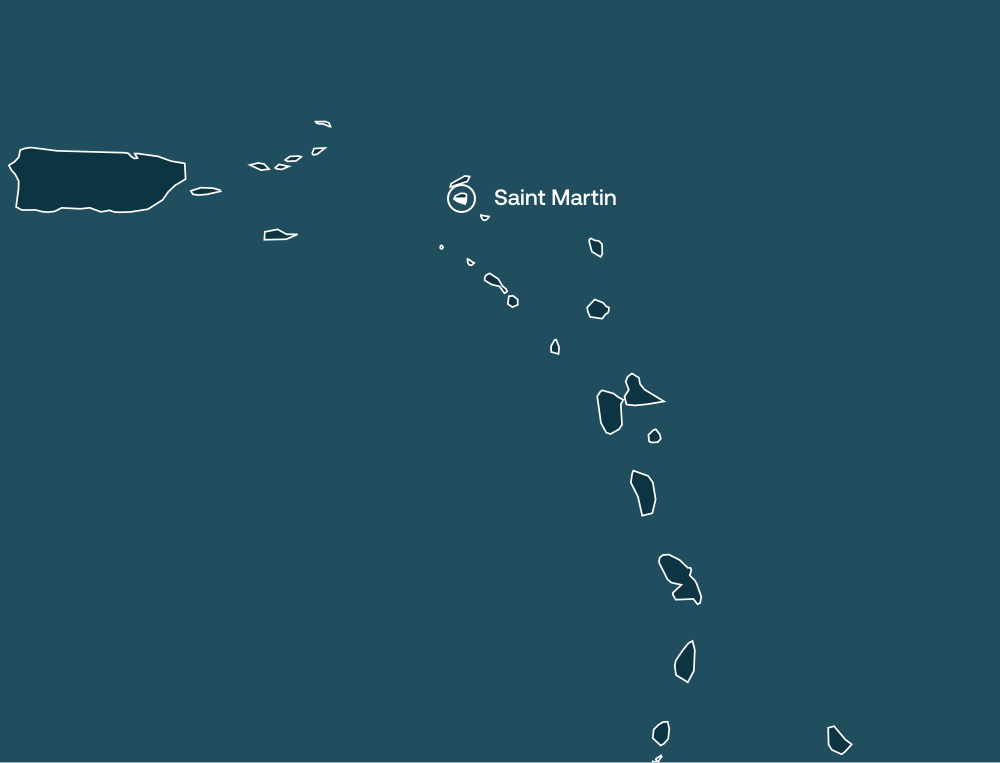
Sharing Saint Martin with the French Collectivity of Saint Martin, Sint Maarten occupies a regional setting that includes generally stable territories as well as jurisdictions facing more complex security and financial concerns. Anguilla is particularly notable for gang and drug-related violence, tax-transparency concerns identified by the OECD, and blacklisting by the EU, France, and the Netherlands. Nearby Saint Kitts and Nevis also attracts scrutiny related to its citizenship-by-investment program, while Saba, Sint Eustatius, and Saint Barthélemy are described as comparatively stable.
AML & Terrorist Financing
Sint Maarten is not subject to FATF enhanced monitoring, yet its cash-intensive, tourism-driven economy, porous borders, and exposure to drug trafficking, fraud, smuggling, casinos, real estate, and other sectors create a complex AML risk environment. The 2025 assessment found gaps in risk data, national policy, beneficial-ownership information, supervision, financial investigations, confiscation, and FIU-SXM analytical capacity, despite cooperation among the CBCS, FIU-SXM, the Public Prosecutor’s Office, and other authorities. Terrorist-financing risks are considered relatively low but remain incompletely understood, with limited specialised capacity, no identified national or institutional TF strategies, delays affecting targeted financial sanctions, and no TF-related unusual transaction reports based on red flags.
Sanctions
Sint Maarten is required under the UN Charter and the Statute of the Dutch Kingdom to implement UN and EU sanctions, including measures administered through Security Council sanctions committees and the Consolidated List, but no international sanctions are currently in force against Sint Maarten. Its enforcement environment is complicated by alleged use of its maritime identity, registration documents, financial institutions, and transit infrastructure in evasion schemes connected especially to Russia, with regional links involving Iran and Venezuela. Limited monitoring capacity, AIS and MMSI fraud, offshore financial activity, and reliance on cooperation with bodies such as INTERPOL leave significant questions around how effectively sanctions-related risks are detected and addressed.
Criminality
Publicly available measures provide only a limited picture of corruption conditions in St. Maarten, with one prominent international indicator unavailable and another offering a broader control-of-corruption assessment. This leaves important questions about institutional integrity, enforcement, and the practical effectiveness of safeguards open for closer examination.
Reports
Sint Maarten remains a significant maritime and commercial-airport transshipment hub for cocaine and marijuana, prompting cooperation among the Korps Politie Sint Maarten, French and Dutch counterparts, and the Eastern Caribbean Law Enforcement Working Group. Human-trafficking concerns continue across sex work, domestic service, construction, and other sectors, while limited victim services, the absence of identified victims or trafficking convictions for a fifth consecutive year, and confusion between trafficking and migrant smuggling remain key challenges.
Industry/Product Sector Risk
Sint Maarten’s industry profile is shaped by tourism, cash-intensive activity, cross-border finance, and a strategically important position on regional transport routes, with casinos, hospitality, real estate, retail banking, and remittance services presenting varied levels of exposure. Particular attention surrounds beneficial-ownership transparency, foreign customers and structures, uneven AML/CFT implementation, and the potential movement of proceeds associated with drug trafficking, migrant smuggling, fraud, tax evasion, and corruption. The roles of the FIU and CBCS, alongside gatekeepers such as notaries, lawyers, accountants, and trust and company service providers, point to a complex risk environment where regulatory coverage and supervisory effectiveness remain significant themes.
Economy & Investment Climate
Sint Maarten’s high-income economy is overwhelmingly service-based and tourism-driven, with services accounting for 89.3% of GDP and tourism supporting roughly 80% of the workforce, while 2023 exports and imports stood at approximately $1.504 billion and $1.489 billion respectively. Investment prospects in hospitality and related activities coexist with exposure to hurricanes, infrastructure pressures, water scarcity, and waste-management challenges, although a multilateral trust fund and the absence of property taxation may offer additional appeal.
Cryptocurrency Regulations
Sint Maarten’s cryptocurrency landscape remains in transition: the NOCMLTF provides a broader AML/CFT foundation, while the Central Bank of Curaçao and Sint Maarten (CBCS) is preparing for a VASP regime that has not yet been fully enacted. Crypto is permitted but not legal tender, with limited exchange oversight, no dedicated token or ICO framework, and tax treatment that generally distinguishes private holdings from business revenue.
Get full access
The information on this page is a brief summary. Get access to EDD country reports, all risk category scores and customisable weightings for 245 jurisdictions.